Hi Rod,
Thanks for the questions regarding the “PE MULTIPLE” study I’ve cited many times and my modeling of Auryn’s AISC costs. People get confused and think that the PE “MULTIPLE” has to do with PRICE PER SHARE divided by ANNUAL EARNINGS. It’s not; it’s PRICE PER SHARE divided by earnings PER SHARE.
For example, a corporation’s annual “EARNINGS PER SHARE” (EPS) is calculated by dividing NET INCOME by the number of shares outstanding. If a company has 70 million shares outstanding and they have an ANNUAL NET INCOME of, let’s say, $28 million, then their “EARNINGS PER SHARE” will be 40-cents ($28 million divided by 70 million shares). If this company trades at a “PE MULTIPLE” of 30, then it would be trading at 30-times $0.40 or $12.
The Stern College of Business at NYU does these “PE MULTIPLE BY SECTOR” surveys annually. A couple of years ago, before the price of gold exploded, the survey reported that the average “PE MULTIPLE” in the mining and metals sector was 31.1. Today, their survey says it is a lot higher (64.56) due to the “multiple expansion” associated with the price of gold continuing to go nuts.
“Intrinio/Sharadar/FullRatio” also does the same survey. Theirs came in at 30.02 for the “GOLDMINERS” this year. You might play it safe and just assume that it is “30 or higher” for the industry Auryn/Medinah are in. I could easily make the case that Auryn’s proper “PE MULTIPLE” should be well over the average figure for this sector because of their enormous GROWTH POTENTIAL in the very near term. They might be able to increase their operating sites from 1 in Q-4 of 2025 to perhaps 8 in “X” number of quarters. But I’m not going to make that case. Just stick with “30” for now and use that for modeling the appropriate share price based on “EARNINGS PER SHARE”.
Below are some links”. The first is the most recent study done by the Stern School of Business at NYU. The second link contains information regarding the concept of EARNINGS PER SHARE. The 3rd link is to the sector-by-sector survey done by “FULL RATIO”.
Price Earnings Ratios
Multiples: First Principles
PE ratio by industry - FullRatio
A corporation’s annual “EARNINGS PER SHARE” (EPS) is calculated by dividing NET INCOME by the number of shares outstanding. The “PE MULTIPLE” is DIFFERENT, it is the price per share divided by the annual EPS. There is an even more accurate ratio known as the “PEG” ratio OR “PRICE EARNINGS TO GROWTH”. This factors in the “ANNUAL GROWTH RATE” OR “G”.
“PE MULTIPLES” are highly dependent on 2 factors: GROWTH RATE and INVESTOR SENTIMENT. Right now, the GOLD MINING industry is about as hot as it gets as far as “INVESTOR SENTIMENT”. This has led to “PE MULTIPLE EXPANSION” as seen in the 2 most recent NYU surveys. This translates into investors being willing to pay more for companies in this sector.
What has happened to the “appropriate valuations” for a gold producer like Auryn is transitioning into, in the recent past as the price of gold has exploded? Two things are occurring simultaneously. With the POG being up so much, “EARNINGS PER SHARE” is going nuts. But so too are the “PE MULTIPLES” for this sector because of “PE MULTIPLE EXPANSION”.
Just look at the NYU study and the appropriate PE MULTIPLE increasing from 31 to 64 in the last 2 years. “INVESTOR SENTIMENT” is way up. If the appropriate share price equals the EPS multiplied by the proper PE MULTIPLE, and if BOTH of these factors are moving up simultaneously, then the “appropriate share price” is going to go up A LOT. Five times five is a lot more than three times three.
A company like Auryn, which is a brand new “PRODUCER”, can grow PRODUCTION and therefore EARNINGS PER SHARE aggressively as it ramps up its number of operating sites from, let’s say, 1 in Q-4 OF 2025 to perhaps 8 in “X” number of quarters. We need to wait for “FORWARD GUIDANCE” from Auryn management in order to estimate what “X” is. Can they add 1 operating site per quarter? We’ll know soon enough.
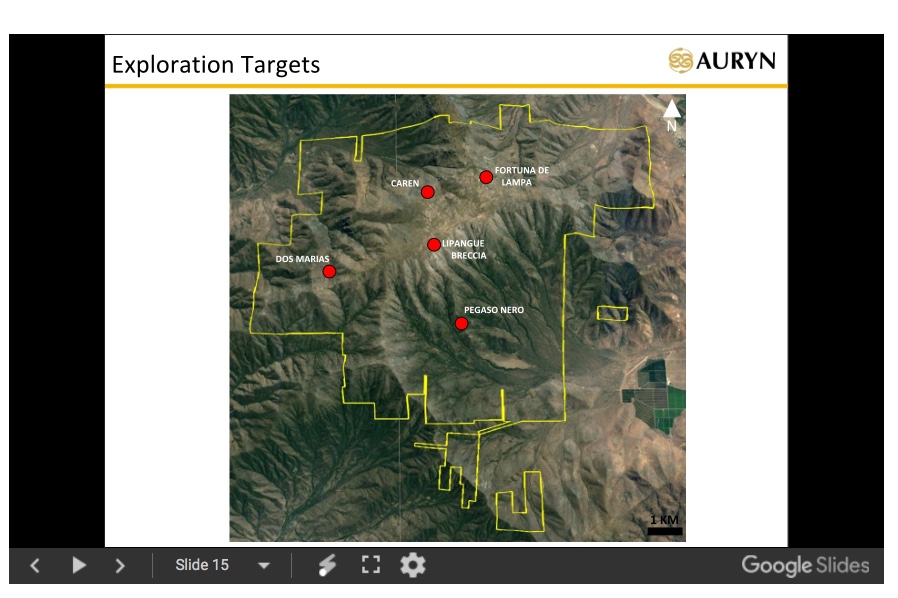
Auryn has already listed the location of 8 operational sites which they’re working on opening up. These include the DL2 Vein, the Caren Mine (Larrissa Adit), Merlin 4 Vein north, Merlin 4 Vein south, Merlin 1 Vein north, Merlin 1 Vein south, and 2 new operating sites associated with “Fortuna 1913” (“1913” refers to the elevation in terms of meters above sea level).
Because of the ability to rapidly ramp up production i.e. “GROWTH”, “the market” will typically award Auryn’s share price with a higher “multiple” of EPS than they would a miner with no ability to ramp up production. The “PE MULTIPLE” is forward looking. A major miner typically can’t ramp up production as rapidly as a company like Auryn can when the price of gold moves up. When the price of gold is breaking out to the upside, all of the miners will likely experience “multiple expansion” because “the market” will anticipate that this trend might continue.
A company like Auryn, with both the ability to rapidly ramp up production and therefore EARNINGS PER SHARE, and being in a sector in which the POG is breaking out to the upside leading to “MULTIPLE EXPANSION”, should command a very healthy “multiple” of EPS. You need to factor in also that Auryn is primarily a GOLD producer. About 82% of its income will be from the gold component of its “float concentrate”.
Within the “MINING AND METALS” sector, the “GOLD PRODUCERS” are always awarded a higher “multiple” than the base metal producers. Thus, the average “multiple” for a gold producer will likely be higher than the average “multiple” cited in the NYU study because the NYU study involves all miners, both of precious metals as well as base metals. It’s “the market” and investors that award “multiples”. Investors want to see GROWTH.
So, between Auryn being a “gold producer”, a “gold producer” able to rapidly ramp up its PRODUCTION PROFILE, and the price of gold showing no signs of slowing down, the likelihood is that Auryn’s share price should enjoy a healthy “multiple” of EPS. In this sector, you need to keep in mind that with incremental increases in the price of gold, those increases tend to drop straight to the bottom line. “The market” knows this and it is the arbiter of appropriate “PE MULTIPLES”.
With the recent increases in the POG, the universe of potential investors has also been increasing. Most “generalist” investors have less than one-half of 1% of their investments in precious metals. They will undoubtedly be looking for “producers” that can DIRECTLY benefit from the increased POG especially any PRODUCERS whose share price has NOT already gone up 100% or more. This opens the door to PRODUCERS like Auryn that are brand new to the PRODUCER category.
Many of the major miners have already gone up 100% to 150%. Some of their shareholders have taken profits and are now sitting with a pile of money while looking for “GOLD PRODUCERS” whose share price has NOT gone nuts yet.
Why is it important to know about EPS and “PE MULTIPLES”? these are very good “screening tools” to determine if an investment under scrutiny is grossly overpriced or not. If you notice “PE MULTIPLE EXPANSION” going on, you’re probably investing in the proper sector.
AURYN’S ALL IN SUSTAINING COSTS OR “AISC”
Since 2013, the World Gold Council has pretty much mandated that all of the miners report ALL of their costs on a “per ounce” basis including the “SUSTAINING COSTS” needed to “sustain” the current levels of production.
There are about 10 categories of ALL IN SUSTAINING COSTS for Auryn. The largest is typically the “ON SITE OPERATIONAL DIRECT COSTS” which we used to refer to as “C-1 Cash Costs” (labor, diesel, electricity, machinery maintenance, consumables, etc.) Some of the other line-item costs include: “CRUSHING AND GRINDING COSTS”, “ON-SITE ORE PROCESSING COSTS” (froth flotation-related), “TRANSPORTATION COSTS” “GENERAL AND ADMINISTRATIVE (“G and A”) costs, ”EXPLORATION COSTS”, “OFF-SITE ORE PROCESSING COSTS” (smelting and refining “T/Cs” and “R/Cs” treating and refining costs) SUSTAINING CAPITAL EXPENDITURES (often diamond drilling to replace the number of ounces of MR/MR mined annually), and “RECLAMATION COSTS”, and “COST OF CAPITAL”.
Auryn presents a very interesting study when it comes to estimating AISCs. I don’t know if I’ve ever done an AISC estimation that comes in as low as Auryn’s. First of all, GRADE is the primary determinant of AISCs and Auryn’s GRADES are pretty much off the chart especially in regard to the level 3 area of the DL2 Vein.
“TRANSPORTATION COSTS” provide a good insight as to why GRADE is so critical. Keep in mind that all costs are reported on a “PER OUNCE” basis whether it be “PER OUNCE TRANSPORTED” or “PER OUNCE” smelted, etc.
Let’s assume that the average “intra adit head grade” being mined by Auryn at the DL2 Vein comes in at about 20 gpt. The “average” miner mining “narrow vein” deposits in an underground fashion worldwide is about 4.18 gpt. For this “average” miner, without any ore processing plant on-site, they will be shipping ore with a grade of 4.18 gpt gold. In a 20-tonne truckload of ore, this “average” miner will TRANSPORT 20 Tonnes times 4.18 gpt equals 83.6 grams of gold.
Auryn is going to be starting out with an “intra adit head grade” of about 20 gpt gold but then they are going to be froth floating that raw ore and thereby magnifying the grade by an average “concentration factor” of 5-fold. This means that the “float concentrate” that Auryn will be TRANSPORTING will average a grade of about 100 gpt. A 20-tonne truckload of this “float concentrate” will contain about 2,000 grams of gold instead of the 83.6 grams of gold that the “average” miner will be TRANSPORTING. Each 20-Tonne truckload of Auryn ore will contain about 23.92-times as much gold as that of the “average” miner’s trucks.
The COST to TRANSPORT one truckload, round-trip, is the same for both Auryn and the “average” miner. Auryn’s TRANSPORTATION COSTS on a PER OUNCE basis will only be about 4.18% of that of the “average” miner. The cost savings are due to firstly, the superior grade of the Auryn ore and secondly, the fact that Auryn spent the time and money needed to build their own FF plant. An FF plant will often pay for itself in about 15-months.
A similar phenomenon occurs in regard to “ON-SITE OPERATIONAL DIRECT COSTS” to bring one bucket load of ore to the surface. The costs will be the same for Auryn and the “average” miner but Auryn’s bucket load of ore will contain about 4.78-times as much gold as that of the “average” miner on a “PER OUNCE” basis i.e. 20 gpt divided by 4.18 gpt gold.
In mining, the saying goes that “GRADE IS EVERYTHING”, now you know why. When you add up the 10 or so line-item entries for AISC for the “average” miner and Auryn, it won’t even be close. The “average” AISC for the “average” miner in 2025 was $1,510 per ounce. My estimation is that Auryn will come in at right around $800 per ounce.
With Maurizio being willing to advance all of the cash needed for Auryn to make it all of the way into PRODUCTION while charging zero interest, Auryn’s “COST OF CAPITAL” for the last 7 or so years was ZERO. The “average” miner, if they could qualify for debt financing, would probably be paying 12 to 15% for capital because of the enormous RISKS involved in mining. Rick Rule, a household name in mine financing, gets about 17% when he funds a miner. Since most young miners rarely qualify for a debt financing, their COST OF CAPITAL is usually MASSIVE LEVELS OF SHARE STRUCTURE DILUTION. Auryn has never sold a share to raise a penny of working capital. They had a tiny number of shares outstanding 7 years ago, 70 million, and that is how many shares they have outstanding today. I’ve never seen that in 45 years of investing in this sector.
WHY IS A TINY AISC AND A TINY NUMBER OF SHARES OUTSTANDING SO IMPORTANT?
This brings us back full circle to the above discussion on EARNINGS PER SHARE and PE MULTIPLES. A tiny AISC translates into a very high level of TOTAL EARNINGS. A tiny number of SHARES OUTSTANDING, in the presence of a very high level of TOTAL EARNINGS, translates into an EXTREMELY HIGH EARNINGS PER SHARE (EPS) figure. An EXTREMELY HIGH EARNINGS PER SHARE FIGURE when multiplied by a VERY HIGH PE MULTIPLE (somewhere around 30, as discussed above) translates into an EXTREMELY HIGH APPROPRIATE SHARE PRICE.
If you have the time, take the time to learn about things like EARNINGS PER SHARE, PE MULTIPLES, and how to estimate an AISC. Also take the time to DO THE MATH. You have all of the formulae right in front of you. As the actual numbers are revealed, plug them in and DO THE MATH. The very act of DOING THE MATH allows the TRUTH to be revealed.

 Miles Jamison