I also found this (June 6 2014) :
During the drifting of the Antonino Adit, I think you’re going to witness a very large number of intersections with subparallel veins and structures that may or may not have been included in the 5,000 meters of veins detected in the trenching program that made it all of the way to surface. The reason has to do with the fact that we’re operating within and near a significant “fault breccia” or “tectonic breccia”. Figure 3 at the below link graphically helps explain what this refers to:
When you glimpse at Figure #1 and look at the areas of argillic alteration surrounding the Merlin 1 Vein to the west and the Fortuna Vein system to the east the disparity in the width of this yellow argillic alteration jumps out at you. The “corridor” of alteration at the Merlin 1 Vein is measured in tenths of a meter. To the right at the Fortuna Vein system, it’s measured in hundreds of meters. How do we account for this differential within the same overall mesothermal “vein system”?
It has to do with no gray coloration in the area of the Merlin 1 Vein to the west. The gray area near the Fortuna Vein system is what is referred to as “fault breccia”. Over tens of millions of years, tectonic-scale movements between huge brittle rock slabs results in large faults filled with what amounts to be loose/unconsolidated/incohesive “gravel”. These vertical columns of gravel are fortunate in that they provide a wonderful plumbing system that allows ore-bearing hydrothermal fluids and gases to ascend towards the surface where they can be detected and mined more economically. They do, however, necessitate more amounts of timbering for safety purposes during the mining process itself. If the hydrothermal fluids within these fault breccias cool and solidify they can “glue” the gravel-like pieces together resulting in a “cemented fault bx”. The ideal scenario would be a gravel-like fault bx phase perhaps for millions of years, allowing ore-bearing fluids to rise followed by cementation later in order to improve the rock mechanics during the mining phase. You often end up with plenty of each in these breccias. Recall from past press releases how Auryn management stated that while drifting an adit they periodically hit areas of unconsolidated rock that necessitated extra timbering.
ACA Howe’s report on the ADL first called to our attention that the ADL is located in one of two “primary tectonic segment boundaries” located in Chile. This has to do with the “subduction” process in which the west-migrating Nazca Oceanic Tectonic Plate under the Pacific Ocean off the coast of Chile slides under (“subducts” under) the less dense South American Tectonic Plate which is eastward migrating. The Nazca Plate gets forced deep into the earth’s crust where it undergoes partial crustal melting. The resultant “magma” resides in magma chambers the roof of which periodically ruptures releasing ore-bearing hydrothermal fluids and gases upwards. The area around the ADL just happened to have a lot of “extra” tectonic activity partially because of the existence of the Juan Fernandez Ridge offshore from the area of the ADL at 33-degrees S. Lat. All of this “extra” fracturing of brittle rocks provided plenty of pathways for these hydrothermal fluids to rise. Recall from the hyperspectral satellite imaging survey performed by C.S. Perez that he detected evidence of a “7 Km swath of about a dozen intrusives across the southern edge of the ADL plateau”. These surveys detect “alteration” caused by hydrothermal fluids and gases at surface. He went on to suggest the presence of a world class discovery involving two or more porphyry structures and hundreds of millions of tonnes of ore in the first 200 meters below surface.
It’s the same hydrothermal fluids that bring up the sought-after metals that does the “altering” of the host rock into clay in the case of argillic alteration. The 3 main components of a world class deposit are a SOURCE of ore-bearing fluids and gases. This is provided by subduction, partial crust melting and the underlying magma chamber that periodically erupts magmatic fluids through its roof when pressures build. Then you need a well-developed PLUMBING SYSTEM like the Fortuna Mine area presents in spades in regards to the fault bx and the various other faults and cracks in the rock. After that you need a method to ENTRAP the gold-bearing fluids so that they can cool and deposit the metals they carry in solid form at that site. An area where these fluids can “boil” is one methodology to get the sulfur attached to gold to break away from the gold and make it solidify. Limestone sedimentary rock beds, like those present at the ADL, provide an excellent way to entrap these fluids and let them cool and solidify. Others get trapped just below the water table which is a “reducing environment” as opposed to “oxidizing environment”. Gold tends to precipitate out of solution in a reducing environment.
As the update suggests, the Antonino Adit has already penetrated 190 meters into the mountain and encountered all kinds of veins. We’ll see if the most recent intersection was indeed the sought-after Don Luis 1 Vein with the bonanza grades higher up in the structure. This is the vein we know the most about. Recall from the last quarterly update 3 months ago, both the grades and the widths were improving with depth at the Don Luis 1 Vein. This is the hallmark of a mesothermal vein system. “Meso’s” also go much, much deeper than epithermal veins do.
The 2 “massive” veins that were over 2 meters wide at surface and one of which sported a 10 gpt gold trench sample, still appear to be a high priority to management. This would be expected because these 2 veins had not only some of the highest surface grades of all of the veins but were also notably wider at surface. If they hit these two soon, then I would guess that all efforts will be focused in on producing from these various structures. The beauty of having this many different “options” is obvious as management can choose to initiate production efforts at the widest and highest-grade veins. In the industry, this is referred to as “optionality”. The intersection they made with the vein structure on August 12, 2021 that increased in width from .8 meters to 1.2 meters while they were in it, bodes well for the widening of these structures with depth as expected in mesothermal vein systems. Up near surface, the veins were averaging about 0.5 meters in width. The vein they intersected on June 23, 2021 that averaged 16 gpt gold AND 5.3% COPPER was an eye-opener with the copper running that high. I would think the chances for an underlying Cu-Au porphyry or “gold rich copper porphyry” as Sillitoe refers to them, is being evaluated.
The beauty of dealing with mesothermal vein systems is not just that they widen with depth but also because they tend to be of higher grade than their epithermal counterparts and descend much deeper than epithermal veins do. The reason has to do with the fact that they develop at much higher TEMPERATURES (about 400-degrees C) and much higher PRESSURES. The average mine life of a mesothermal vein system put into production exceeds that of the epithermals. I found the analysis of Luis de la Torre who worked on the development of Yamana’s massive El Penon Mine project to be quite interesting. His observation was: “I have the firm belief that once the Fortuna de Lampa project goes into production, and a correct evaluation of the entire project is achieved, it will be a MINING OPERATION with very similar characteristics of El Penon.” As far as “the characteristics of El Penon’s mining operations”, I’d refer you to the below link provided by Mike:
THE NEED TO CONSTANTLY OVERLAY NEWLY RECEIVED INFORMATION WITH THAT WE ARE ALREADY IN POSSESSION OF AND HAS ALREADY BEEN INCORPORATED INTO THE GIS DATABASE
A “GIS Database’ is basically a computerized compilation of ALLgeographic/geologic information pertaining to a group of mining concessions. Perez’s work gave us the wide-angled SURFACE VIEW of the ADL Mining District. The satellite bounced radiation of various wavelengths (“hyperspectral”) off of the ADL surface and these returned back to the satellite and studied. Different types of “alteration” induced by hydrothermal fluids making it to surface will result in different geophysical “signatures” being sent back to the satellite. The “signature” of argillic alteration will be different than that of propylitic, phyllic or potassic alteration. His study basically showed that there was an enormous amount of upflow of hydrothermal fluids from magma chambers that made it all of the way to surface. In other words, there were functional magma chambers periodically erupting fluids and gases and there was a good “plumbing system” in place to act as a conduit for those fluids. His study did not reveal anything directly about grades. The geosciences have already revealed to us that certain deposits, like porphyries and mesothermal veins, will have different types of alteration typically associated with them in various recognizable spatial patterns. The “Lowell-Guilbert Model” is the classic model used to recognize the alteration patterns around porphyry deposits. I think it’s fair to say that his study revealed that whatever was in those hydrothermal fluids and gases, the ADL had a whole bunch of it. Seven kilometers equates to about 4.34 miles.
Later, the Auryn trenching program revealed that an inordinately large nexus of veins made it all of the way to surface. In total, over 5,000 meters of veins were successfully detected at surface. These veins held varying grades of gold, copper and silver. You don’t expect high grades of gold right at surface unless the erosion process brought the current surface level to an area in which the conditions were optimal for the deposition of gold. At the trenching phase, you want to know if the veins are gold-bearing (“auriferous”) or not. This study corroborated the results of the satellite imaging survey. At the Adl through history, there had been an enormous amount of upward fluid flow through a well-developed plumbing system of faults, cracks, fissures, breccias, etc.
The historical production of gold and copper from the Fortuna Mine’s “Fortuna Centro Vein” (now called the Don Luis 1 Vein) involved extremely high-grade gold averaging around 64 gpt gold over the course of 30 years. These production records gave us a detailed look at one particular vein within this vast nexus of veins. During the early 1950’s, the average grade was closer to 122 gpt gold. ACA Howe’s report cited that the surface hadn’t even been scratched by the work done by “SMFL” during that 30-year stretch. So, within this “7 Km swath of about a dozen intrusives” we see that 5,000 meters of veins made it all of the way to surface. We know a great deal about the production from one of these veins over the course of 30 years.
This Don Luis 1 Vein is on the eastern border of this vast nexus of veins that made it to surface. The westernmost terminus of this nexus of veins is the Merlin 1 Vein and the Caren Mine. Three adits, one now collapsed, were drifted into this structure. “Bonanza” grades were found in 2 of the 3 adits. Adit 3, the Larrissa Adit was drifted at a point about 140-meter below the plateau surface. Lo and behold, the grades found over at the Merlin 1 Vein were very similar to those exceptionally high grades found over at the DL 1 Vein. Auryn originally decided to start production here at the Larrissa Adit until SERNAGEOMIN insisted management construct 3 separate “safety exit chimneys” each of about 140 vertical meters. Management decided that this would be too expensive so they amended the attack plan to go after the Fortuna Mine and rehab it. Seven vertical shafts were already in place there.
After studying the results of the exhaustive trenching program, management decided to drift a “crosscut” adit from about 130 meters below the plateau. The adit was oriented from NNE to SSW. The trenching results revealed that this path would intersect the very high-grade DL 1 Vein as well as 2 “massive” veins that were over 2 meters wide at surface. As one might expect from working in and around a “fault breccia”, management intersected many structures one of which they thought might be the DL 1 Vein which later turned out not to be the case after geological scrutiny. Just days before the October 4, 2021 release of their quarterly update, they think that they may have intersected the DL 1 Vein but are awaiting lab results to make any confirmation. The adit is now 190 meters long and they intend to resume going after the 2 “massive” structures in hopes that, being a mesothermal vein, it may have widened even more at this depth. Due to various Covid-19 realities and supply chain restrictions, the wait time to receive lab testing results is prohibitively long so management is stockpiling ore that appears to be well-mineralized while they await lab results. The new 22-tonne truck purchased by management is due for delivery within days from now. Processing results might precede lab results in an environment like this.
When you layer new information upon previously received information like satellite surveys and trenching results, you can witness a lot of corroboration of the previously received information. The veins are indeed widening with depth and the grades are improving with depth. This corroborates the work of both ACA Howe and Richard Sillitoe that independently suggested the existence of a mesothermal vein system.
SO, WHAT’S NEXT?
• For me, I’m anxious to see some of the overdue assay results from the various structures intersected in the Antonino Adit. Auryn hit two previously unknown veins early on while drifting the Antonino Adit. They are shown on the “hand drawn map” linked to in the July 6 quarterly update as “new veins”. Since they both run E to W, I’m referring to them as “New North vein” and the “New South Vein”. I’m referring to the new vein originally mistaken as the DL 1 Vein as the “16gpt /5.3%” for its initial assay results of 16 gpt gold and 5.3% Cu. The vein they intersected on 8/12/21 which measured in between 0.8 meters and 1.2 meters I’m referring to as the “0.8 to 1.2-meter stockpiled vein” since its contents were stockpiled. The vein they intersected on 9/29/21 that they now think might be the DL 1 Vein I’m referring to as the “9/29 fingers crossed vein”. This gives us 5 veins to monitor over and above the 2 “massive” veins .
• Witnessing the new truck shipping the stockpiled ore will be refreshing as well as informative as the results are reported.
• The home run ball out there I supposed would be related to any intersection with these 2 “massive” structures and what kinds of widths and grades they possess. This brings us up to 7 veins to monitor.
• The search for an intersection with “Shaft #4” of the DL 1 Vein appears to be critical to add to the ventilation system.
• Road improvement is also on the menu.
• We need to monitor for developments on an on-site concentration/processing plant. This would minimize the amount of truckloads being shipped to Enami.
• Adding a jumbo drill rig to prep the blastholes is also under study as is adding another mining crew probably subsequent to any intersection with the Dl 1 Vein and/or either of the 2 “massive” veins. (We can check off the issuance of the definitive exploitation permit as this has been received. This provides a sigh of relief as well as corroboration that the project is a go.
5 Likes
Very insightful in-depth analysis and commentary DOC. Much appreciated, including the detailed history. It reminded me of Maurio’s Cordoba’s aspirations as written up in the March 2017 edition of the Chile Explore Report after encountering Caren and Merlin 1 Vein Adits 1-3.
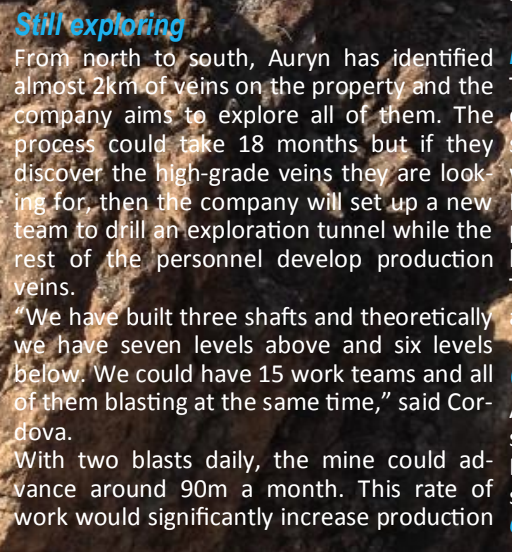
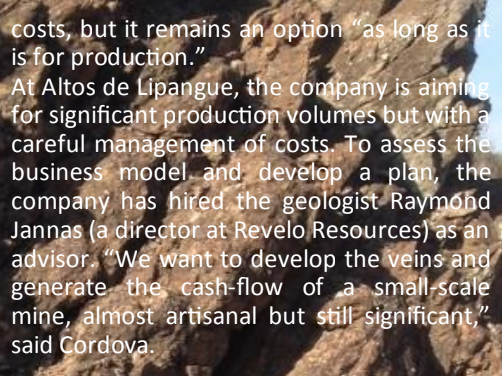
Of course that was before Servicio Nacional de Geología y Minería required construction of 3 vertical safety exit shafts to progress further on Merlin 1. Because of the expense, it was time to reassess the best course forward. Bringing in Dr. Jannas, and subsequently Dr. Sillitoe, confirmed the ADL was a mesothermal system with two porphyries present. The Perez Report conducted by Vale and BHP Billiton years ago identified a variety of mineralization types and first suggested the presence of this complex porphyry system. Dr. Sillitoe’s report was for internal guidance and any needed change is likely a direct result of that report. Despite all the delays, MC optioned to concentrate on the Fortuna Mine as the best way forward. In November 2019 AUMC announced:
For the last few months AURYN has been dewatering and putting in reinforcement in previously developed tunnels of the historical Fortuna Mine, located at the Altos de Lipangue plateau. The Fortuna Mine has produced up to 85 g/ton in the past.
AURYN is aiming at the recovering of this site. Once work has finished and the mineralized vein is uncovered, a systematic sampling campaign will be done in order to decide what will be developed in the future. The AURYN team has come to the conclusion that the several high grade veins are all related and interconnected, including the Merlin and Larissa vein, and tentative mining plans are being reviewed.
Shareholders have long awaited the significant progress towards exploitation moving forward today. While the Merlin 1 Vein was put on the back burner, I’m sure it has not been abandoned and is included in the systematically careful future planning stages of development. I was sorry to see the resignation of Walter Casquino from the BOD earlier this year. It will be difficult to replace one with his expertise and unique skill set. One can easily see, however, how the plans for exploration, personnel to develop production veins, and working multiple faces and blasting on different levels that were originally planned for the Merlin 1 adits 1-3 were transitioned and incorporated in the current dynamic planning to develop and exploit the Fortuna Mine area first. The Merlin Mine and Larissa vein simply will have to wait until the Fortuna de Lampa project goes into production.
EZ
I’ve got to say, regardless of what one thinks about the potential value of this investment, it’s indisputable that AUMC’s greatest asset is its shareholders and their relentless patience. What other company would expect to hear praise after issuing an update saying the CEO resigned, they erroneously found the DL vein (key to the looong overdue transition from exploration to exploitation), no update on the inexplicable delay of the dividend to long suffering MDMN shareholders, etc, etc, etc…
Hey, MDMN gave up 75% of its asset a over 1/2 a decade ago to a group that claimed they could bring the Alto into production (well capitalized and ready to finance to production), no worries…they bought a truck, have tolled 9 tonnes of material and have some amazing grades on a few grab samples with no evidence of actual, lab standard assays…just numbers without the certified/QP verification…
everyone here deserves a win regardless of whether or not one is coming
5 Likes
Just to remind MDMN shareholders, all the work AUMC (CDCH) is doing right now is on the CDCH properties.
3 Likes
Or “what was originally the CDCH properties”
1 Like
Wizard, am I wrong in thinking that the properties that used to be CDCH’s properties are now Auryn’s properties, and in turn MDMN shareholders will eventually have an interest in those properties as shareholders of Auryn? Sorry, maybe I’m not understanding.
1 Like
you own a slug of AUMC (via the dividend) …AUMC took the CDCH assets (and MDMN’s) so you benefit/participtae in progress on either.
2 Likes
That was the point of my clarification.
I believe W. was just making a point over against BE’s comment re MDMN giving up its asset to point out MDMN shareholders are benefitting or should benefit from work being done on claims that originally MDMN did not control.
–stepping out of the middle–
3 Likes
Exactly my point.
1 Like
Having just now finished reading Brecciaboy’s wonderful report, I am struck by how, during the decade since I first hitched my wagon to the MDMN star, the entire aura surrounding this investment/gamble/pipe dream has turned from night to day:
– During my first five years, the conversation on this board was dominated by the question: “Is MDMN’s management just a bunch of lying, incompetent, bumbling crooks, or what?”
– During the five years since that riddle was conclusively answered, the question has shifted to: “Is AURYN’s management sufficiently competent, honest, intelligent, shrewd, determined, and well-financed to pull this thing off for all of us?”
This is such a much more comfortable place to be.
– madmen
3 Likes
It looks like we will get picture and video updates between official quarterly releases! I subscribed to the YouTube channel. You may want to in order to get updates as they are posted. I wish we could do that to the image gallery too.
5 Likes
That’s a beautiful truck! I would hate to scratch that paint job, but we got rocks to load.
Thanks Kevin for the post! I’ll subscribe
2 Likes
The caption under the picture of the truck says it will be put to work “immediately”. Good. Progress.
1 Like
20 m^3 or 23 tonnes
Equally important: They have started installing the forced air ventilation as mentioned in the update.
3 Likes
That put a halt on that little run real fast. 
TAFF ??? Don’t understand your post !
There was some nice little buy orders going through up to .003 then a 20 mil sell order hit at .003 and .0032 out of the blue at once
Now someone took out the 5 mil at .003 the 2 other orders of 15 mil have been removed
Spring is in their sights. Probably still cool up on the hill. I don’t know when their spring rains come, if any? Hopefully they get most of that ore body off the hill before then. For a small operations they are moving along nicely.
Ventalation is a good sign as that loader and the blast dust has to be one of the factors the deeper they get. Faster recovery time after blasting.
And safer for all. Great work gentleman.
4 Likes