Is there a possible buy in of shares at .004-.0055? This thing should be tasing over .01 with all this volume. We got to .0084 pretty quickly a couple weeks ago
1 Like
TOTAL CONJECTURE ON MY PART
All of this is based on charts I found for the four stocks mdmnwonk cited as being the previous handiwork of Mister Harvard/Mizz Wharton:
STOCK / Low-to-high / Increase (Price Today)
AMLM — .07 to $1.75 — up 2,400% (.35)
APLD — .07 to $2.25 — up 3,115% ($1.75)
OSKA — .002 to .225 — up 11,150% (.015)
CATG — .01 to .44 — up 4,300% (.08)
– Each stock followed the same pattern, and each did so over the course of just a few weeks or months during this current year – 2021.
– The Harvard/Wharton team apparently employs some procedure whereby they gain leverage over a functional company (not a dead shell company) whose stock is hovering in the “low penny” range.
– The procedure produces a big payday for at least H/W themselves (maybe the company pays them to go away?), and apparently also results in some sort of lasting gain for other stock holders.
– The pattern shows these four stocks creeping slowly upward, then a dramatic spike (the payoff?) followed by a quick fallback, but not a fallback to the previous lows. At least not yet, at least not for these four companies.
– I suspect that the “spike price” represents one of those “private/mystery/lightning strike” transactions that we’ve occasionally seen in MDMN and elsewhere, transactions which are posted out-of-the-blue, with the stock price dropping back down again almost immediately, and allowing no window for small-potato/small-fish folks to sell at the “spike price.”
– Since no one who actually “knows anything” is talking, it seems impossible to tell where this leaves MDMN commonfolk. As Wizard said: “Not much shareholders can do.”
– We may have already seen the spike/payoff/fallback scenario unfold (from .0005 in December up to .0059 earlier today and then already back down to .0049 when I looked just a moment ago)?
– Or maybe this is just a stop along the way, with more spectacular fireworks coming up before/during/after the rumored July 1 hearing?
– Your guess is at least as good as mine, but probably better.
– Below is a screenshot of MDMN’s rhythmic pattern so far today. Obviously someone is doing something that a market-fool like me cannot fathom.
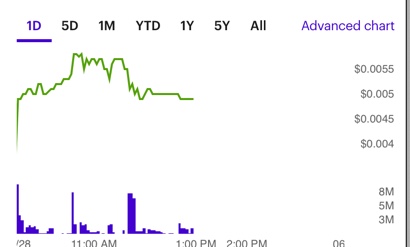
– madmen
4 Likes
THE NEED FOR A MEDINAH/AURYN “STUDY GUIDE” TO COMPLEMENT THE AURYN WEBSITE
The volume tells us that Medinah has obviously gotten the attention of somebody. If I were a prospective investor in Medinah or Auryn that just recently heard about these companies for the first time, what I would greatly appreciate is some type of roadmap or “study guide” written by knowledgeable shareholders familiar with the history of these companies as well as those that have knowledge of the geology of the property and the mining industry itself. The Auryn website has a ton of great information but to the average investor with little geological background and the inability to connect the dots as it were there is just something missing. There is no narrative to make the information flow smoothly. The current management team of both companies are very professional and very nonpromotional. They are handcuffed by the securities laws from being overly promotional. As management said at the Las Vegas “informational meeting” a couple of years ago, “the market will take care of itself, our goal is to build a major mining firm”. Clearly, that’s exactly what they are doing but in the interim time period it sure would be refreshing for prospective investors to hear from those shareholders that have been around since Day 1 about 22 years ago. As the word gets out as to recent developments, it seems logical that “TheMiningPlay” forum would be the best way to share the contents of any such “study guide”. If you have an interest in participating in such an effort, please contact me. In order for prospective investors to circumvent the need to review many thousands of posts on TMP, perhaps a section of TMP can be dedicated to a “study guide”. Comments like “this stock is going to da moon” obviously would have no part of a professional study guide nor would comments like “management sucks”.
An example of important information that a new investor might not appreciate unless he carefully reviewed the share prices over the last 22 years is that the average current shareholder probably needs a 5- to a 10-bagger just to get back to even. Medinah peaked at about 18-cents several years ago. Think about the difference between buying into an investment in which the current shareholders need a 5- to a 10-bagger in order to break even versus one in which the average shareholder is sitting on a 400% gain and just looking for the exit signs. Management is by far and away the largest shareholder in both companies. Their average cost for their Medinah shares is probably the highest cost of nearly all shareholders yet they continue to cut out of pocket checks and infuse funds in a noninterest bearing fashion. The following is from an update I put out to family members, friends and colleagues. It contains some thoughts as to what type of information might be contained in such a “study guide”- Dr. D.
Recently the Ex-CEO of Medinah (“Wiz”) used the sentence “We will have a massive breakout to the upside when this discovery is VALIDATED”. I find myself both agreeing and disagreeing with this assertion. I agree with the high likelihood for a breakout in the share price of both Medinah (“MDMN”) and Auryn (“AUMC”) from current levels when investors learn of the significance of the ADL discovery and the cash flow it will generate but I beg to differ on the timing of the VALIDATION of this discovery. This has to do with the unique history of this deposit and prior production accomplishments. In reality, the discovery of an extremely high-grade “vein system” (not just a singular vein) has already been “validated” through a series of developments/findings. Recall a past press release citing that the geoscientists confirmed that the westernmost of the veins identified to date at the Caren Mine (probably the Merlin 1 Vein) was “related” to the easternmost of the veins (the various “Fortuna” Veins) present in this system. I believe that the evidence for a one million plus ounce gold deposit is extremely compelling but yet to be officially confirmed. So too is the evidence for a copper-moly porphyry system which may or may not be directly associated with the epi- or mesothermal vein system.
I’m reminded of being scolded by a mining analyst who closely followed the Fruta Del Norte discovery by Aurelian many years ago in Ecuador. His name was Dirk Masuch. He basically called a bunch of us followers of Aurelian morons for not realizing the significance of this discovery clearly outlined on Aurelian’s website. He was right. His lashing carefully connected the dots in a common sensical manner that left little to be doubted. As would be my luck, the stock ran from $0.60 to $40. Oh well, I deserved a good “Masuching”. Never again! Can this connecting of the dots in a common sensical manner be done in the case of the ADL discovery before the fact and not after the fact? I think so.
We need to keep in mind that one small portion of what we now know to be a true “vein system”, the Fortuna Centro Vein, was in production from 1940 to 1970. The average grade produced was a robust 64 to 90 gpt gold OVER THE COURSE OF 30 YEARS. That’s a long time to be averaging those kinds of numbers. Back then gold was trading at $35 per ounce and the mine was economic. The owners of the prior operation, “SMFL”, were constantly going back to a consortium of banks to secure financial resources to expand production. The banks would send out their engineers and geoscientists to secure samples and sure enough they kept cutting checks. There is no more robust method of “validation” of a gold deposit than long term production statistics. Previous production factors in all of the various parameters that affect the prognosis for the success of a mining investment AS LONG AS YOU CAN CONFIRM THAT PLENTY OF SIMILAR ORE IS STILL AVAILABLE. If you’re looking at a map of the eastern aspect of the ADL plateau, I’d mentally highlight the Fortuna Centro Vein in neon because of these average production grades over such a long period of time.
Keeping this in mind from a “validation” point of view, the salient question really became (past tense) whether or not there is plenty of similar extremely high-grade ore still around whether it be in that one (Fortuna Centro Vein) or perhaps in surrounding veins or did the previous miners pretty much exhaust the supply. The answer to this question was partially addressed by C.S. Perez’s hyperspectral satellite imaging survey several years ago. This survey revealed the existence of a massive 7 Km swath of “about a dozen” (not just one) intrusives aligned in a SW to NE direction across the ADL plateau and its southern downslope. An “intrusive” rock is derived from once molten magma that has risen through the rock structure towards the surface, cooled and solidified. Perez cited the evidence for a truly world class deposit as well as the existence of hundreds of millions of tonnes of ore in just the upper aspects of the deposit. His report was a “summary report” incorporating the findings of previous parties like Shell’s Mineral Division and E. Tidy Finch and he had access to the production records from SMFL’s work over 30 years.
When focusing in on that 7 Km swath, the question obviously arises as to what the average grade contained in these various “intrusives” might be as the evidence of plenty of tonnage/mine life, if economic, is certainly suggested. The question also arises as to why Perez had the cajones to start talking in terms of a WCD while simply revealing the presence of “about a dozen” intrusives. If you think about it, if you see evidence of a dozen similar-looking intrusives on the satellite survey and you know that the easternmost of these relates to a vein with huge gold grades couldn’t one intuit that the similar looking intrusives MIGHT have similar contents at least until proven otherwise? Recall that magma chambers are absolutely gigantic. There are two under Yellowstone. The little (shallower one) is 25 miles wide by 55 miles long. The deeper and larger one is 4.5 times those dimensions. Keep in mind that the hydrothermal fluids and gases that magma chambers periodically release have the ability to mix up into a somewhat homogenous mixture while in the liquid and gaseous states within the chambers. Note that Auryn’s work on the “Larrissa Adit”/Merlin 1 Vein, which might correspond to the westernmost of this dozen or so intrusives, also had off the chart gold grades. So, if the easternmost and westernmost of this dozen or so similar looking “intrusives” BOTH have off the chart gold grades, is it likely that the intervening ten or so intrusives no doubt derived from the same underlying magma chamber might follow suit?
For me, the clencher in this “validation” process, was a combination of Auryn’s exhaustive trenching program involving 1,600 samples as well as what they seem to find every time they go underground. The trenching results that came out in 2015 revealed 5,000 (not a misprint) lineal meters of gold-bearing veins that made it all of the way to the current surface. That is a very rich surface “footprint” of a vast nexus of veins. It suggests the presence of a once very busy “vein system” and not just a singular vein with extraordinarily high-grade gold. A “vein system” typically includes somewhat parallel as well as subparallel veins with some veins that “crosscut” the parallel veins like the Merlin 3 Vein in this case. The intersections between the parallel veins and the crosscutting veins (areas of dilation) are often very rich. Many of these veins are traceable at surface and via old workings for 1,000 meters or so. There are a lot of veins present and they extend for a considerable distance before they dive down under the overburden and presumably continue onwards. The results suggested both continuity and contiguity of gold-bearing ore. Interestingly, veins have been found well down the southern downslope off of the plateau suggesting the possibility of these veins being of the highly sought after “mesothermal” variety. In this “validation” process, it’s critical to keep in context firstly the extremely high-grade past production figures. This set the stage for the trenching results to represent a HUGE DEVELOPMENT even though the market didn’t recognize this.
Subsequent to the trenching program, Medinah and Auryn drifted the “Larrissa Adit” in the area of the Caren Mine at the western terminus of this 7 Km swath of “about a dozen” intrusives. The results were also nothing less than stellar especially in a 42-meter intersection they encountered but have yet to mine. The previous work done at the Fortuna Mine occurred over 7 different horizontal levels so we’re seeing some continuity from a depth point of view. From previous work done at the various adits of the Caren Mine/Merlin Vein System to the west as well as previous production derived from 1940 to 1970 at the Fortuna Mine to the east, Auryn’s P. Geo Luciano Bocanegra was able to estimate the presence of 664,000 ounces of gold in just the top 200 meters of just two individual veins. This calculation did not include the vast nexus of veins in between the two veins because deeper work had not been completed on these and many did not make it all of the way to surface (“bosses” and “plugs”). For me, the question then becomes, what percentage of the total amount of gold ore present are represented in those 664,000 ounces. Is it 50%? Is it 10%? The answer to that question will partly have to do with whether or not those veins present are of an epi- or mesothermal vein variety. Mesothermal veins often extend down to about 1,500 meters in depth and they tend to widen with depth. They dwarf the size of typical epithermal veins.
In this “validation” process, when you overlay the production figures from 1940 to 1970 with the hyperspectral satellite imaging surveys and then with the trenching results and then with the drifting of the various adits the picture becomes fairly clear. The IP/IR study performed by Geodatos, S.A. gave us an outline of the disseminated sulphides contained in some of these veins and due to the dipole spacing chosen suggested that these veins extend a lot deeper than 200 meters. The evidence supporting the existence of a very large and very high-grade epi- or mesothermal vein system at the ADL is overwhelming. The London and Toronto-based mining consulting firm, ACA Howe, commented in its summary report of the ADL Mining District that the previous work done by “SMFL” on the Fortuna Vein at the ADL barely scratched the surface. This “validation” process necessitates that we think in three dimensions. We need to realize that veins are planar structures similar to a sheet of plywood. When the grades are consistent the key becomes the total volume of these sheets of plywood. If these sheets of plywood are indeed of the mesothermal variety and extend down perhaps to over 1,000 meters depth and they are over 1,000 meters long and perhaps .5 to 2 meters wide and average in grade the numbers having been reported and there are a whole bunch of them then………
WHAT IS SOME OF THE EVIDENCE SUGGESTING THAT THE PREVIOUS PRODUCTION SITES EXPLOITED BY SMFL ARE PART OF A VERY LARGE MOSTLY UNTOUCHED VEIN SYSTEM?
The question becomes how does a discovery involving epi- or mesothermal veins like those found at the ADL become “validated”. The “validation” of a discovery occurs in phases and the information is stored over time in what is referred to as a GIS computerized database. As noted, in this format, previous information related to a mining prospect is constantly being overlaid by newer information. The trouble with junior mining investments is that an investor constantly needs to study new information IN CONTEXT WITH THE GEOLOGICAL INFORMATION ALREADY IN THE GIS DATABASE. This is a lot of work but it is integral to investing in this arena.
As suggested, the first phase of validation at the ADL might have been the results of the hyperspectral satellite imaging survey performed by C.S. Perez several years ago. This revealed the existence of a 7 Km long swath of “about a dozen” intrusives extending across the ADL plateau and its southern downslope in a SW to NE direction. These surveys detect surface alteration caused by hydrothermal fluids emanating from underlying magma chambers. Hyperspectral radiation aimed at a prospective property from a satellite does not penetrate the earth so the hydrothermal fluids causing the “alteration” must have made it all of the way to the current surface in order to induce surface alteration and be detected by the satellite. These studies measure the radiation reflected back to the satellite after it aimed radiation of a certain wavelength to the property under study. Different types of “alteration” will have different electromagnetic “signatures” that the computer software recognizes.
The “alteration” typically involves the native surface rock being “altered” (by heat, pressure and chemical interaction) into types of clay. The type of “alteration” in the part of the ADL hosting the vein systems is termed “argillic” which means that the surface rock was converted into the kaolinite and smectite types of clay. In some areas where the veins surfaced at the eastern ADL plateau, the “argillic alteration” stretched 200 meters in width suggesting that the “plumbing system” within the mountain made up of cracks, fissures and porous rocks was VERY conducive to gold-bearing hydrothermal fluids and gases being able to transport the contained metals upwards towards the surface. One isolated vein composed of hydrothermal fluids having been allowed to cool and solidify might typically result in from centimeters to a meter or so of alteration in the rock surrounding the crack in the rocks that got filled up. A swath of 200 meters of argillic alteration would necessitate a vast nexus or “swarm” of veins in close proximity.
The extent of the “surface footprint” of the veins was impressive. The trenching results (done at surface) that came out a couple of years ago revealed 5,000 (not a misprint) lineal meters of veins that made it all of the way to the current surface. That is a big surface “footprint”. This suggests the presence of a once very busy “vein system”. The gold grades found even at the surface were very solid. From previous work done at the various adits of the Caren Mine/Merlin Vein System to the west as well as previous production derived from 1940 to 1970 at the Fortuna Mine to the east, Auryn’s P. Geo Luciano Bocanegra was able to “conservatively” estimate the presence of 664,000 ounces of gold in the top 200 meters of just two individual veins. This calculation did not include the vast nexus of veins in between the two veins because deeper work had not been completed on these and many did not make it all of the way to surface. Keep in mind that Bocanegra had a copy of the IP/IR survey done by Geodatos revealing the outline of the veins and the fact that they appeared to descend much deeper than 200 meters because of the dipole spacing chosen by the geophysicists. The question then becomes, what percentage of the total amount of gold ore present are represented in those 664,000 ounces. Is it 50%? Is it 10%? The answer to that question will partly have to do with whether or not those veins present are of an epi- or mesothermal vein variety. Mesothermal veins often extend down to about 1,500 meters in depth and they tend to widen with depth. They dwarf the size of typical epithermal veins.
This new “Antonito”/”Fortuna” adit that management is drifting is targeting the extremely rich Don Luis 1 Vein as well as two “massive” veins featuring widths of about 2 full meters. The new adit already intercepted two previously unknown veins on the way to the Don Luis 1 Vein. This is becoming a common occurrence. If you picture this somewhat parallel system of veins as a loaf of sliced bread with the veins occupying the space between the slices, the trenching program revealed that the upper crust of this loaf is very rich and that there were a lot of “slices”/individual veins. When you come down in elevation from the plateau on the side of the mountain, an adit like the new Fortuna Adit will intercept these individual veins well below the surface and allow the geoscientist to more accurately estimate the mineral reserves/mineral resources present in these spaces in between these “slices of bread” in three dimensions. The very successful trenching program “primed the pump” for what could be some rather explosive growths in MR/MR especially when you consider the grades being revealed. The information contained in the grades, average widths and MR/MR calculations associated with the drifting of this new adit will play a key role in this “validation” process for those that have not followed the history. Further, each intersection with a vein structure provides two “working faces” for mining activity. One crew can go in one direction and the other crew in the opposite. The game plan was to go after 6 working faces simultaneously. This is especially beneficial while the Covid restrictions are in place and the work crews need some physical separation.
When I compare the vein systems at the ADL with other vein deposits, three things jump out at me. First is the extraordinary density of the surface veins revealed by the trenching results not to mention their lengths of nearly 1,000 meters while remaining “open” in both directions. The second is the grades being revealed. These are extraordinary to say the least. Recall in the Fruta Del Norte discovery by Aurelian, how excited the company was when the average grade came out in excess of 10 gpt gold. To be fair, it should be kept in mind that the FDN deposit was basically a “bowling alley” that extended for an immense amount of distance. The third is the low-cost infrastructure present. I’m used to projects up high in the Andes where there pretty much is no infrastructure or power or water or in remote areas where helicopters are used to fly in personnel and equipment. There can be no guarantees but the potential for some pretty crazy ECONOMICS, when compared to industry standards, is definitely present.
In their April 5, 2021 update, management made it abundantly clear that they would be producing at a minimum of 40 tonnes per day this quarter (Q-2 2021). All of us can do the math on a somewhat miniscule 40 tonnes per day operation with the grades being encountered. To date, the Don Luis 1 Vein’s average grade published has been “over 2 ounces per tonne” (over 62 gpt in one context and “over 85 gpt” in another. I’m penciling in a $700 per tonne all in sustaining cost (AISC) until I hear differently. At an estimated average gold price of let’s say, $1,900 per ounce over the next few years (think Basel III) , this leaves nearly $1,200 per ounce as profit and over $100,000 per day as profit IF, IF, IF THE NUMBERS HOLD TRUE AND THE ASSUMPTIONS ARE CORRECT. Let’s refer to this approximate $100,000 per day profit as the BASE CASE scenario with certain assumptions. As new data arrives, it will be easy to add to or subtract from this BASE CASE scenario. The main parameters of this BASE CASE are the production rates, the grades, the POG and the cost to produce an ounce of gold.
In order to gain some context as to the grades being encountered, here is a link to the grades being mined at the richest gold mines in all of Canada:
https://www.kitco.com/news/2021-06-18/Richest-gold-mines-in-Canada-in-Q1-2021-report.html
The first thing I would call to your attention is that this 40 tpd figure factors in the current supply chain disruptions and the Covid-related protection measures that temporarily reduce production. This projection incorporates the fact that Santiago is all but completely shut down currently. Question #1 becomes what will this 40 tpd production rate become once the Covid restrictions are lifted. In “The gallery” portion of the Auryn website shows many pictures of the 4- or 5-man mining crew on site. If this were expanded to perhaps 20 or so miners, what would the resultant production rate become. Question #2 becomes how many working faces are involved in the 40 tpd projection and if it is based on, let’s say, two working faces, can we triple that production rate when all 6 of the currently planned working faces are being mined. Note that the permitted production rate already reported is 5,000 tonnes per month. Based on a 30-working day month, the permitted production rate would be over 4 times that 40 tpd figure. Based on a 22-working day month, the daily permitted production rate would be 227 tonnes per day or about five and a half times that 40 tpd figure. Refer back to the BASE CASE scenario involving 40 tpd resulting in a little over $100,000 profit per day. The key reason to have a BASE CASE scenario in your head is that as news is released one can quickly calculate the approximate effect on the earnings potential and the appropriateness of the current share price and market cap.
PLAYING WITH THE NUMBERS
Please note that the accuracy of the various assumptions will be easy to evaluate through time as news breaks. Assuming 200 working days per year, the BASE CASE annual profit for Auryn would be $20 million. This would represent $0.2857 per share earnings assuming 70 million Auryn shares issued and outstanding. If you assume a multiple of 30-times earnings for a new gold producer with plenty of upside in productive capacity then this equates to an Auryn share price of $8.57. Based on 300 working days per year, the annual profits would be $30 million. This would equate to about $0.42 per share earnings. Using the same 30 EPS multiple the appropriate share price would equate to $12.85. Auryn currently trades at about 50-cents per share. This is not a recommendation to go out and buy the stock. It is a message that it might be worth your while to test the validity of the BASE CASE scenario through time.
You can do the math if that extremely conservative 40 tpd production rate scaled up to the permitted allowable 5,000 tonnes per month. For the sake of argument let’s assume that the number of working days per year is 250 or 21 days per average month. This would represent 238 tonnes per day or 6 times the BASE CASE scenario of Auryn’s appropriate share price being $8.57. I’M NOT PREDICTING ANY FUTURE SHARE PRICES HERE. I’M TRYING TO PRESENT SOME TOOLS FOR YOU TO USE AS THE NEWS ROLLS OUT. I’ve personally found BASE CASE scenarios like this to be helpful otherwise I’d have to constantly start from scratch in redoing the calculations.
One needs to keep a sense of CONTEXT here. All of the above concerns just the epi- or mesothermal vein system near the central and eastern ADL plateau. At the end of the day, the Pegaso Nero copper-moly area might end up being the star attraction of the ADL but these types of probably open pit operations are slow to develop and it could involve the expenditure of hundreds of millions of dollars. Recall the ridge crest sampling program instituted by Auryn. It revealed high grade copper and moly right at surface extending over 3,600 meters in a north to south direction and 1,200 meters in an east to west direction.
SUMMARY
Feel free to liberally apply discounts to any of the assumptions made. I ran the numbers based on $1,900 per ounce gold and I am aware that gold has backed off to closer to $1,800 per ounce in late June, 2001. I like management’s new quarterly updates citing past accomplishments and future objectives. This will allow us to rapidly assess how good they are at achieving prognosticated goals. Management is studying the usage of their own concentration and processing facilities on site. This will save on the all-important transportation charges as a more concentrated form of ore can be shipped.
I have no qualms concerning the ethics of management whatsoever. One thing you need to keep in mind is that management is not overly promotional. I believe they are squarely in the “under promise and overdeliver” camp. IN THE CASE OF MEDINAH/AURYN, I SENSE THAT THE EARNINGS WILL DO THE TALKING IN A LANGUAGE THAT EVERYBODY UNDERSTANDS. When management states facts I think you can assume that the numbers are conservative. I don’t sense that any “cherry-picking” of data in regards to grades has or will occur. The grades being reported are extremely high but importantly they’re in alignment with past PRODUCTION figures. I don’t have enough data to comment on “mine life” in regards to the epi-mesothermal vein deposits nor for any future mining (if deemed economic) of the porphyry, skarns and breccias but I sense it to be very significant and I think that the net present value (NPV) estimates will reflect that.
I don’t have time to develop this aspect of Medinah/Auryn right now and I will in the near future but one needs to concentrate on the FAVORABLE SHARE STRUCTURE. The financial interests of management are tightly aligned with that of the average shareholder. This is almost a Rob McEwen-esque type of scenario. Maurizio and family own approximately 73% of Auryn’s 70 million shares. More later….
WHAT ARE THE MOST IMPORTANT QUESTIONS I’D LIKE ANSWERED?
- Did management receive the “definitive production permit” they were expecting on or about April 12, 2021?
- Is the allowable production rate still 5,000 tonnes per month?
- Did management successfully intersect the Don Luis 1 Vein which they estimated they’d intersect on or about April 12, 2021?
- If successfully intersected were the grades still in the 85 gpt range? What kind of widths were encountered?
- On the way to the Don Luis 1 Vein, management cited intersecting two other veins and samples were taken and sent to the lab. What were the widths and grades?
- What is the current plan in regards to on site concentration and processing facilities?
- Is the current rate of production 40 tpd as assumed in the BASE CASE scenario? (this yet to be confirmed scenario resulted in approximately $25 million in earnings)?
- Were the two “massive” vein structures (greater than 2 meters in width) anticipated to be intersected after the Don Luis 1 Vein successfully intersected?
- If yes, what were the widths and grades?
- If Medinah does indeed have a $40-plus million tax loss carry forward, shouldn’t management run some income through Medinah prior to the distribution of the 16 million plus “AUMC” shares?
4 Likes
There you go again brecciaboy… I used up all my band width reading your post. 
3 Likes
I did a search under PACER, the docket system serving the federal court system of the United States - I found nothing related to Medinah Minerals, Barbara Bauman, and/or Frederick Bauman. Hmmmmm … must be a state court matter. If anybody can direct me to a Nevada state statute, that might be helpful. I want to snoop around and see what these people are up to.
Oh, and by the way, that $40 Million+ loss carryforward could be very valuable to somebody who wanted to own the corporate shell, right? The question of the survival of such a carryforward in a merger context would be irrelevant when somebody has gained ownership by merely becoming a shareholder. Hmmmmm … lots of angles here.
2 Likes
Doc;
It’s nice to see you’ve shortened your elucidations. 
1 Like
We might trade over 200 million on mdmn
25 million shares in last 8 min traded and we are at 137 million right now
1 Like
What just happened? Down to .03 in 5 mins
1 Like
Getting hammered! ASK gets slapped all day and then it goes down just like that. What a joke!
1 Like
I guess my buy at .0043 was a bad buy
1 Like
Might hit 225 to 250 million volume
1 Like
7 mins up 35% to now down 35% this is crazy
1 Like
From the other board:
Notice to Vacate Application for the Appointment of Custodian…looks like they gave up?
4 Likes
Maybe it was all a scam. They have made some money and moved on!
1 Like
Ouch and she sucked them followers in
1 Like
I found the Nevada State Court docket number for this action, In the Matter of the Petition of Barbara Bauman, Case Number A-21-836783, but the system does not publish the contents of the pleadings (maybe I’m just not there yet).
I also found what seems to be the relevant statute - NRS 78:347 - subparagraph 6 of which gives the applicant the right to “continue” the business and not to liquidate it (without permission of the court).
I also now see on the docket what Mike says above - the Motion to Vacate - which means they’re moving to dismiss the action. Without seeing the motion document itself, it seems like that would be it.
Well, did they get the lion’s share of Medinah shares they were after? The Baumans’s knew exactly what they were doing by filing a lawsuit and creating panic and opportunity! It appears they just need to hold shares gathered now until all shares are unrestricted and distributed to make it worth their while.
2 Likes
Well that was fun. Was also eye opening and great reminder how many shady Touts there are selling you the next big moon rocket. Shares back in the drawer. Re-commencing lawn chair status…
2 Likes
Not clear from the filing who filed the Notice to Vacate Application for the Appointment of Custodian. The original party or somebody representing Medinah?
3 Likes
273000000 traded today. Those who sold can still get in if they aren’t in a hurry to make money. As wiz said hold on to your shares
1 Like