Auryn/Medinah 2025 2nd half General Discussion

You are correct, so many don’t know the difference or how one individual vs. Blasting aquire.

If you are jack drilling only, you’re just chasing a small vain. If you’re jack drilling to do blasting their is usually quality to the surrounding ore.

Either way jack drilling is a one man job and a very slow process…

That would be a pretty DB move of MC to publish 60k ton stockpile if 95% is barren rock….just saying

And even at 95% of the pile average 1gpt and the other 5% averaging 60gpt you would still average out ~4gpt. Enough to wipe out MCs debt and pay off the $4M loan for the plant. Still an impressive chunk of ore to kick start this thing off.

Things probably lie somewhere between the 2 extremes of BE and BB. If we should expect 10gpt on average and we consider this stockpile has an inordinate amount of wall rock as well as an inordinately high grade of the smaller portion of the pile that was mined directly from the vein, 5gpt average is a reasonable assumption. That’s what I used because again, the truth lies between these 2 polar opposite extreme posters on this board.

Excellent point, but the $20M service agreement is going to jack the AISC back up.

I’d beg to argue the AISC lands somewhere in between what you and Baldly are predicting. Safe bet here again is to assume reality is somewhere in between what you two are forecasting.

I see how this fits management’s plan. Since jackleg drilling is best for the tighter widths in the vein, then that one-man job would be a slow process, but more precise. So, the overall use of jackleg drilling (with or without blasting) results in more efficient mining. Since it “minimizes dilution with wall rock”, that efficient mining should help the overall process (from vein to FF) to be completed faster … according to management’s plan, as stated …

“… Our management team is diligently developing the Mining Plan for Fortuna with the goal of achieving our mineral extraction production targets as quickly as possible.”
(Oct 2024 Updates)

2 Likes

Yes I agree, this will be extensively used as the hired experts move into a different phase of production. Jacklegs were very selectively used in the past and will continue in use for some areas in chasing down veins. There is something much greater than just exploration occurring as the project moves forward.

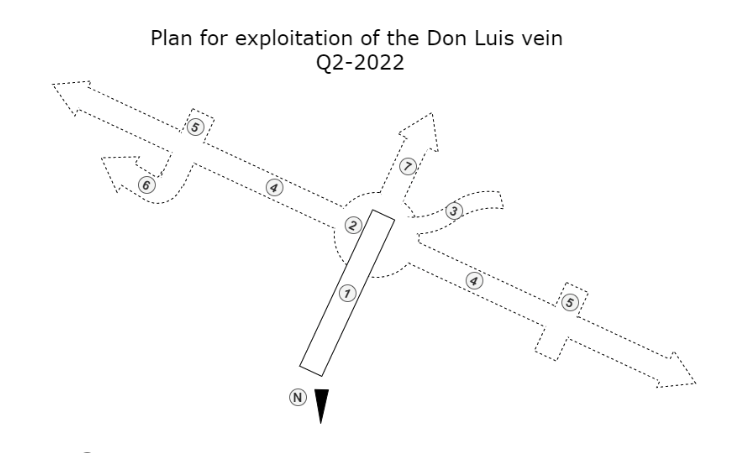
I’m sure everyone will remember this diagram:

“Each level of the mine will have 2 working faces being simultaneously mined. One will orient towards 11 o’clock (NNW) and the other towards 5 o’clock (SSE)”. (BB)

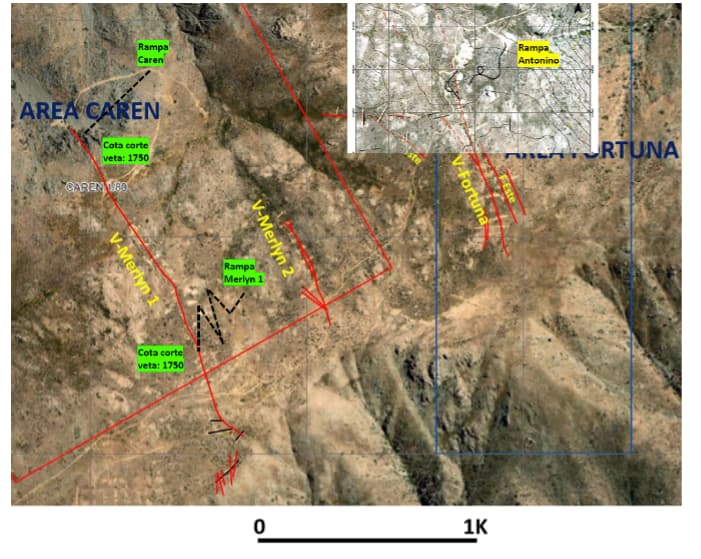
I doubt many here will remember when BB said; “A “decline spiral” will be drifted to access the various sub-levels below level 3. Level 3 of the DL2 Vein which is centrally located within this VEIN SET, is located at the 1,840 meters above sea level elevation. The westernmost of these 6 main veins, the Merlin 1 Vein, also shows these same “bonanza gold grades” at the same elevation level i.e. 1,840 masl.“

Also, back in Dec 2021

Professor Luis de la Tierra’s comments on the ore at the DL1 Vein are as follows: “The ore extracted and stockpiled from the old and new works on AURYN’s La Fortuna de Lampa mining project strongly reminds me of the ore from El Peñon Project, owned by Yamana Gold Corp. They are very similar to the color and rock quality of the ore I personally observed during my time working on the development of El Peñon. I have the firm belief that once La Fortuna de Lampa project goes into production, and a correct evaluation of the entire project is achieved, it will be a mining operation with very similar characteristics of El Peñon.”

It was back in April of 2023 BB went on to say:

“If you look into the future and assume that levels 3 through 7 are in operation, there would be 10 working faces being simultaneously mined. The key to being able to mine this many levels simultaneously, and in a safe manner is plenty of fresh air ventilation and a “ventilation/safety egress chimney” from the level of the Antonino Adit (level 3) to the plateau surface. This “chimney” will be located very close to the center of the watch dial and the “decline spiral”.

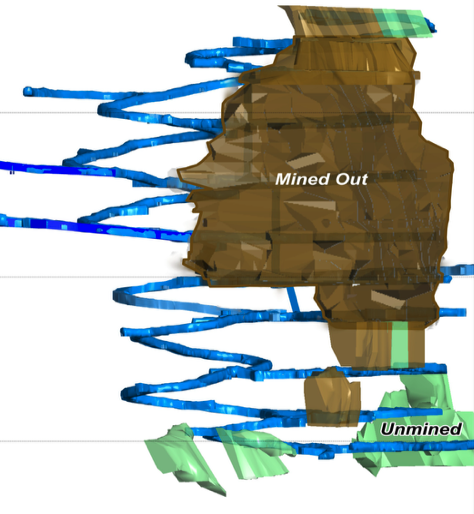
If you know anything about stope mining you will realize immediately this is what he was talking about. This is a schematic of a spiral decline with lateral drifts similar to how I visualize work will progress at the Fortuna Mine main adit.

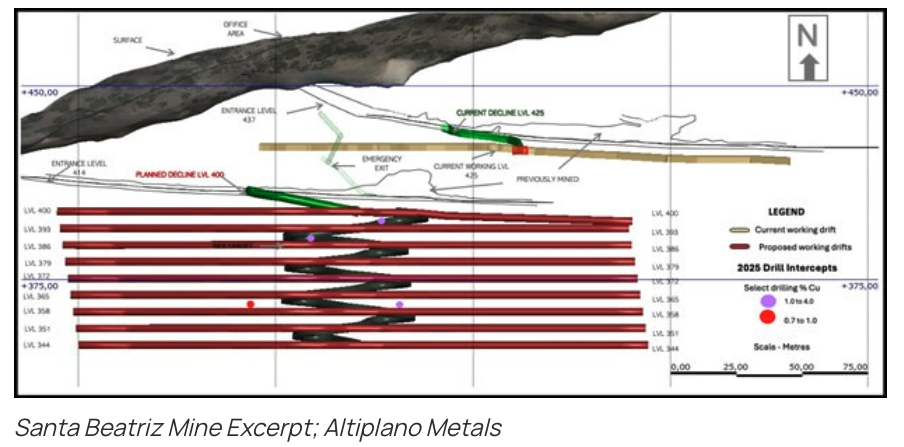
… and from the Santa Beatriz Mine another visual perspective about what was being discussed with this method of mining. Think in 3D that as the main vein is being exploited, the horizontal direction has a length that is mined laterally in 2 opposite directions from the centrally located spiral decline. As the vein descends vertically, it can again be mined if the next drift is spaced parallel to the drift above by about 25 meters, and sequentially mined in this fashion to great depth.

Here’s a video I thought useful in explaining shrinkage stope mining, a variation of long hole stope method which is the method I think will likely be used. I may have posted this one before. The utube link, has parts 1-5 in sequence. Each is about 3 minutes long, but it is #5 that I find the most instructive for a very general understanding of the mining that may prove useful for how a specialized variation of long hole stoping may be adapted on a much smaller scale for now. https://www.youtube.com/watch?list=PLhLmsHj1U0Gm7LMfAmAOWKDri70s2lD9y&v=Oaxs7EEIp4k

Also, a note I asked AI to explain for any newcomers: Shrinkage stoping, when used on high-grade, narrow epithermal gold veins, can decrease waste rock and potentially increase grades by selectively targeting the most valuable portions of the orebody. By carefully managing the stoping width and the removal of ore, miners can minimize the inclusion of barren or low-grade material, leading to a higher concentration of gold in the ore being processed.

Shrinkage stoping involves removing ore in slices, leaving a portion of the blasted rock in place to support the stoping walls and provide space for the next slice. This method is particularly effective for narrow veins where the walls are not always planar and vary in both lateral and vertical dimensions. By carefully controlling the stoping width, miners can minimize the inclusion of barren or low-grade material, reducing the overall volume of waste rock being moved.

Hope this helps explain what I think is progressing. There is much more that could be added here, but for brevity, I will end it here.

EZ

5 Likes

Yes, intuitive, but I’ll have to re-read and study to “get it”.

Or, maybe our resident expert, BE, will give us his opinion on this?

So, the overall use of jackleg drilling (with or without blasting) results in more efficient mining. There will be no production whatsoever without blasting. The jackleg drills do not produce any ore. They just make small diameter hole is the ore or waste rock which are then loaded with explosives and blasted. Your statement that (….without blasting..) makes no sense whatsoever.

I’m led to believe that Auryn Mining Chile has adopted the sub-level stoping method as part of it’s Fortuna de Lampa Project for the Don Luis vein. The vein system is described as having a steep dip and being within competent (strong) host rock, which are ideal conditions for open-stoping methods.

Antonino Tunnel Operations: The mining plan has been designed to optimize production by extracting ore from the Don Luis Vein, which is the primary target, and accumulating ore for future processing.

January 2025 – Shareholder Update | AURYN Mining Corporation

great optionalityOperations and Plan Developmen

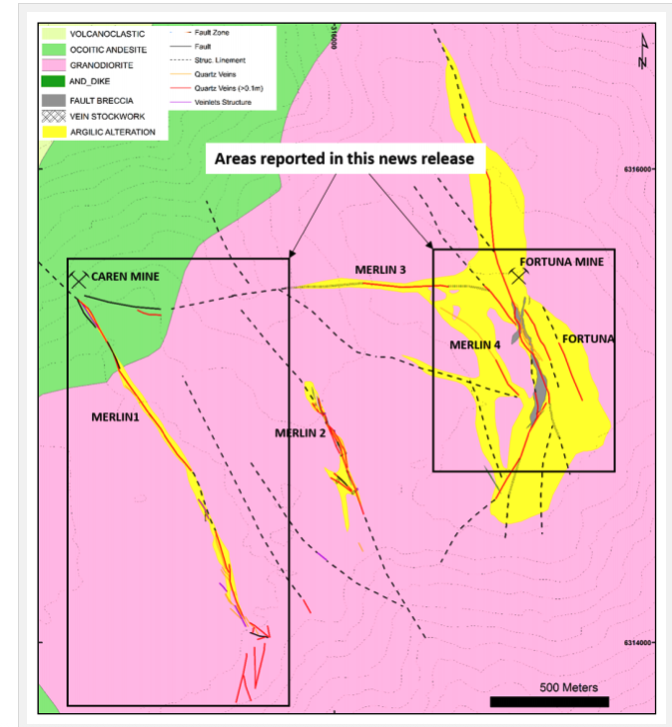
There is great optionality across the 6 Main Veins within this overall “VEIN SET” that offer the opportunity for scalability. A certain length of Larrissa Adit has already been opened up. Both the Merlin 1 Vein (Larrissa Adit) and the DL2 Vein show “bonanza” grades at the 1,840 meters above sea level elevation. This is an interesting level across the entire ADL. At this favorable sub-level management will likely choose to mine out these areas first. Major veins were first mapped out in a release December 2015:

The April 15 PR earlier this year states there are expanded opportunities that are actively being pursued.

During this quarter, we significantly advanced activities at our Fortuna site:

  • Antonino Tunnel Operations: We retained a specialized contractor who is managing Antonino Tunnel operations as part of the La Fortuna Sub-Level Stoping Project. Current efforts include enhancing tunnel access, improving grade, and ensuring continuous, efficient operations with minimal disruptions.

  • We are advancing two additional exploitation projects targeting the Merlin IV vein, both in its northern and southern extensions. Each project targets an extraction rate of 1,000 tons of ore monthly, bringing our total authorized production capacity to 3,000 tons per month by the third quarter of 2025.

https://aurynminingcorp.com/april-2025-shareholder-update/

I’m looking forward to following progress as each quarterly update becomes available.

EZ

3 Likes

:joy: Probably not, since that’s not even what I stated. :laughing: THIS is what I said …

Researching a variety of topics is my favorite passtime, including mining. Even IF “with or without blasting” were removed from my post, the meaning would remain the same. This is soo insignificant.

You said jackleg drills do not produce any ore. Perhaps not, but maybe you can explain why the OCT 2024 Update says:
" In addition, the ore from the DL2 Vein is extracted with jack legs, ensuring precise, controlled removal directly from the vein and minimizing dilution with wall rock."

I’ve read information from a few different sources regarding jackleg drilling. If you don’t agree, no worries, no need for nitpicking. Just take it up with this (below) and other sources with similar statements. :peace_symbol:

Jacklegs are not always used with blasting … They also drill holes into the rock to install various types of ground support, such as expansion-anchors or resin-grouted rockbolts.”
(JackLegDrillInjuries2016.pdf)

1 Like

The barren rock is 0.00gpt not 1gpt. The points I’m making may seem “extreme” in contrast to some of the crazy metrics BB throws around but I’m actually making assumptions inline with industry norms. You will come to learn this if/when we start to get results from mining/processing.

EZ. I also love to use AI to help with analysis. Unfortunately, you forgot one last important prompt :

I’m involved in a high grade underground gold mine that may attempt shrinkage stoping, the width of the vein varies from .3 to 1 meters in length. They have not drilled out the resource so they are essentially chasing the vein, visibly. Does that change any of the benefits you laid out before?

Yes — your situation is very different from the classic shrinkage stoping I described earlier, and it significantly reduces or eliminates most of the traditional advantages of shrinkage stoping while amplifying the risks.

Classic shrinkage stoping assumes:

• A reasonably continuous, predictable, steeply dipping tabular orebody (width usually 1–3 m, often 1.5–4 m in South African gold/UG2 platinum examples)

• The vein has been drilled off on strike and dip so you know where you’re going and can plan 50–150 m high stopes

• You can develop proper raises, undercuts, and drawpoints in advance

Your case:

• Vein width 0.3–1.0 m (extremely narrow — almost “Bonanza-style” chasing)

• No drilled-out resource → blind vein chasing

• You are following the structure visually as you advance

Bottom-Line Recommendation for Your Situation

Pure shrinkage stoping is one of the worst methods for a 0.3–1 m vein that is not drilled out. You will get:

• Very high dilution

• High costs

• Poor recovery of the actual resource

• Frequent stope losses when the vein pinches or shifts

Better alternatives while you are still chasing the vein:

• Mechanized cut-and-fill (Alimak or small jumbo + remote LHD) — keeps dilution low and lets you follow the vein tightly

• Narrow-vein longhole (e.g., 2–3 m lifts with 51–64 mm holes) once you have even modest strike length defined

• Hand-held development with selective mining → mill only visible high-grade, stockpile low-grade for later

Hope this response clarifies things for the “newcomers”!

The usual counterpoint oppositional view to almost every poster fails to follow the main narrative of what is presented. Rather than going to the most recent information clarifying an earlier post the “nameless wonder” picks an obtuse tangengial argument rather than the central theme to a broader macro view of what is presented. There was a rather lengthy recent post stating a quite simple straight forward headline statement that should logically have been responded to:

“I’m led to believe that Auryn Mining Chile has adopted the sub-level stoping method as part of it’s Fortuna de Lampa Project for the Don Luis vein. The vein system is described as having a steep dip and being within competent (strong) host rock, which are ideal conditions for open-stoping methods.”

This is an explicit personal view as I brought up a few significant supporting details that did not mention shrinkage stoping. A reference to shrinkage stoping in an earlier post was just an interesting tangential side note for educational purposes meant to broaden an investor’s knowledge base when seeing a mention to it in other possible investments. The post to which this nameless FUD poster referred to was not focused on shrinkage mining. It was more properly focused on something much greater than just exploration occurring as the project moves forward. There was a very general macro view understanding of the mining that may prove useful and used in the future exploitation on the ADL. I proposed the possibility of a specialized variation of long hole stoping that may be adapted on a much smaller scale for now. The current small pilot-like mining operation is using a permit allowing an exploitation rate of up to 1,000 tons per month. It is not yet in the larger mid-tier category that much of the information on methods pertains to. It is no secret the company aspires to move to a higher fully reporting trading tier and one day become a mid-tier company. High grade narrow vein mining is very difficult and an experienced team that specializes in this type of mining has been contracted to use the most efficient methods adapted to optimize ore extraction from the Don Luis Vein.

Comments could have been directed to my opening comment that jacklegs were very selectively used in the past and will continue in use for some areas in chasing down veins. The Antonino Adit has encountered hundreds of meters of all kinds of veins. There are likely a very large number of intersections with subparallel veins and structures that may or may not have been included in the 5,000 meters of veins detected in the early trenching program that made it all of the way to surface. Many “hidden” veins surely did not make it all the way to the surface. During this earlier trench program, the two main Fortuna veins encountered areas that were over 2 meters wide at surface. Mesothermal veins tend to pinch-and-swell, both along strike and down-dip and really do get richer and wider with depth. One of the most insightful posts appeared earlier in the year when BB posted:

[quote=“brecciaboy, post:304, topic:3488”]

“As we’ve recently learned, the Auryn and Ashmore/Stracon engineers opted to go with a “SUB LEVEL STOPING” approach to mining. This is a “big boy” mining approach to very large deposits that are inclined fairly steeply and whose borders are easy to distinguish.

This approach involves simultaneously mining at several different horizontal levels. The miners in the upper adits drill long holes into the floor of their adit and the miners in the lower adits drill out the ceilings/”backs” of the lower adit. The drill holes are filled with ANFO and kaboom, the fractured ore falls by gravity into the lower adit where it is scooped up usually by “LOAD, HAUL, DUMP” (LHD) trucks. The resultant empty “STOPES” are then often “back-filled” with the tailings/discards from the froth flotation plant in order to stabilize the mountain. At the end of the day the 7 Main Veins will probably have a bunch of “cross-cuts” linking them together like you see at El Penon.

We’re all looking for reliable sources of information. Trust the guys like Professor de la Tiero who ran the underground operations for Yamana at El Penon after Yamana bought out Meridian Gold that made the initial discovery. Trust the hiring of a major mine developers like Robert Mayne-Nichols who Auryn just hired as the new “General Manager”. He has been associated with mega-mines like Los Pelambres and Collahuasi in Chile. Trust the Ashmore/Stracons of the world that act as “mine operator” for 51 different mines in 4 countries. Trust the Isac Bursteins of the world who was appointed to the Auryn BOD a year or two ago. He heads up Hochschild’s “Business Development” department. Watch some of his keynote addresses to various worldwide mining and banking forums. He is considered one of the premier “deal cutters” in all of South America. You just don’t put a team like that together for the heck of it.”

All shareholders should focus on important information and assimilate it as best fits their investment goals. I do not consider many of the misdirected minutia posts, blown out of proportion by a single poster that specializes in FUD on this thread to advance shareholder interest. Again, this is my personal opinion. The one poster who delights and specializes in spreading FUD is little more than a diversion for me. I would rather focus on all the things that are finally coming together for a successful bootstrapping operation on the current approach by Mr. Cordoza. I recognize my bias in this investment as I desire a successful and profitable future for myself and all shareholders invested here.

EZ

8 Likes

For those of you trying your best to model Auryn’s potential annual earnings and even more importantly, Earnings Per Share (EPS) over the first couple of years post-commissioning of the new FF plant, the key metric becomes the “AVERAGE HEAD GRADE” coming out of the various adits being exploited or from the over 60,000 Tonne stockpile of ore that Auryn has already mined, brought to surface, and segregated by grade.

The role of the “over 60,000 Tonnes” already mined, stockpiled, and segregated by grade, needs to be appreciated. Despite the claims of how tough it is to “chase veins”, Auryn just mined, stockpiled, and segregated by grade a tremendous amount of high-grade ore. Perhaps you’ve seen the pictures of Auryn’s 20-Tonne blue truck on their website, now imagine 3,000 of them filled with ore ready to be processed by Auryn’s new ore processing facility once the ribbon has been cut.

When the “fine tuning” process of the FF plant commences in the near future, Auryn will intentionally feed in some of their lower-grade ore so that they don’t inadvertently send a bunch of gold to the tailings storage facility while they are trying to calculate the ideal settings for maximizing the “recovery rate”. You want to “practice” with the low-grade ore before you risk losing some of the high-grade ore.

Once that is completed, then it becomes “game on” and Auryn is likely to constantly process their highest-grade ore in order to maximize free cash flow. This keeps constant upward pressure on the “AVERAGE GRADE” of the ore being processed.

Once Auryn has 3 operational sites contributing 1,000 Tonnes per month each (collectively 36,000 Tonnes per year), this will keep the FF plant more than busy since its nominal throughput rate is 100 TPD or about 30,000 Tonnes per year. As more and more operational sites come on-line over time, Auryn will no doubt be processing the highest-grade ore from all of those sources, including the original 60,000 Tonnes of stockpiled ore, in order to maximize free cash flow. The lowest grade ore from that original stockpile may never get processed.

Within the various adits, Auryn will no doubt be hitting “ore shoots” within the veins. These are areas where the conditions were ideal for the laying down of extremely high-grade ore, well above the “average grade” of the vein ore. When they encounter these, they will aggressively focus their resources on rapidly exploiting these areas.

The geological data collected to date suggests that Auryn, at level 3 of the DL2 Vein, is operating within a “boiling zone”. These are vertical zones, averaging 300-meters in vertical width (the range is from 50 to 800-meters), in which the conditions were ideal for the laying down of extremely high-grade ore. These “boiling zones” are confirmed by the presence of a special type of quartz known as “milk quartz” or “cryptocrystalline/aphanitic/chalcedonic quartz”, in which the quartz presents with no discernible crystalline structures.

Gold tends to travel in super-heated hydrothermal fluids that emanate out of magma chambers when their roof/carapace burst when pressures build up. The gold travels bonded with sulfur in “thiosulfate complexes”. These fluids are way too hot to “boil” but when they rapidly cool in these “boiling zones”, the fluids are allowed to “boil”. This disrupts the bond between the gold and the sulfur, and the gold tends to pile up in extremely high concentrations locally.

This rapid cooling does not allow the molten quartz (a “silicate”) to build the nice crystals you’re used to seeing with quartz. The result is quartz that takes on the appearance of milk. When you witness “milk quartz”, also known as “chalcedonic” quartz, be on the lookout for extremely high-grade gold nearby.

The presence of “boiling zones” also provides an upward pressure on “AVERAGE GRADES”. Through time, the “AVERAGE GRADE” of the ore being processed by the FF plant is going to exceed the “AVERAGE GRADE” of the ore being mined in the adits or the “AVERAGE GRADE” of the ore contained in the original stockpile. The best of the best always gets processed first because money has a “time value”. I can’t overstress the importance of Auryn having its own on-site geochemical assay lab. This is what allows management to determine the highest-grade ore to be fed to the FF plant first.

You need to keep in mind that the constant upward pressure on the “AVERAGE GRADE” being processed also puts constant downward pressure on the ALL IN SUSTAINING COST (AISC) to produce each ounce of gold. This in turn puts constant upward pressure on the “MARGINAL PROFITS” per ounce produced. As I’ve mentioned dozens of times, in this sector “GRADE IS EVERYTHING”.

UNLIKE YOU’VE BEEN TOLD, MAURIZIO IS NOT GOING TO BE SENDING WORTHLESS ORE TO THE FROTH FLOTATION FACILITY

When Auryn drifted the Antonino Adit, there were stretches of the adit wherein the granodiorite host rock was clearly nonmineralized. This ore was dumped “over the cliff” outside of the adit portal which led to the creation of an expansive flat operations area. You can study the satellite photos and trace how these areas grew in size as the adit was being drifted.

During the drifting of the adit, Auryn encountered 3 very promising vein structures that they thought might be the DL2 Vein. The lab results concluded that none of these 3 structures was the DL2 Vein. Auryn discovered a total of 24 new “veins/structures/faults” during the drifting of the adit. Since the target DL2 Vein was a “known” extremely high-grade vein, Auryn did not pursue these new opportunities but instead ventured further down the line until they did successfully encounter the DL2 Vein. These other new opportunities will no doubt add to “mine life” much later on.

At the intersection with the DL2 Vein, Auryn immediately did a sampling consisting of 4 groups of “channel samples” of the DL2 Vein ore. The results came back with an off-the-chart assay reading AVERAGING 164 GPT GOLD amongst the 4 groupings. When you get results like this, you pretty much have to run a “check sample” to rule out any improprieties, usually at a different assay lab. The “check assays” came back at 150 gpt gold at this new “level 3” of the DL2 Vein which sits about 30-meters below level 2.

What these results served to do was to corroborate the stellar results that the artisanal miners got when they were mining levels 1 and 2, from 1940 to 1970. They averaged an outstanding 64 gpt gold in their shipments to Enami. Enami ended up funding the artisanal miners of the DL2 Vein.

When Medinah and Auryn released these outstanding assay results, our favorite naysayer on “THEMININGPLAY” accused Auryn of publishing fraudulent “eye popping” results that actually consisted of “grab samples” (not the much more reliable “channel samples”) for which Auryn failed to even list out the width of the intersection despite the fact that the 0.6-meter width of the intersection was contained in the text of the press release.

The share price of Medinah soon went into a tailspin from which it never did recover. Right before being delisted to the “Expert Market”, Medinah was trading at $0.0009. Oddly enough, Maurizio, the CEO of Auryn, had recently purchased hundreds of millions of shares of Medinah all of the way up until the $0.09-level (9-cents) which is 100-times the share price level Medinah descended to in the midst of a barrage of accusations made by our favorite naysayer.

Think about that for a moment, the “smart money” that sits with the knowledgeable geoscientists and engineers all day long, was paying 100-times the share price that Medinah finally descended to shortly before they started their descent. To this very day, the daily attacks have not abated one bit despite the fact that Auryn is about to go into extremely high-grade gold production at a time in which the 3 metals being mined and sold are all trading at or near all-time highs.
7 Likes

“This ore was dumped “over the cliff” outside of the adit portal which led to the creation of an expansive flat operations area.”

Well, well, well - now I have my answer. BE had me wondering if MC was processing barren rock. No, MC isn’t stupid - he’s smart. He got RID of the barren rock, dumped it over the side of the mountain! And I’m about 100% sure he’s gonna be sending the HIGH-GRADE stuff over to the FF machine to maximize his return. If the artisans could average 64 gpt back in the day, then why can’t we do AT LEAST as well? Technology has gotten better, right? But, oh I forgot, we will NEVER see a dividend, right BE? That’s what you said on 10/23/2025. I think I know who I’m gonna believe.

2 Likes

Sometimes it’s better to be silent than to try to educate some that don’t want to be educated they just want to be right…

I totally understand what you’re saying!

2 Likes

I recall this post also stated that jack drilling alone can be used to chase a vein. I thought that part was interesting as well, because I followed with that same thought. The only difference is that I was criticized for it.

Carlos gets uptight with a statement that suggests any jack drilling without blasting — but maybe only when a woman says it. Perhaps he just didn’t read or comprehend your preceding post.

And no, he wasn’t ‘educating’ either, he was trying to be demeaning over a tiny insignifant phrase I said, no matter who said it before. I even backed up my comments with Auryn’s updates to avoid bringing up your comment. He was just nitpicking at me personally. :roll_eyes:

It would be nice if we could all just let go of this pettiness.

3 Likes

Who ever suggested that Maurizio would send worthless ore to the FF plant? All of our posts are archived, right? Clearly not an option worth considering but the discussion on expectations of grade across the 60k tonnes is a very important one. I would suggest that the blended average is nowhere near the suggested 28gpt (BB’s calculated number) based on simple laws of volume/math. When digging a large “tunnel” to ultimately find a meter long vein there will be a lot more “barren rock” vs. valuable ore. If a large portion of the 60k tonnes came from BEFORE they hit the vein(s) and had a lab (which they still may not) the average grade will be considerablly lower. Maybe 1gpt on average?? More searching= more barrent rock. More mining of the vein= more high grade material. This is pretty simple stuff but you can’t average 25gpt+ unless the majority of that stockpile is derived from directly mining the vein. I don’t believe that to be the case. If anybody does know that answer it would be invaluable. The existance of a lab and/or the timing of the same is also very important. Based on visuals and lack up any updates specific to the lab I would suggest the vast majority of the stockpile was not assayed and thus impossible to value. Visual sorting at best.

Specific the the “grade argument” Maurizio and I are in agreement: a targeted average grade going foward in the 10gpt+ range is certainly possible. Arguing that this project will be the highest grade mine in history by several factors based on 1) historical/artisenal mining and 2) samples taken directly from the vein, is flawed logic. The artisenals mined a total of 2000 tonnes over 30 years!! Over 30 years, meaning 60 tonnes, on average, per year. The equivalent of three trucks per annum. As they mined, they ONLY grabbed the highest grade material they could find, loaded it on donkeys (or beat up trucks) and hauled it down to Enami. There is do doubt that they left high grade material behind. They certainly left everything that was no/low grade. The total weight over 3 decades would suggest they left a VAST amount of anything but the highest grade material behind. To conclude that 65gpt material is somehow representive of the average grade is grossly “flawed” (to be very nice). Similarly, taking a sample directly from the vein has no relevancy to the average grade of the project. Our favorite comp, PPX, just announced core drill results of 50gpt over 2 meters (twice the size of the DL Vein), but nobody would ever cite that grade to infer grade over the project. Based on the information we KNOW my position is that this will be a very high grade (10gpt+) opportunity. Could it be higher or lower? Yes +/- 5 grams but grab samples and historical results have no indicative relevancy.

I NEVER claimed the assay results were “fraudulent”. What I did say was that a 2000lb sample of ore taken directly from the vein was not an indication of unfathomable riches nor a validation of the running narrative on this board to whip out the magical calculators and use 150gpt to extrapolate valuation.

The results from the “experimental batch” came out in October 2023 when MDMN was trading at .0009, the same price that it was trading when it became delisted. For context the share price a year ealier was .002. I’m not sure what constitutes a “tail spin” but its safe to assume that anything less than a fraction of a penny is not great and, for the record, the last time MDMN was trading above a penny was September of 2016.

Whether its naked shorts or the big bad Bald Eagle, BB blames everything but his own poor investment decisions/analysis to explain a market that “just doesn’t get it.” One could argue that the share price was struggling b/c AUMC had not delivered on a promise to be in production for the past seven years and was about to pivot, again, to build a plant vs. ship to Enami. Food for thought.

Do I believe they could have made that decision based on readily available information 5 years earlier? Yes. Do I believe that some dilution in exchange for a small, defined resource could have led to a significantly better outcome over a shorter timeline? Of course. I also believe that the decision to build their own plant was a good one and, hopefully, its mostly fun stuff going forward. Ironically, if Maurizio hits his goals and is able to produce 5-10koz at a nice little profit, some folks will still be disappointed but he won’t. He has the advantage of only being involved for under a decade while it feels like some of the “ol’ timers” are looking for monster (unattainable ) outcomes to somehow make up for a very long, very “challenging” journey.

Next stop, a stock pile worth $150M, trading at 30 times earnings, massive dividends, and a $2 billion market cap. Or, unless you’re in a rush, maybe wait for them to prove they can make a proft post commissioning the plant (a big acheivement), wait for proper disclosure of the debt financing, wait for a mine plan with actual numbers. Normal, boring stuff for us back here on Earth.

Carlos,

While the first statement is correct, explosives are loaded into drill holes to blast for ore production. This will be used extensively by the experts moving production going forward. It will not exclude high grade veins being chased and dug out by hand as the Antonino mine declines are advanced by blasting. It is not correct say “NO ORE HAS BEEN NOR WILL BE PRODUCED WITHOUT BLASTING.” The jackleg or stoper drills are indeed used to produce hi-grade ore selectively in limited quantities. Some limited blasting may be involved.

It is poorly stated in one sense when you say “there has been no production mining, just development advance meaning that only jacklegs have been used to date.” The hi-grade stockpiled ore was selectively sorted when high grade veins and areas were encountered and likely “dug out” with jackleg drills, saving this hi-grade ore for the floatation mill. This ore was clearly planned as early production ore and going to be used for early production at the mine. I have personally seen veins in Colorado that have been chased and dug out using hand held jack drills to considerable horizontal depth with great effect. Vertically, ladders and scaffolding were used to as high as the tunnels could accommodate to maximize the volume of hi-grade ore collected.

So aside from any miscommunication, jackleg drills and stoper drills have traditionally been used to selectively go after narrow vein hi-grade ore in small mine production. Blasting is part of mine production. They are also essential for advancing an adit or production decline to drill the holes for blasting. Someday we may be using a jumbo to speed up the process! :slightly_smiling_face: GCCapital and MDMNJaded are both quite clear on this. Production ore is already stockpiled awaiting completion of the froth floatation plant. Proper techniques and equipment are going to be used going forward to efficiently advance production for the mill.

EZ

3 Likes

While every one is right and wrong… and, I don’t think Carlos was trying to be disrespectful. Actual drilling is mainly used for blasting… to get a large portion of rock out of the way so you can keep chasing the veins. Although drilling is used for various purposes as JD mentioned. But without jack drilling and explosive devices… your not going anywhere.

That being said there are different types of jack drillers that except different tips that are meant for chipping away at centralized areas of focus.

Again it’s such a small area that you can work in, so if you find a vain you drill, put your explosives in and open it up so you can work more efficiently.

One leads to another, yes you find a vain but to explore you have to expand to work and there comes all the ruble that you don’t want to just trash because it’s mixed with the vein your chasing after…

So… in a way.. everyone is correct :ok_hand:

3 Likes

There will be no production form the veins without blasting. Trying to chip out vein material with a jackhammer may get you as couple of hundred pounds of rock per day.

This is my only point. All development, be it in ore or waste rock and all production of vein material will be blasted.

3 Likes