I would personally like to Thank Kevin “ our Grand Wizard" for all that he has done in the past several years… He is a remarkable man. He has his own totally engulfed life, yet still stands among us fighting for the ones who trusted.
In my eyes Kevin Tupper has gone above and beyond for the shareholders of Medinah.
I have just received my 10 year anniversary as a moderator for this site, and am blessed and privileged to apart of what was once great… Sent to ruins… only to be back on a slow but progressive trail to what could be a very special time.
Thank you Kevin, without you this site would have disappeared long ago… and I should add that while he is the key, us as moderators never hear a word out of him that he doesn’t make public.
We don’t hear anything that you dont….
CHEERS, Mr Wizard and thank you for the last ten years ÷÷÷ of your support!!!
And also a personal thanks to Kevin and also a Big thanks to GCCapitol and brecciaboy and Mike Gold and his (goat cheese) and EZ, mrbubba, MDMNJaded and all the other supporters of Auryn/Medinah.
Well well well…so close but yet another calamity has befallen our investment. I had been certainly concerned that the local environmental activists would attempt to stop Auryn’s mining operation. It appears that they were successful. (at least for now.) Hopefully, Auryn has access to some good attorney’s to fight this. (Perhaps they can also spare a few minutes to inform investors on exactly what is going on after months of silence?)
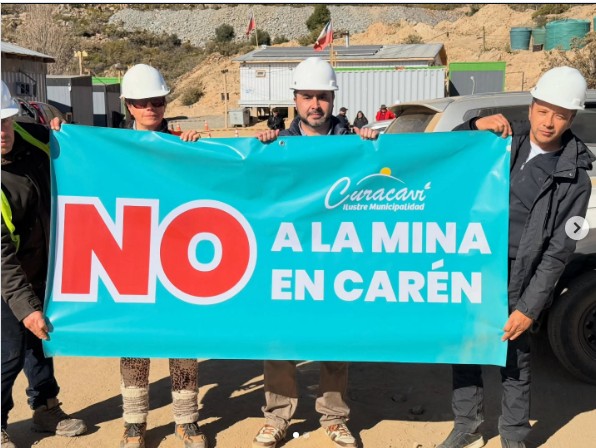
Auryn’s operation was shutdown yesterday by the Municipality of Curacaví yesterday for lack of building permits. The mayor of the city was actually present to do the honors suggesting this was politically motivated. This was announced on the Municipality’s website:
Videos available here: https://www.facebook.com/reel/1515196853442565
“The Municipality of Curacavi informed this Saturday the closure of a mining site located in the Caren sector, corresponding to the company Auryn Mining, because it would not have the necessary municipal permits to operate. From the municipality noted that this measure represents an important step for the protection of the local environment, especially of the biodiversity of the area and the Puangue mine, as mining activity could generate pollution in the waters of the outskirts that outflow this important course of water. Also, the municipal authority stressed that the work would also be affecting the natural environment and wildlife of the sector, reaffirming the commitment of the administration to the protection of Curacavi’s environmental heritage.”
What are the local municipalities permit requirements for a new small gold mining operation near the town of Curacavi, Chile? If Curacavi wont issue required permits, what recourse does the Company have?
Small-scale mining near Curacaví requires approval from the Environmental Assessment Service (SEA), technical sign-off from SERNAGEOMIN, and municipal zoning/construction permits. If the local municipality denies permits, a company can file administrative appeals to regional authorities, seek judicial recourse in Environmental Courts, or appeal directly to civil courts asserting arbitrary or unlawful municipal overreach. [1, 2, 3]
Key Permit Requirements
A new small-scale gold mining operation in Curacaví must navigate three primary layers of compliance:
Environmental Qualification (RCA): The project must be submitted to the Environmental Assessment System (SEA), usually via a simplified Environmental Impact Declaration (DIA). This is to ensure the operation does not negatively impact the local ecosystem, particularly the Puangue Estero and surrounding watersheds (a focal point of recent municipal closures in the area). [1, 2, 4]
Mine Closure & Operations Plan: Regulated by SERNAGEOMIN, the company must have an approved Mine Closure Plan. Small-scale operators processing under 10,000 gross metric tons per month may be eligible for a simplified approval or sworn declaration process. [1, 2, 3]
Municipal Permits: To construct infrastructure, conduct earthworks, and operate, the company must obtain permits from the Dirección de Obras Municipales (DOM) and the Dirección de Medio Ambiente, Aseo y Ornato (DMAAO). Local municipalities enforce the Ordenanza General de Urbanismo y Construcciones (OGUC) and local land-use zoning (Plano Regulador). [1, 2]
Recourse if Curacaví Refuses Municipal Permits
If the Ilustre Municipalidad de Curacaví or its DOM denies necessary municipal permits, a company has several avenues of recourse:
Administrative Appeal: The company can appeal the Municipal Mayor’s or DOM’s decision to the Regional Environmental Commission (COREMA) or the Ministry of Mining, particularly if the municipality is applying criteria outside its regulatory jurisdiction. [1]
Recurso de Protección: Under the Chilean Constitution, a company can file an appellate court injunction (Recurso de Protección) if they believe the municipality has acted arbitrarily or illegally to obstruct a legally valid project.
Environmental Courts: If the permits are denied on environmental or land-use grounds intertwined with the project’s Environmental Qualification (RCA), the company can appeal directly to the Environmental Tribunals (Tribunales Ambientales). [1, 2]
Judicial Permit: Under the Chilean Mining Code, a company can bypass surface owner or local territorial obstructions by petitioning a regular civil court to establish legal mining easements, provided that required compensation is paid to the surface landowners. [1]
If you are evaluating a specific project, let me know:
What is the estimated monthly tonnage of your extraction?
Has your project received its RCA from the SEA?
Is the land private property, and do you hold surface access agreements?
I got the translation of Mike’s video: “We are at the Auryn company’s mining camp. Following an official directive to verify the status of the structures and facilities behind me—which lack building permits and final occupancy certification—and in accordance with current regulations and the oversight authority of the Department of Public Works, we are proceeding to declare this entire camp uninhabitable and order its evacuation.”
So, it appears that the issue here has to do with somebody, the contractor?, not getting the final permit for the new camp and the final occupancy certification. THEN SOMEHOW THEY CONFLATE THIS INTO SAVING THE ENVIRONMENT BECAUSE MINING IS SO DIRTY.
You can see the blue sign saying “NO MINING AT THE CAREN MINE” as if this represents a major victory for the environmentalists. I’m going to assume that on the final inspection, if there was one, the contractor was handed a piece of paper approving of the ability to occupy the premises. If true, our contractor should be able to produce that document theoretically. If the inspector failed to properly file that document back at the office then that’s another thing entirely. Another possibility is that the contractor failed to order the final inspection and/or he did and the inspectors didn’t show up in order to set up a potential victory for the environmentalists.
Notice the stretch from going from “this camp has not been approved for occupancy” to “mining is dirty; don’t pollute our rivers.”
One solution is to bus the workers up the hill until the issue is cleaned up. Remember that the froth flotation plant and the tailings facility were already signed off on by SERNAGEOMIN. From what I can infer, they’re not shutting down the mining operation; they’re forbidding the occupancy of the camp building.
This is confusing either way. What am I missing? The January 2026 Update states:
“Final operating permits for the flotation plant and tailings facility remain pending. Permitting timelines were impacted by a cybersecurity incident affecting the regulator’s systems, and Auryn has maintained close coordination with SERNAGEOMIN throughout this period.”
I see that MG pointed out that small miners require approval from the Environmental Assessment Service (SEA) in addition to the technical sign-off from SERNAGEOMIN, and municipal zoning/construction permits.
So which comes first; approval from SEA or securing all of the necessary permits? Has MC provided an announcement regarding those stated permits since the last Update?
This was posted on X on Feb 22st: “Along with this week’s photos, AURYN is happy to report we’ve received permit approvals for the tailings pond and the mill.”
Note, the message didn’t say anything about getting approvals for the mining camp itself.
I’m skeptical they will be able to get around this by using a bus from Lampa to ferry workers with Winter approaching with the lack of shelter, sanitation, food services etc especially since they likely didnt plan for this ahead of time.
At the end day, this will amount to simply yet another delay. Let’s hope it isnt a long one.
You would think Glencore would help out as well especially since AMNP will likely have the same problem with their camp on the other side of the Alto. Caveats, AMNP hasn’t provided any photos of any kind of camp or flotation plant construction so don’t know for sure they actually have anything despite claims production to start there in the last quarter 2026. There is also no signs that the very problematic access road there is being upgraded. Also, I haven’t seen any local interest in that project either. Finally, it appears that project is likely in a different jurisdiction.
This was the universal assumption back in April 2024. Per usual, I was criticized for questioning how AUMC could be ordering equipment advancing engineering design/permitting and guiding towards production decisions BEFORE having all of the necessary permits in hand. My investment in Peru suffered from a full year of delays waiting on permits BEFORE the company could break ground. In this case we simply don’t have enough information to know if this is a fatal blow or just another, prolonged delay (permitting matters like this don’t resolve themselves in a few months).
This is clearly a “local” issue which, can be more complicated vs dealing with the federal agencies. In South America, managing community relations often requires a company hiring a dedicated individual/role. Buidling a school or hospital or employing a certain percentage of the locals in the mining operation can become imperatives to a successful mining operation. Communities are run by both official and unofficial “leaders” who are typically motivated by quid pro quos (legal or illegal bribes). The environmentalists can make the most amount of noise but the drivers are rarely “envioronmental.” Yes, a failure at the tailings could theoreticaly create issues down the mountain but there are other ulterior motives. Even in situations where a company has been exhausitive in their efforts in attaining all of their permits (which AUMC clearly was not), the local communities can create problems. If there are holes in the permitting it can be disastorous. The Curacavi crew used ACDC as their background music in their video of them shutting down the operation. They ain’t rolling over on a clerical filing matter.
We don’t know all of the variables but this is not solely related to the camp. Give me a break. This is operational (mining) and environmental (tailings) related. Translation: anything to do with digging and processing. Even if you assume a successful appeal to Sernageomin, this project will not have wings until AUMC is able to get the community on their side. This can take years. I speak from personal experience.
Beyond the obvious, I would highlight two main concerns:
AUMC entered into debt financing to build the plant. Mining co’s typically shy away from debt b/c of the risk of delays. The debt servicing has or will kick off regardless of the state of production. This is why Maurizio was focused on an equity raise for a year prior to being forced into debt. Time will tell if Maurizio will be to able to convert the interest payments into a PIK or if he’s willing to continue to allocate personal funds to cover the interest payments.
This is clearly a material event. The company has not commununicated with investors since January and this community related issues didn’t pop up a few weeks ago. As a public company, there is a requirement to inform investors of any material events, typically within 48 hours of them occurring. As of now, MGold’s post serves as the only disclosure.
I can only laugh at the recent posts, calling for $30+ price targets ($2B+ market caps), on a stock that isn’t even investable. The lack of disclosure just further highlights this fact.
Baldy, I do think the permitting issues are just related to the mining camp and local government only but nevertheless, Auryn should inform shareholders on what is going on and how they plan to address it as soon as possible. Unfortunately, it is hard to imagine that this new issue will get resolved quickly.
Yes, its a local issue as you detailed in your AI bulletpoints. IMO, if the issue was solely related to the mining camp, AUMC would have been able to proactively deal with the issue. The mayor isn’t going to embarass himself by showing up to a “closure party” if there is any near-term prospect of a mining operation. Best case, this will take a decent clip of $$$ and six months to remedy. It takes time to “bribe” your way through this type of fiasco.
Admittedly, Chile isn’t nearly as challenging as Peru:
If you’re evaluating mining jurisdictions specifically through the lens of community opposition, social conflict, and the risk of project delays, Peru is generally considered more problematic than Chile.
Peru
Peru has a long history of mining-related social conflicts, particularly around:
Water usage and contamination concerns
Indigenous and rural community rights
Land ownership disputes
Perceived lack of local economic benefits
Distrust of both mining companies and government institutions
Large projects have frequently experienced:
Road blockades
Community protests
Mine occupations
Multi-month production disruptions
Examples include major copper mines such as Las Bambas and Antapaccay, which have faced repeated community disruptions. Peru’s ombudsman regularly reports dozens of active mining-related social conflicts across the country.
Chile
Chile certainly has community and environmental opposition, especially regarding:
Water scarcity in the Atacama region
Indigenous consultation issues
Environmental permitting
Glacier and biodiversity protection
However, Chile generally benefits from:
Stronger institutions
More predictable permitting processes
Better-defined mining regulations
More established mechanisms for resolving disputes
Conflicts still occur, but they tend to be more manageable and less likely to completely halt operations for extended periods.


 I had been certainly concerned that the local environmental activists would attempt to stop Auryn’s mining operation. It appears that they were successful. (at least for now.) Hopefully, Auryn has access to some good attorney’s to fight this. (Perhaps they can also spare a few minutes to inform investors on exactly what is going on after months of silence?)