Auryn/Medinah 2026 2nd Half General Discussion

One suggestion? I think I see at least 4 or five. If I didn’t know better, with all your sage advice in this post directed to MC (and thus the current BOD) it sounds like you may be auditioning for a slot on Auryn’s BOD team! :laughing: Audacious ego is again on display here Baldy! :clap:

Management Team

Maurizio Cordova, Board Chairman, CEO

Maurizio Cordova is a seasoned technology and mining entrepreneur based in Santiago de Chile. He is the visionary founder of SIGAL, the leading software package for environmental, health, and safety management in the mining sector.

Mr. Cordova serves as Chairman and President of two publicly listed companies: American Sierra Gold Corp. (AMNP) and Auryn Mining Corporation (AUMC). He is also the majority owner of EGM Colombia, a privately operating gold mining company in Antioquia, Colombia, with active production.

In addition to his corporate leadership, Mr. Cordova founded MASGLAS Limited and AURYN Mining Chile, SpA, focusing on consolidating and advancing mining projects in Chile. Notably, under his leadership, AURYN achieved the landmark consolidation of the Altos de Lipangue mining district, a promising greenfield site less than 40 km from Santiago, Chile. This area, fragmented for over 41 years, is now undergoing exploration and advancing toward production.

David Brownrigg

Mr. Brownrigg is a Professional Mining Engineer with extensive knowledge and experience, having developed his skills through years of operations, study stage, start-up and development projects. His experience includes work in Canada, Peru and Chile. Capabilities include management, engineering, operations, environmental, feasibility studies, board & ministerial communication among others.

Mr. Brownrigg has worked for large mining companies (TECK, IAMGOLD), junior miners (Chariot Resources, Stonegate Agricom), and an established mining contractor. Metal and industrial minerals include Coal, Phosphate, Copper, and Gold. As General Manager of Marcobre SAC (Mina Justa) a $800M FS was completed in 2009. He was General Manager of Mantaro Peru SAC with a Phosphate property in the central Andes. While at Teck Resources he contributed at Canadian coal operations and at the Antamina project as a member of the development team during start-up.

Mr. Brownrigg is a graduate of the University of Toronto (Bachelors of Science), Laurentian University (Bachelor of Engineering, Mining), a Professional Engineer with PEO Ontario.

Tomas Valega

Mr. Valega completed his studies of Industrial Engineering at the University of Lima and is experienced in international trade. He has represented North American companies such as Honeywell Inc, Itt Mc.Donnell & Miller, Itt Bell & Gossett, among others for more than 14 years. Since 2000, Mr Valega has been a mining advisor to the Santolalla-Cajamarca group, co-managing Cia. Minera San Nicolás S.A. His knowledge that covers several areas in the sector including, Mining, Transportation, Legal, Plant, Metallurgy, and Marketing.

(Management Team | AURYN Mining Corporation)

Well Baldy, I do know better! All I have to do is go back and look on the repetitive comments you have made for years in this forum denigrating this company and it’s shareholders. Frankly, I do not see your professional insights of the same caliber to be worthy of consideration for a position among the distinguished professionals currently managing the ongoing operation. Luckily for shareholders, your comments here will have little effect after production is meaningfully underway and MDMN conversion shares are distributed. Maybe you will reconsider in November what 9 months means, if you know what I mean.

EM
4 Likes

I spent a bit of time constructing a handful of posts over the weekend with all sorts of tidbits for both the bears and bulls and all you could muster was another angry, emotional, accusative response…Speaks volumes.

To address your speculation, I would never consider joining this board for (just about) any quantum of compensation, especially if it were in shares BUT if I was already on the board, I’d be mortified with how this recent snafu was handled and I never would have forgone a small quantum of expenses to keep shares of MDMN trading. Not how I operate.

It’s funny. Every time I offer a timeline that doesn’t jive with the optimistic spin, someone likes to challenge me with “I’ll see you in XXX.” I believe Kevin said that when I claimed that production wouldn’t occur in 2025, “I’ll see you in July”. To clarify, that was July of 2025. Now I get to “see you in November” (technially September if you want to be literal). Considering the mine is closed down and they are already 6 months behind their guidance issued in January. I’m good with November am and looking forward to a whole new batch of excuses as we kick off ski season.

Ok, apologies, I wasn’t obvious enough this was really sarcasm and friendly cajoling. All things considered, despite all the setbacks and obstacles, I find this is beginning to look exceptionally interesting for the future of the company.

Note: Q3 2026 (period ending September 30): Due November 16, 2026 (Extended from Nov 14 due to the weekend).

Also a reminder**, Robert Mayne-Nicholls, General Manager of Auryn Mining Chile is a seasoned mining engineer with over 30 years of experience in both public and private sectors. His career includes several high-profile leadership positions:

*Former Executive Vice President of Empresa Nacional deMinería (ENAMI), the Chilean state-owned mining development corporation.

*Private Sector Leadership:General Manager of Minera Los Pelambres and leader of the Twin Metals project for Antofagasta PLC.

*Director of Operations for South America at Barrick Gold Corporation.

*Executive roles at CODELCO, SQM, and Compañía Minera Doña Inés de Collahuasi.

(April 2025 – Shareholder Update | AURYN Mining Corporation)

I do expect good things to happen this year. Patience is required.

EM

5 Likes

Map that shows the approximate location of Curacavi and Lampa administrative boundaries. The Curacavi commune is in red. It appears the the tailings facilities and the flotation plant is within Curacavi while the actual mine is not. (The bunk house(s)/offices appear to be in Lampa.)The potential Caren mine is also within Curacavi which is another reason to suspect that plans for that have been scrapped.

Note, the very exact boundaries are a little harder to come by as the Chilean web servers are very slow but if I can get them, then can have an exact boundary to reference.

Perhaps Auryn got building permits from Lampa but not from Curacavi due to confusion about the boundaries? Don’t know. Seems unlikely as Lampa has made it clear that it wants to halt the project just as much as Curacavi does.

3 Likes

And here we are once again shareholders trying to figure it all out. Embarrassing.

2 Likes

Wow. Thx MG. Seems somewhat insane (given the map) that they didn’t receive permits from C.

Time to get the checkbook out and start greasing “local leaders”

AURYN Mining: Recurring Permitting Narrative (2016–2026)

Mining projects routinely require numerous approvals as development progresses. However its worth highlighting a recurring pattern in the Company’s communications in which permitting has repeatedly been presented as the final hurdle before commercial operations, only for additional permitting requirements to emerge later.

Recurring Pattern

Over the past decade, shareholder updates have frequently followed a similar sequence:

  1. A permit is described as the final regulatory requirement before operations can begin.
  2. Investors are told production or cash flow is imminent once that permit is obtained.
  3. The permit is subsequently obtained or significant progress is announced.
  4. A new regulatory approval, amendment or registration becomes the next critical milestone before production can commence.

While each individual permitting requirement may have been legitimate, the cumulative effect has been a continuously moving regulatory finish line.

Examples

  • 2016 – ENAMI approvals
    • Early updates focused on obtaining the necessary approvals to begin shipping ore to ENAMI.
    • Once approvals were received, ventilation and operational issues became the primary constraints.
  • 2021 – Temporary permits
    • Management announced temporary permits allowing shipments to ENAMI.
    • Shareholders were told definitive permits were expected shortly and that regular shipments would soon follow.
    • Commercial production did not scale as anticipated.
  • 2021–2022 – Mining permits and underground development
    • As underground development progressed, new operational approvals and mine-development requirements continued to be introduced.
    • Permitting remained closely tied to each successive production objective.
  • 2022–2023 – Ventilation approval
    • Construction of the ventilation chimney became necessary.
    • Upon completion, management highlighted acceptance of the revised ventilation system by Chilean mining authorities.
    • Even after this milestone, additional operational prerequisites remained.
  • 2023 – ENAMI Mining Register
    • Management announced receipt of the ENAMI Mining Register and presented it as enabling regular ore deliveries.
    • Shortly thereafter, the strategic focus shifted away from ENAMI toward constructing a flotation plant.
  • 2023–2026 – Flotation plant permitting
    • Investor communications increasingly centered on:
      • plant construction permits;
      • environmental approvals;
      • operating permits;
      • commissioning authorizations;
      • throughput approvals;
      • expanded processing capacity.
    • As each permitting milestone approached, another regulatory step frequently became the next prerequisite.

Observations

  • The regulatory pathway has consistently evolved over time.
  • Individual permits have generally represented legitimate project milestones.
  • However, obtaining one permit has often not resulted in the commencement of the commercial activities previously associated with that milestone.
  • Instead, subsequent updates frequently introduced additional permits, registrations, amendments or regulatory approvals that had not previously been identified as critical.

Communication Pattern

Across multiple years, permitting communications have often followed this sequence:

  • “We are awaiting permit X.”
  • Permit X is received.
  • Investors expect commercial production.
  • Management announces permit Y is now required.
  • Permit Y is obtained.
  • Permit Z becomes the next focus.

Viewed individually, each permitting step appears reasonable. Viewed collectively over nearly a decade, shareholders have repeatedly been told that production and cash flow were dependent upon obtaining what appeared to be the final regulatory approval, only for additional permitting requirements to emerge afterward.

The public record suggests that permitting has functioned less as a series of discrete milestones and more as an evolving process in which each completed approval has often been followed by another regulatory requirement before the previously anticipated operational milestone could be achieved. This does not necessarily indicate regulatory problems—mining projects commonly require multiple approvals—but it does help explain why investors may perceive permitting as a continually moving target over the past ten years.

None of the above considers the current permitting fiasco and we simply don’t have enough information to formulate an analysis.

One other topic worth revisiting and discussing while we wait for clarity on the community/permitting issues would be the 60k tonnes of high grade, stockpiled material. I’m not looking for an argument but rather a healthy debt on the origin on this material. I CANNOT come up with any reasonable scenario on how this above ground asset, of undeterminable value suddently appeared in AUMC’s public communication. Beside the obvious questions like " if there were 60k tonnes of high grade ore, over all of these years, why didn’t MC ship the material to Enami to self-finance the plant and exploration vs. enter into debt financing and personally sink ~$15M of his personal money to advance the project?" I haven’t heard reasonable explanation. More importantly, if you actually go through AUMC’s public announcements over the past decade its almost impossile to reverse engineer an equation that results in that much volume of mined ore. Not to mention, after being shown numberous piciture and videos (on the ground and aerial) of the site, there is ZERO visual evidence of any tailings of significance.

Questions Regarding AURYN’s Reported >60,000-Tonne Ore Stockpile

One of the most significant claims made by AURYN in recent shareholder updates is that the Company has accumulated more than 60,000 tonnes of stockpiled ore . If accurate, this represents a substantial corporate asset and a major source of future mill feed. However, after reviewing the Company’s public disclosures over the past decade, there are several unanswered questions regarding the origin, accumulation and measurement of this reported inventory.

Historical Stockpile References

  • 2016–2017: Approximately 76 tonnes were shipped to ENAMI during the initial trial mining campaign. No significant remaining stockpile was disclosed.
  • April 2021: Approximately 9 tonnes were shipped to ENAMI. Again, no material stockpile inventory was discussed.
  • January 2022: The Company reported shipping approximately 48 tonnes to ENAMI and stated that approximately 50 tonnes remained on site awaiting shipment. This is the clearest historical inventory disclosure prior to the flotation plant strategy.
  • August 2023: Following completion of the ventilation chimney, AURYN announced another experimental shipment to ENAMI, but no cumulative stockpile tonnage was disclosed.
  • October 2023: The Company abandoned the ENAMI processing strategy and announced that ore would instead be stockpiled for the future flotation plant. No inventory reconciliation accompanied this strategic shift.
  • October 2025: For the first time, AURYN reported approximately 28,000 tonnes prepared for processing and “estimated to exceed 60,000 tonnes” of total stockpiled material.
  • January 2026: The Company continued to report more than 60,000 tonnes of stockpiles while stating that approximately 13,000 tonnes had been prepared for transport to the plant. It also disclosed that the first official blast at Fortuna had produced approximately 150 tonnes of fresh ore.

Factors That Raise Reasonable Questions

1. The 60,000-tonne figure appears without a historical reconciliation.

The Company’s public disclosures progress from inventories measured in tens of tonnes through 2022–2023 to more than 60,000 tonnes by late 2025. I have not found a press release explaining how that inventory accumulated over time or reconciling the reported total.

2. Historical mining appears insufficient, by itself, to explain the reported inventory.

AURYN has referenced the historic artisanal workings and indicated that historical miners extracted approximately 2,000 tonnes over several decades before the Company’s involvement. If that historical figure is accurate, it suggests that legacy mining alone cannot explain a current inventory exceeding 60,000 tonnes .

3. The Company’s own operational timeline does not obviously support uninterrupted accumulation.

Reviewing the press releases over the past decade, there were numerous periods in which:

  • underground development was delayed;
  • permitting was outstanding;
  • ventilation constraints limited mining;
  • financing was constrained;
  • operations were placed on care and maintenance or significantly slowed;
  • management’s focus shifted between Caren, Fortuna, Antonino, Don Luis, ENAMI and ultimately the flotation plant.

While development headings certainly generate mineralized rock, the public record also reflects extended periods of limited or no meaningful mining activity. Based solely on the disclosed timeline, it is difficult to reconcile those intermittent operating periods with the accumulation of more than 60,000 tonnes of ore without additional explanation from the Company.

4. The source of the stockpile has never been identified.

The Company has never publicly disclosed how much of the reported stockpile originated from:

  • Fortuna;
  • Antonino/Don Luis;
  • Caren;
  • development headings;
  • historic workings;
  • legacy artisanal mining;

Without this breakdown, investors cannot determine how the inventory was accumulated.

5. The stockpile is described as an estimate.

The Company refers to the inventory as “estimated to exceed 60,000 tonnes.” However, shareholders have not been told whether the estimate is based on:

  • surveyed volumes;
  • truck counts;
  • engineering calculations;
  • independent surveys;
  • or internal estimates.

6. No grade reconciliation has been provided.

The Company has disclosed tonnage but has not provided a comprehensive breakdown of:

  • average grade;
  • contained ounces;
  • recoveries;
  • or expected economic value of the various stockpiles.

As a result, investors cannot independently assess the economic significance of the reported inventory.

Bottom Line

The issue is not whether the stockpile exists —it may very well exist. Rather, the Company’s public disclosures leave several material questions unanswered.

The historical record shows relatively modest disclosed inventories for many years, intermittent operating activity, periods of care and maintenance, and historical artisanal production of only approximately 2,000 tonnes . Against that backdrop, the subsequent appearance of a reported inventory exceeding 60,000 tonnes raises reasonable questions that would benefit from further disclosure.

A straightforward reconciliation showing:

  • when the ore was mined;
  • where it originated;
  • annual accumulation by project;
  • average grades;
  • survey methodology;
  • and current stockpile locations

would significantly improve transparency and allow shareholders to better understand one of the Company’s most important stated assets.

Maybe I’m missing something It happens all of the time and I’m the first to point out that this stockpile is not THE critical factor determining AUMC’s ultimate sucess. However, if this point, so heavily focused on in recent and PRs and eagerly embraced by the “unquestioning flock” is not factual, there’s a larger underlying problem.

A well informed rebuttal vs. more personal attacks of ulterior motives or claims that I’m calling MC a “liar” will add a lot more value to this board.

Maybe he did. Ask yourself where did the money from the test runs go? Remember the skip loader that had to go up a mound of dirt to empty its bucket in the new blue truck we bought. Can’t forget these things John. To much history.

Agreed that there are handful of shipments to Enami that were never recorded on AUMC’s financials but, even if you consider 60gpt, 50 tonnes would only equate to ~$250k. Dozens of truck loads wouldn’t have dented the “personal loan.” Its worth exploring. While its undeniably beneficial for shareholders that $15M+ of nondillutive, non interest bearing, financing helped advance the project, you gotta wonder where all of that money went. They debt financed the plant. Maybe all of the $$ went into actual mining which could explain 60k tonnes of stockpiled ore. It just doesn’t jive with the actual operational updates issued by the company. The only real progress seemed to occur in tryng to find the DL but, even in that case, they were pretty clear that they identified new mineralization but never pursued it. Worth pointing out in high grade/narrow vein deposits almost all of the rock is considered barren until you are actualy mining the vein. Sooo, all of the tunneling, work on ventilation, etc. would not have produced a high or even low-grade stockpile.

1 Like

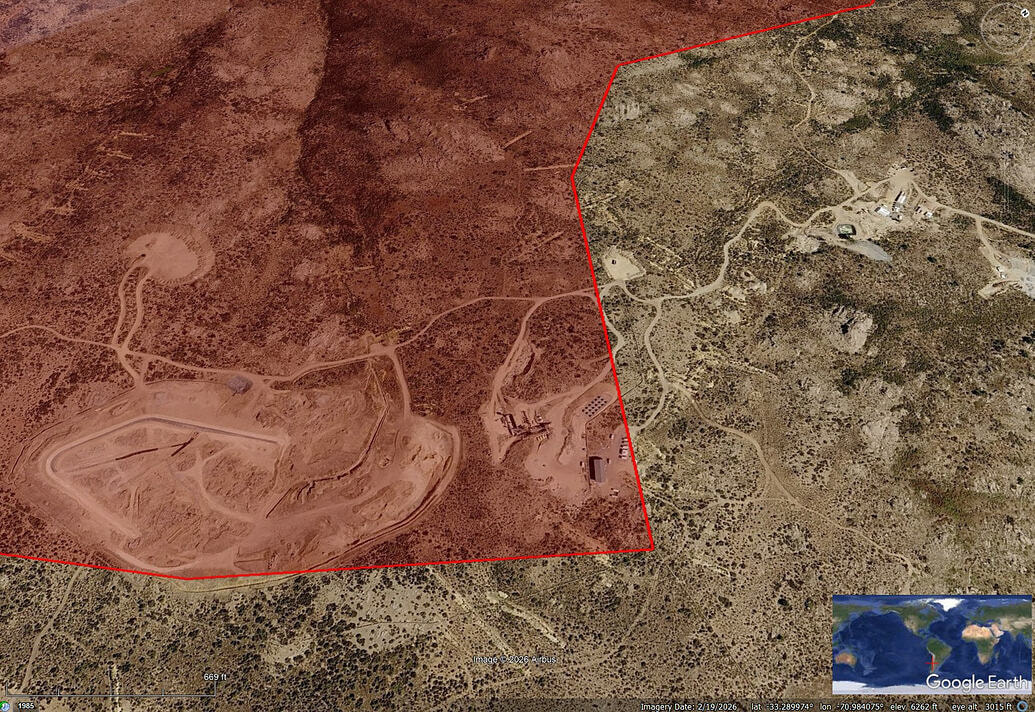
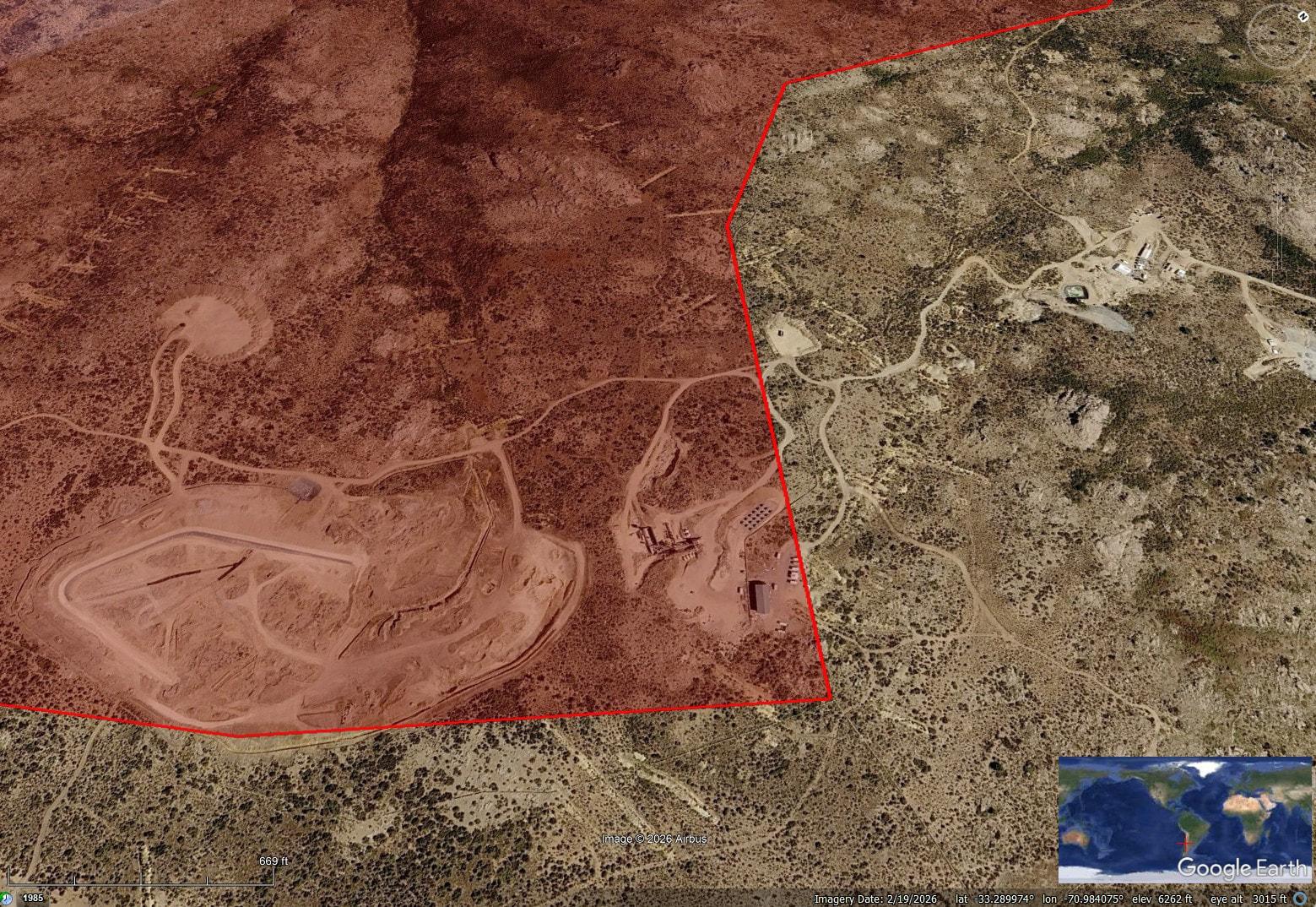
ChatGpt

Based on this image , I do not see any stockpile that visually supports anything close to 60,000 tonnes of ore.

What is visible:

  • A large excavated or terraced area in the lower-left, which looks more like a pit, earthworks, waste dump, leach-pad-type area, or construction excavation than a discrete ore stockpile.
  • A circular cleared pad in the upper-left quadrant.
  • A plant/work area near the center-right edge of the red boundary, with buildings, equipment and several small disturbed pads.
  • A few small mounds or irregular accumulations around the workings, but nothing that stands out as a substantial, organized stockpile.

Why 60,000 tonnes should probably be visible

Depending on broken-rock density, 60,000 tonnes would represent approximately 30,000–40,000 cubic metres of material.

Illustratively:

  • At an average height of 5 metres, it would occupy roughly 6,000–8,000 square metres.
  • At an average height of only 2 metres, it would occupy approximately 15,000–20,000 square metres.
  • A conventional conical or elongated stockpile of that size would normally produce a very noticeable footprint, relief, shadowing and haul-road pattern at this image resolution.

Using the 669-foot scale bar, a 60,000-tonne pile should not look like a minor patch. It would likely be one of the more conspicuous features on the site.

Possible areas someone might try to identify as stockpiles

There are only a few candidates:

  1. The disturbed material surrounding the large lower-left excavation.
    There may be earth or broken rock distributed along the perimeter and benches, but it does not appear to be a discrete ore stockpile. Much of it looks integrated into the excavation or grading.
  2. The grayish mound immediately north of the large excavation.
    This is perhaps the clearest individual mound in the image, but visually it appears far too small to represent 60,000 tonnes.
  3. Small material accumulations around the central processing/work area.
    These appear to be modest in scale—possibly construction aggregate, waste rock, operating material or equipment pads. None appears remotely large enough on its own.
  4. The large circular pad in the northwest.
    It is clearly disturbed ground, but it looks relatively flat. I do not see the shape, height, edge definition or shadows that would ordinarily indicate a large piled inventory.

My conclusion

The image shows evidence of mining-related disturbance and potentially small quantities of stockpiled or displaced material, but I cannot identify:

  • a distinct 60,000-tonne ore stockpile;
  • several smaller piles that plausibly aggregate to 60,000 tonnes; or
  • a broad, low-profile ore pad that is visually obvious enough to substantiate that quantity

Because Enami’s fees were too high. Its like throwing money down the toilet when compared to processing on site. That was the purpose of the Enami vs Plenge analysis.

2 Likes

Enami was crediting them for 57 grams per ton. Hardly “flushable” but, to your point, it clearly wasn’t economic or didn’t exist. Keep in mind, the cutoff grade they used for the Caren mine was 15gpt due to the extremely high transportation costs. When they were acheiving 11gpt it simply wasn’t a viable project but the price of gold was also considerably lower so today’s cutoff would be way lower. Even if they only processed the 28,000 (now 13,000) that they allocated to run through the new plant and even if it were only grading 20GPT, it still would have generated a few million dollars and its not like they are “flushing money” given their expectations of millions upon millions of tonnes. I’m only asking questions (which I don’t have the answers to) on matters that don’t make (common) sense.

There was a reason why regular shipments to Enami didn’t occur over that long stretch of time and that reason must have been that it wasn’t profitable or viable to do so. I can assure you that Maurizio wasn’t thinking "yeah, we can make money now but we can make even more money in five years, let’s just suffer through even more delays and allow me to sink $15M of my personal wealth into the project.

I think that we can alll agree that building a plant was the right decision and dwelling on the past serves little purpose. Unfortunately, the past (example: stockpiles, comparisons to the Lassonde Curve, etc, etc) continues to play a pivotal role in any anaysis of the future. Not to mention, the company’s long history of “fuzzy” and, at times, misleading public diclosures/guidance only appear to be getting worse. Big aspirations with little to no details nor accuracy on timing.

2 Likes

The difference between that and the Peruvian Lab was flushable. Its the equivalent to throwing money away when you can yield substantially higher by installing your own plant. Thats why they went that route. This isnt a difficult concept, im not sure why you are making it one.

4 Likes

Its not at all difficult. What you seem to be missing is that this decision was made on a microcosmically small sample. Nobody makes big decisions based on so little data. You also seem to be missing another point. Even if they were being slighted by Enami, why not process ore in hand if there is so much still in the ground? Opportunity cost, etc. Nonetheless, based on all of the reasons I’ve already laid out. I’m highly skeptical that this stockpile of ore even exists (at anywhere near the quantum described).

How big was the sample?

2 Likes

Well, that’s a trick quesion because, like so many things, they never publicly disclosed the quantum. The only thing they disclosed was that it was an “experimental batch” so you can draw your own conclusion. Or you can look at the historical shipments to Enami for context. Sending a single experimental batch to two labs and making a huge pivot was always what struck me. Either way, you know that they took ore direclty from the vein. Hardly a representative sample of what would be processes through the actual course of mining.

So now MC is flat out lying in public disclosures? I’m all for giving him his credits and criticisms but suggesting that its possible he is downright lying about the stockpile is quite a leap.

I do respect your knowledge and experience in this space and therefore if you are skeptical, it does give me some pause. I would like the company to provide some photos of this enormous stockpile to put to rest any skepticism. If MC is exaggerating or flat out lying about this very important point, it would be catastrophic for the integrity of this investment in my opinion.

Unless I’ve missed something, MC still needs to update shareholders about the planned ‘on-site lab’ mentioned in the OCT 2023 and OCT 2024 Updates. I’m not saying anybody is lying or deliberately deceiving us, I’m just hoping for more recent info.

No worries, no panic — the 2024 Update indicates that they only selected the equipment for the lab at that point. So it’s likely the lab was delayed until the FF Plant was under construction. But now it’s nearly completed. Perhaps they forgot that the lab was briefly mentioned in prior updates. (below) idk, but I’d give them the benefit of the doubt. The barbaric ‘Shoot First, Ask Questions Later’ method only make matters worse.

OCTOBER 2023 UPDATE :
Beginning in October, we will initiate the necessary permitting process for the flotation plant, including all required submissions for plant operations, tailings ponds, and an on-site lab.

OCT 2024 UPDATE :
Geochemical Laboratory : The necessary equipment has been selected to establish an on-site geochemical laboratory, which will be operational before year-end. This lab will facilitate same-day analyses, crucial for exploration and future production control.

1 Like

There is no enormous stockpile. It would be easily visible on aerial photos. (Picture a cone as tall as an 8-story building sitting on a footprint about the size of a football field.) There is a lot of low grade old tailings scattered around the property but I’m skeptical that its adds up to 60,000 or that it is of high enough grade to bother with. They should get enough newer high grade material from the Fortuna to keep the plant running(assuming they get the required permits) indefinitely so I’m not sure it makes any difference.

1 Like

Thank you. Question : can you get more recent satellite photos that would even confirm the referenced 13k tones that have supposedly been mobilized for processing? This would also be very easy to identify.

The gasps of any accusations that MC could possibly be misleading in his public update are comical. The “integrity of this investment??!!” He just put out a press release that failed to mention the mine was (is?) shut down. This is public knowledge. Or, gasp, is the mayor and publicly fined documents lying?

1 Like