Thanks Wizard for your advice/suggestion on how to indicate obscure sentiment. Maybe I should just get you to edit all my posts 
1 Like
There were so many members here that were against editing and the deletion of post that were attacks or off topic we decided to see how well everyone liked the wild west, even at that we have had to calm down and delete some post’s. Kevin has said repeatedly that those post that members do not want to stand will be auto deleted if flagged by three members… We are trying to cut down on what many call censorship, but the censorship has been mostly do to inappropriate posting.
We appreciate everyone’s staying on track… And maybe watch a little football
Go Skin’s!!!
OK flag me that was OT…Lol
3 Likes
From Today’s New York Times (An actual honest-to-god front-page story)
China’s Hunger for Commodities Wanes, and Pain Spreads Among Producers
By Clifford Krauss
January 9, 2016
Chile is expanding its largest open-pit copper mine below the northern desert to dig up 1.7 billion additional tons of minerals, even as metal prices plummet around the globe.
India is building railroad lines that crisscross the country to connect underused coal mines with growing urban populations, threatening to dump more resources into an already glutted market.
Australia is increasing natural gas production by roughly 150 percent over the next four years, as energy companies build half a dozen export terminals to serve dwindling demand.
Across the commodities landscape, this worrisome mismatch mainly traces back to the same source: China.
For years, China voraciously gobbled up all manner of metals, crops and fuels as its economy rapidly expanded. Countries and companies, fueled by cheap debt, aggressively broadened their operations, betting that China’s appetite would grow unabated.
Now everything has changed.
China’s economy is slumping. American companies, struggling to pay their debts as interest rates rise, must keep producing. All the excess is crushing prices, hurting commodity-dependent economies across emerging markets like Brazil and Venezuela and developed countries like Australia and Canada.
The geopolitical and financial consequences of this shift have shaken investor confidence. Concerns over global growth intensified in recent days, when weakness in China prompted a stock sell-off around the world.
The commodities hangover, the dark side of a decade-long boom, could last for a while.
Multibillion-dollar investment decisions made years ago on big projects, like the oil sands fields in Canada and iron ore mines in West Africa, are just getting up and running. Facing huge costs, companies cannot simply shut off projects. So the excess could take years to work through.
The flood of raw materials is pressuring prices, prompting a painful shakeout. Oil companies have laid off an estimated 250,000 workers worldwide. Alpha Natural Resources and other American coal mining companies have filed for bankruptcy protection.
Saudi Arabia, a giant energy economy, has had to tap the credit markets as its financial reserves dwindle. Venezuela, an oil-rich nation that went on a spending spree, is struggling to meet $10 billion in debt obligations this year, since 95 percent of export earnings depend on crude.
Michael Levi, an energy expert at the Council on Foreign Relations, likened the reversal to a rainfall that first relieved a drought but then created a flood. “Producers ended up being their own worst enemies,” he said. “No one ever worried they would produce too much, but that is exactly what has happened and gotten them into this mess.”
Lower energy and material prices are often welcomed by consumers. An energy glut has allowed American households to save hundreds of dollars a year on gasoline and heating oil.
But economists worry that the commodity mess reflects a weakening global economy, lowering the value of trade worldwide and perhaps even pushing some countries into the same kind of deflationary spiral that has hampered the Japanese economy for decades. Global turmoil last summer, stemming from China, prompted the United States to delay raising interest rates until the end of last year.
“Lower oil prices have not proven to be as stimulative as economic theory once had it,” said Daniel Yergin, the energy historian and vice chairman of the IHS consultancy. “The question is what are weak commodity prices telling us: Is it overinvestment in the past, or signaling a weaker global economy forward? My own feeling is the answer is both.”
Commodities have always been subject to booms and busts, rising and falling with the global economy. But China and the cheap debt have changed the equation in some ways.
China’s rapid growth led to an increase in crude oil consumption to 7.5 million barrels a day in 2007, from 5.5 million barrels a day in 2003. It is now the world’s biggest importer of crude, having surpassed the United States. Other commodities have followed a similar pattern.
The increased demand fueled a surge in prices; copper tripled and zinc doubled over the five-year period ending in 2007. Americans and Europeans found themselves in what amounted to a bidding war for products as diversified as gasoline and coffee.
Then the financial crisis hit in 2008. While the global economy faltered, China continued to grow, buying ever more commodities from developing countries. Those economies, in turn, flourished from the infusion of money.
Peru, with its big bounty of copper and other metals, used its newfound riches to expand its middle class, creating a boom in shopping centers and apartment houses in its capital, Lima. Lagos, Nigeria, experienced the same, benefiting from the high price of oil.
The low interest rates, which had been cut to the bone because of the crisis, fueled the boom. The Brazilian energy company Petrobras accumulated $128 billion in debt, doubling its annual borrowing costs over the last three years.
Then the commodity story started to change when Chinese growth slipped.
In 2015, commodity prices had their worst year since the financial crisis and global slowdown. Nickel, iron ore, palladium, platinum and copper all declined by 25 percent or more. Oil prices have declined by more than 60 percent over the last 18 months. Even corn, oat and wheat prices have sunk.
And the commodity slide has continued into this year. At just over $30 a barrel, oil has reached levels not seen in over a decade.
The bust is made all the more pernicious by rising interest rates, as the Federal Reserve changes gears. Companies that took advantage of the cheap debt to increase production are now stuck with a big bill that will be difficult to cover.
Freeport-McMoRan is putting the finishing touches on a $4.6 billion expansion of the Cerro Verde copper mine in Peru, which will triple production. The project is so big that it could consume nearly 10 percent of Peru’s electricity.
With copper prices at their lowest level in seven years, Freeport-McMoRan reported a $3.8 billion loss for the third quarter. The company’s shares have dropped by more than 70 percent over the last year. At the behest of the board, the executive chairman James R. Moffett stepped down at the end of 2015, and the company’s next moves are uncertain.
Although companies are retrenching, they cannot completely retreat. Many new mines, for example, are designed to function at full capacity to keep them operating efficiently. And the sales are necessary to pay the debts incurred to build them.
At particular risk are coal mines in the United States, Australia, Indonesia and elsewhere. Not only is Chinese demand declining, but rising environmental concerns are also hurting their prospects.
“Raw material producers invest according to current prices without realizing how those prices might affect future demand,” said Michael C. Lynch, president of Strategic Energy and Economic Research, a consultancy. “Now that the demand is declining because of high prices, they have too much capacity, and once it’s built, you can’t unbuild it.”
1 Like
I think if everyone would simply treat each others’ posts as the speculation and sharing of potential possibilities that they really are, and maybe even have discussions about such where people don’t take disagreements personally and insult each other, this place would be a lot more pleasant. If I can pull that off with MG’s posts then certainly others can do it!!! 
5 Likes
Thanks Madmen,
Great article! You do not want to be a gigantic major miner that just spent a fortune on a copper project. You can see a niche opening up, however. The desirable projects TODAY have to be LOW COST per ounce or pound of metal produced. This translates into high grade and favorable infrastructure preferably at low elevations. The low costs of drilling, oil products and human resources is there for the taking right now. Near surface deposits will be highly sought after.
You also want a deposit that is POLYMETALLIC. If you’ve got near surface epithermal gold like that at the Caren/Merlin which is holding its own price wise and deeper copper and moly you simply go after the near surface gold first. The Merlin/Caren area is going to keep Masglas busy for a whole lot of years which will give the copper markets a chance to rebound. With interest rates going up you don’t want to be tied to a major with a huge debt burden to service. From a historical perspective this would be a wonderful time to have a large war chest and have first dibs on low elevation Chilean Coast range deposits with no POWER and WATER issues. In an environment like this current one, the key is NEAR SURFACE HIGH GRADE (preferably gold) LOW COST EARLY PRODUCTION OPPORTUNITIES IN GEOPOLITICALLY STABLE AREAS.
The next message we want to hear out of AMC/Masglas has to do with PRODUCTION PLANS. This is synonymous with “WE’RE EXERCISING THE ADL OPTION”. There’s a reason that Medinah stipulated that you at AMC “own” nothing UNTIL you exercise the option. If you crank through the numbers at the Caren/Merlin area and use industry standard cash costs (mining, milling, admin and tranportation) based on the infrastructure present, recoveries, etc. you’ll note that $100 million is NOT going to take very long to recoup if you have 85% of the action. To me, it’s the COMBINATION of the early production opportunities PLUS the you own nada UNTIL you exercise the option clause that suggests that the option exercising is not too far away especially if an exchange listing is coming soon.
We’ve all read the stats that there is a 1-in 1,000 chance that a junior explorer will not only make a large mineral discovery but find a partner to help put it into production. I did a mining class the other day and the lecturer stated that the odds are now closer to 1-in-5,000. This is because of the enormous amounts of hoops and hurdles that need to be negotiated succesfully before going into production. If an exchange listing is sought after it will be more succesful if the project is in PRODUCTION and cash flowing because those hoops and hurdles represent RISKS that have already been mitigated.
3 Likes
It might have very well been common knowledge but it did escape me.
I am glad to learn Mr. MC played such a vital role in salvaging the ADL deal.
1 Like
How many people would buy more mdmn shares this month, if they had the funds to do so??? Regardless of how many shares you already have, or how much you already paid…
https://web.archive.org/web/*/theminingplay.com
You will see the past history that is a good historical reference of where we have been, for the ones that do not know.
Wow… Kirk… I hadn’t thought about him since he quit posting shortly after you offered him the deal that if he left and quit posting you would do the same. Time flies.
I have been buying the last few months only to get my cost basis down some more. Mostly in the .01 range.
I already have bought more.
1 Like
That was me. When you stated “Here’s a small sampling of the comments I’ve received from the good dr. over the past 60 days” I thought you were quoting private emails quotes not public posts. I must have been wrong? They seemed so out of character for BrecciaBoy. But thinking about it now. People do sometimes respond to you from their dark side. 
if you dish it out, expect to take it, remember… Then it’s over.
No reason to rehash it. Some of the stuff i saw here today newleaf, was never published publicly to my knowledge.
Yes, it was all on the board for all to read, we let the two have their say and I was hoping that was the end of it. The west is not as comfortable as many thought, the post has been erased as we don’t need to rehash the past as far as shareholder to shareholder… Time to move on… Thanks
1 Like
Good luck to all the longs who have persevered over the many years. It should be an interesting next few weeks.
4 Likes
There is an archive of all past posts. FYI
3 Likes
Not all- older than 4 months back and forth is no longer on record. I did misread a couple of phrases I was referring to.
Rumors are clear. Auryn news is imminent.Should be a very good week for us. 3 cents appears to be possible especially with no Claro share overhang and if even moderate buying shows up. Next week’s big meetings should continue the momentum going forward.
14 Likes
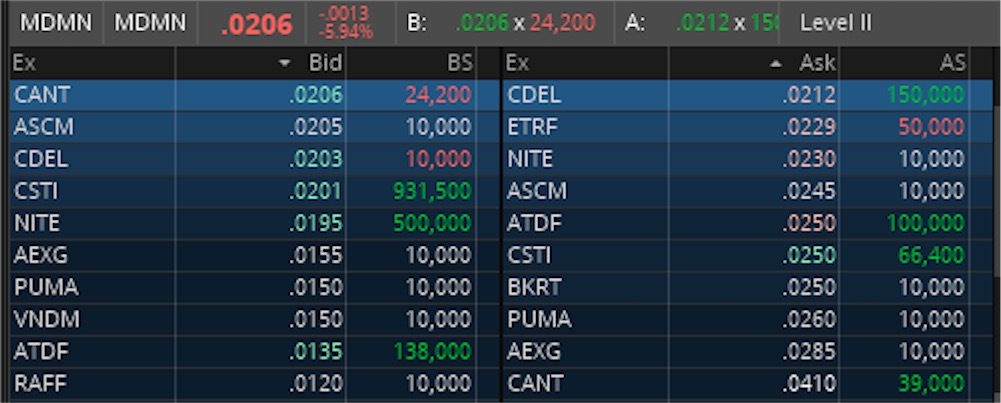
Nice bid support on the low side. I would think that if the news is as imminent as we are told there would be very large buys coming in soon. But of course we usually go down on news. Thats MDMN for you. I would love to eat crow here though.
2 Likes