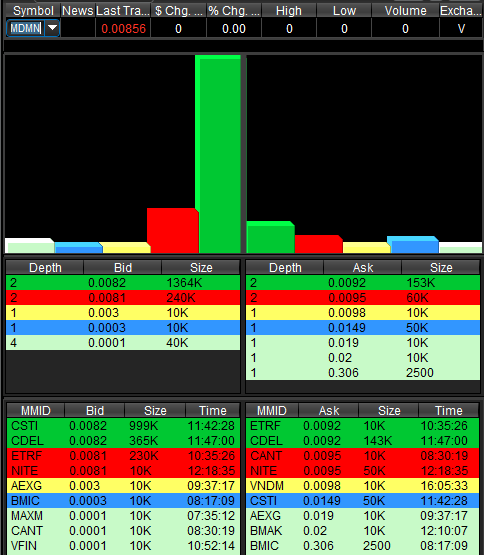
MDMN looks interesting since there are about 3-4 bidders at .0081 and then there appears nothing below them while the ask sits at .0094
1 Like
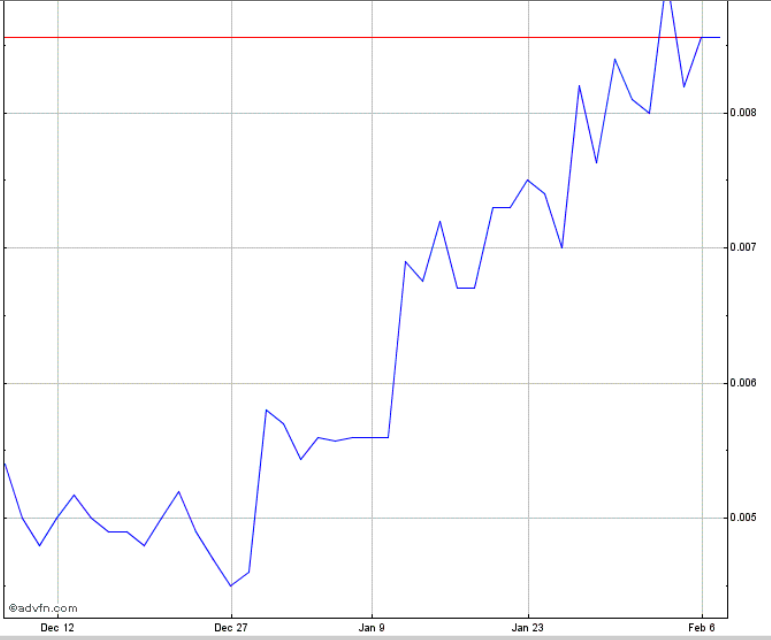
At this time, it looks like those looking to buy below the ask are growing in volume and a small price increase attempting to encourage a seller to come to the bid while on the ask side of the fence a much smaller amount of shares are dangled at the ask hoping for a buyer at the $0.0092. While it sometimes feels like MDMN is setting stagnant, as you look back we can all easily see we have made the turn to the upside. Not every day will be an up day but I’m happy with the recent run of more up’s than down’s. (Thanks Kevin and AURYN)
1 Like
First shipments were sent Dec 26th and results back Jan 13th
The additional 4 truckloads were sent Jan 9
Its Feb 7th and I would think we’re overdue for results of the additional 63.6 tons
1 Like
Hi EZ,
There are some interesting parallels between Mariana’s Hot Maden deposit and Medinah’s “bonanza grade” epithermals found in adit 1 and adit 2. We know that in these low and intermediate sulphidation epithermal systems bonanza grade gold almost always occurs within the vertical zones wherein the hydrothermal fluids were allowed to cool down, depressurize and then “boil”. Boiling provides just the right amount of energy to break the bond between the gold and the sulfur it travels with in solution. The gold tends to concentrate in these zones which average about 300 meters vertically.
We also know that the form of “silicates” found in these boiling zones is a type called chalcedony or chert. You can’t make out individual quartz (a common form of silicate) crystals in these areas like you typically can with quartz at other vertical layers. Instead the silicates like quartz and chalcedony appear “milky” or cryptocrystalline (“hidden crystals”). So if you find milky-like silicates like chert and chalcedony you’re in the right neighborhood to find super high grade gold in this particular type of epithermal system.
At Mariana’s Hot Maden deposit the super high grade gold hangs out with a reddish chalcedony/chert. At the Caren Mine the super high grade gold hangs out with white “milky” chalcedony as seen in adits 1 and 2. Recall that adit 3 never had sampling done like it was done at adit 1 and 2 due to a cave in many years ago. Adit 3 is going to be the “production adit”. The super high grade ore is in adits #1 and even moreso in adit #2 but these are artisanal adits without all of the safety features. I would assume they’re in the permitting process right now to go after adit 2 unless they plan some type of a “block caving” methodology to exploit the high grade ore. Maurizio stated at the informational meeting that they plan on producing from 4 separate adits at the Caren Mine en route to becoming a mid tier gold producer.
3 Likes
What happened to the open pit exploration and production next to Foutuna. The last report from Auryn a few days ago does not indicate to me that major progress has been made there. It sounds like we are essentially where we were during the time of the information meeting Am I missing something?.
Brecciaboy, the last line of your post about Mr. maurizio mentioning becoming a mid- tier producer , is so incredible to my ears . Thanks for highlighting.
Lets not get the cart before the horse. They’re a long long way off from becoming a mid-tier company! Mid tiers you’re talking the likes of Yamana Gold, Alamos Gold, IAMGOLD etc …baby steps boys, simmer down…its a long road
3 Likes
Thanks for that additional information. The Jan 6, 2016 has the following information:
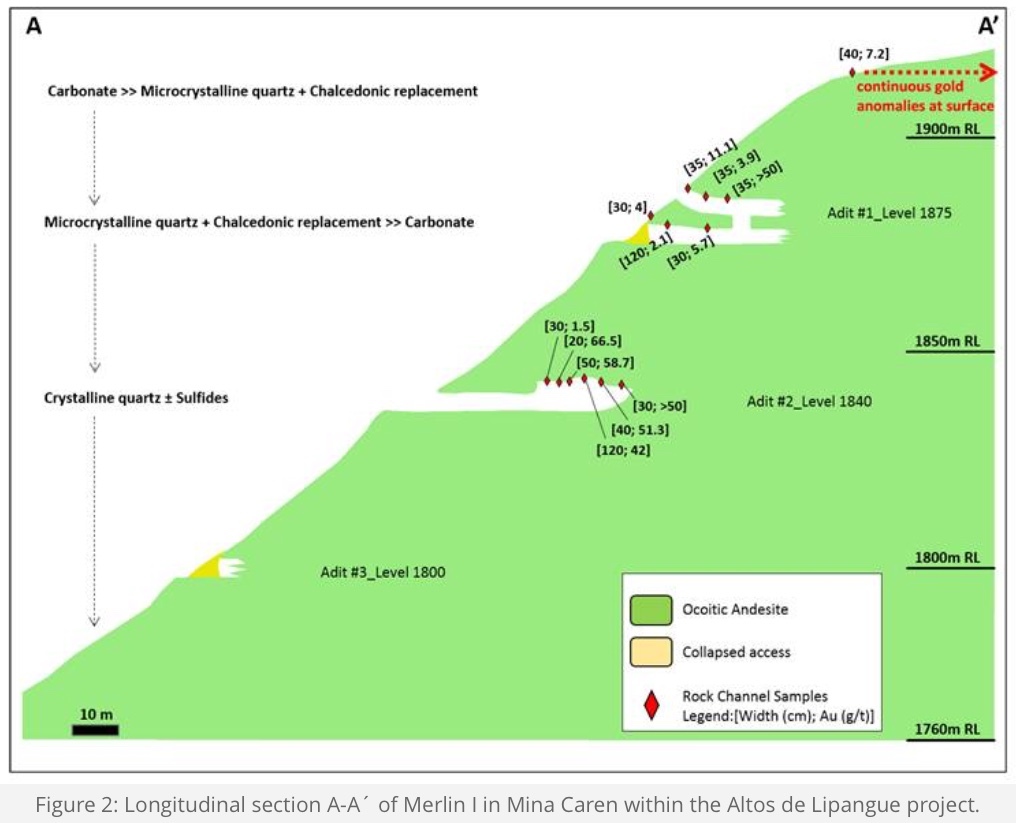
The Mina Caren sector comprises the northern extension of Merlin I vein and there are three old adits exploited in the past by artisanal miners. The old adits allowed AURYN’s geologists to collect samples from different topographic levels over the Merlín I vein. (See Figure 1 & 2)
At meter level 1875 the sampling was difficult because of the collapsed colluvium and dumps over the access, and at meter level 1800 the access was definitely closed. At meter level 1840 it was possible to collect several samples.
Over 15 samples were collected in adit #1, adit #2 and outcrops where it was possible to have safe access. The sampling was executed in different campaigns corroborating bonanza gold grades, (See Table 1).
Discovery of Bonanza Gold Grades at Caren Mine within the Altos de Lipangue Project. - AURYN Mining Chile
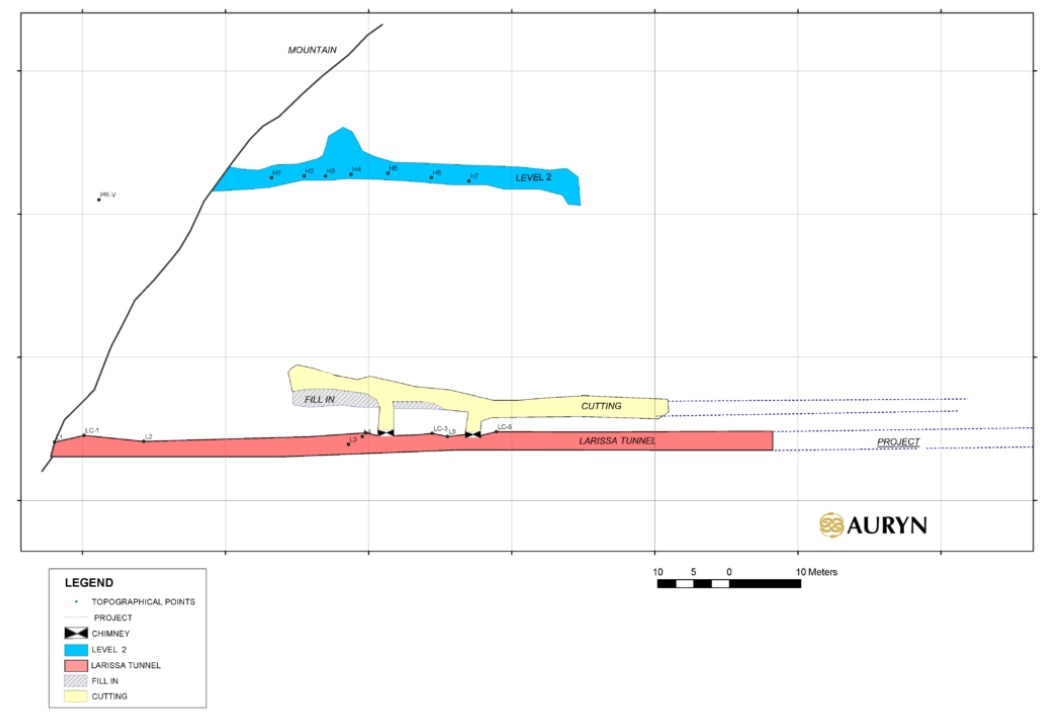
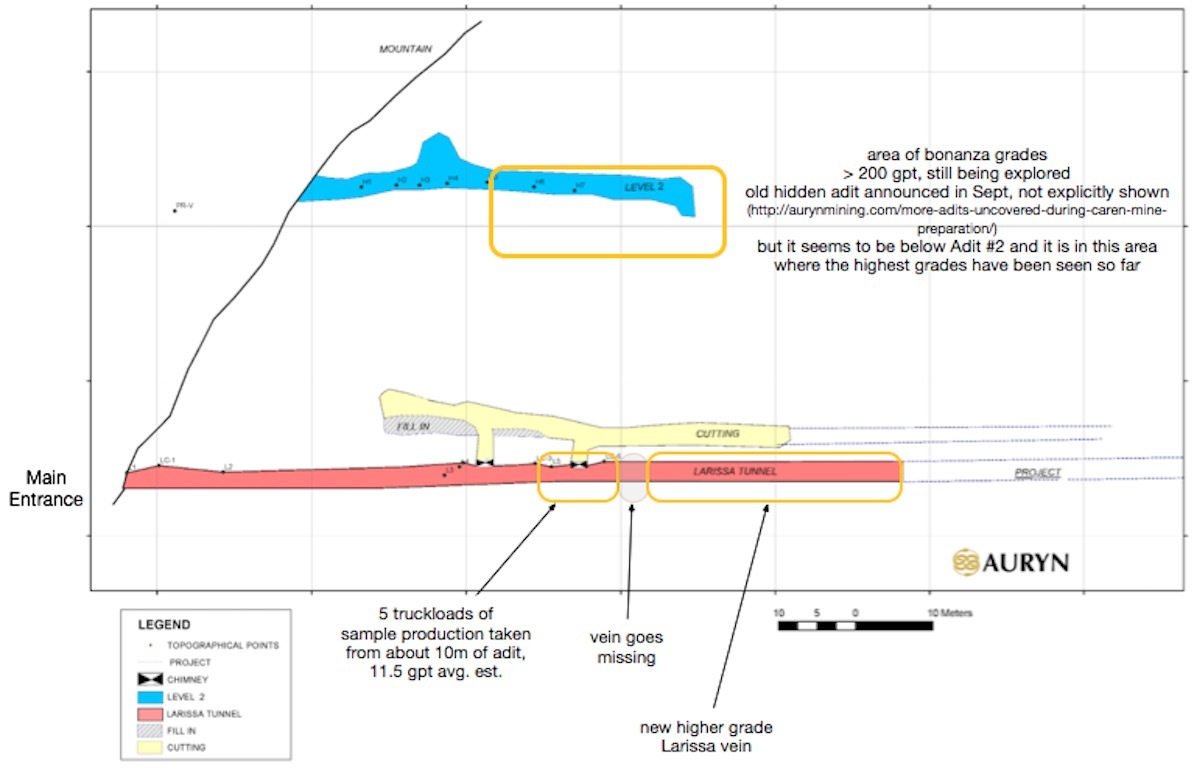
A lot has occurred since Jan 2016 as noted in the recent Jan 30, 2017 update. Level 1800 is the current production level, where as you noted, samples were not previously taken due to the cave in. It is interesting to compare the progress made so far to see where future work is headed up towards the higher grade adits #1 & #2 you highlighted. Eventually, I expect work will progress upwards tracing the vein(s) through these levels. Note that all the current exploitation is occurring at the Adit #3 level through what is called the Larissa Adit as shown in the figure below:
The blue area (level 2 in the above figure) is the recently discovered adit between adit #3 and adit #2 noted in the Sept 1, 2016 update which also mentioned samples were taken. Did we receive the assay results from the samples taken from that newly discovered intermediate artisanal adit? Also, as Dentman mentioned, we are awaiting results from the additional 63.6 tons already shipped.
Auryn mentioned producing 5,000 ounces in 2016 and 25,000 in 2017…we know now that these goals are delayed until we know the grades of all 5 truck loads…on where we sit now is it a realistic goal for them to still produce 25,000 ounces of gold in 2017…I know we will find out more after these next 4 truckloads are assayed but we do have grades from the first truck to figure how many truck loads it will take to meet goals of 25,000 ounces
Don’t worry Elrac , I am not expecting an overnight sensation with MDMN and CDCH , I have already been invested in both for about 17 years. LOL
But I am hoping that the occasional incremental positive recent information that BB and others , especially Kevin, are sharing will instill some much needed investor confidence and which will be eventually reflected in the share prices.
My own feeling is that we are the past few days experiencing a little simmering. Hopefully it continues.
2 Likes
Note:
The 4 truck loads will not tell us much.(1 that was already reported and 4 pending)
“Four additional truckloads containing 63.6 tons of ore from the same section of the vein were sent to ENAMI for processing. The last one was sent on January 9th, 2017 closing out that order. We expect the results will be similar to the first shipment.”
More interesting will be the 42 meter section that they are currently working on:
“It’s reappearance visually appeared to indicate an increased level of mineralization.”
And finally, most interesting will be what they report on Level 2:
“Our speculation is that this vein is not the same vein that we uncovered in September on level 2. The vein on level 2 returned bonanza grades which we reported on at the informational meeting. However, further exploration and analysis is necessary to make a conclusive determination.”
1 Like
Mike,I guess they will continue production during winter ?
Of course. They probably won’t do much field work during the Winter(hence why they are doing it right now) but production will continue unabated. I would think no more than one week or so will be lost during a normal Winter due to bad roads if properly maintained.
Good,at least we won’t have part of the year that nothing is happening.
MG beat me to it, and more concisely, however …
I would contend after re-reading AURYN’s most recent report that perhaps the next 4 truckloads will not accurately predict what the next quarter shipments to ENAMI will deliver or how many truckloads are needed to meet a 25,000 OZ goal this year. Future shipments may be much improved based upon what I infer from the following information and what has been previously released and posted.
Ore was extracted from the Larissa Adit until the LC-6 vicinity. At that point the vein disappeared and reappeared approximately 4m later. It’s reappearance visually appeared to indicate an increased level of mineralization.
We have spent the last two weeks advancing the adit toward the southeast keeping the vein on the east side of the adit. We have left the vein mostly unexposed so that we can define the boundaries of this section of the vein without having to extract, sort, and stockpile the mineralized sections of ore. Every several meters we have been taking samples and verifying that the vein is still on the east side of the adit. Sample results indicate the grades are higher than the test production runs which were sent to ENAMI.
We expect that this intersection extends vertically at least 30 meters in each direction with similar grades and width. Our speculation is that this vein is not the same vein that we uncovered in September on level 2. The vein on level 2 returned bonanza grades which we reported on at the informational meeting. However, further exploration and analysis is necessary to make a conclusive determination.
The level currently under production is some 40 meters below the high grade ore assayed in adit #2. You will recall the present production level was not previously assayed prior to shipments being made. Earlier estimates of production were likely based on the assays made from adits #2 & #1 (edited) that are 40-75 meters above the current production level and somewhat more advanced to the southeast (interior part) within the mountain.
The present area being prepared for production is quite interesting in several respects. It is becoming more vertically aligned with the higher content deposits assayed in Adits #2 & #1 ( edited) and those reported as bonanza grades on level 2. This vein (4 meters advanced past LC6 where the first truckloads to ENAMI were extracted) appears to be higher grade visually than the ore already shipped from the early Larissa level, but is not directly underneath the vein discovered above on level 2 with the bonanza grades. The newer area past LC6 appears to extend 30 meters in each direction. The level 2 vein is is only 20 meters above and does not directly overlay this new section. We will need to see what is next reported from AURYN to know definitively what they are uncovering and what estimates are made for future production.
1 Like
Hi EZ,
The above link directs you to one of the seminal articles on low and high sulfidation epithermal deposits. Geoscientists love to pigeonhole deposit styles into different categories. The Caren Mine and Merlin 1 Vein represent a classic low sulphidation system. Here the veins are narrow but of high grade. The ore within the vein is very well demarcated from the adjacent non-vein host rock. The PH of the rocks and inclusion bodies is neutral.
At the informational meeting, Maurizio described how the ore within the Merlin 1 Vein occurred in what are most often referred to as “lenses” which are analogous to rosary beads held together by a tiny chain. The left side of Figure 1 in this article shows these “beads” or lenses of ore. This might be why the vein appears to “pinch off” periodically like it did in that 4 meter stretch only to reappear later. In 3 dimensions you might actually liken these types of veins with periodic areas of dilation to a sheet of plywood wrapped in “bubble wrap”.
At the ADL, the Cu/Mo porphyry is about 91 million years old but the well preserved low sulphidation epithermal veins rarely exceed 50 million years of age otherwise they would be eroded by now. There is a concept called the “paragenesis” of a deposit. In this case it’s like watching a 91 million year long movie. A lot of these mineralizing events come in “pulses” spread apart by perhaps millions of years. These pulses often share the same “plumbing system” (faults, fissures, cracks, etc.) whose contents remelt periodically when super-heated magma approaches from underneath. This sometimes leads to very rich “ore shoots”.
To complicate matters, sometimes there are late stage “cross-cutting” dikes or veins that are involved. The intersections between older veins and cross-cutting veins are excellent locations for rich concentrations of metals. Sometimes the super heated hydrothermal fluids will encounter the water table and a huge amount of explosivity is induced (phreatomagmatism) leading to billions of tiny veinlets often arranged as “stockworks”.
On the AMC power point deck for the ADL deposit, slides #8 and #12 show an interesting phenomenon. The areas of alteration surrounding the Fortuna Veins is massive in comparison to that surrounding the Merlin 1 Vein. “Low sulphidation” epithermal veins like the Merlin 1 Vein are famous for narrow zones of sericitic (or ilite/smectite clays) alteration as is evidenced there. “High sulphidation” epithermal veins have broader areas of alteration often composed of kaolinate and alunite clays like we see near the Fortuna veins. This is referred to as argillic or advanced argillic alteration. Porphyry deposits are famous for having large areas of argillic or advanced argillic alteration somewhat centered over the porphyry stock. Prospectors love to key in on argillic and advanced argillic alteration. See the link below illustrating how large bodies of advanced argillic alteration tend to inhabit the areas directly above the centralized porphyry stock:
DOC, Thanks again for all the extra detailed information and link.
Trying to simplify the information a little bit from all the previous posts and news releases. Would I be correct in stating that a half dozen or so major parallel veins have been identified and risen from the depths (perhaps 200-300 meters down) all the way to the surface? Interspersed between these are numerous offshoot veins and veinlets, especially at depth that are only accessible and identified upon excavation. There is one additional major vein making it to the surface, Merlin III, that is running primarily EW, whereas most of the other veins making it to the surface are generally parallel running NW or NNW. These were mapped out early on back in Dec 2015. Only adit #3 of Merlin 1 is currently in production.
Now,there’s reverse split rumours, don’t mind it,but at a higher stock price, like when we hit .10 perhaps.
1 Like
This is a death trap for a penny stock and Kevin knows that. When Auryn is profitable and money starts rolling in to Medinah they can buy back the shares. I don’t know where you heard that but I haven’t.
2 Likes