Other Mining Stocks

AG Daily Interval

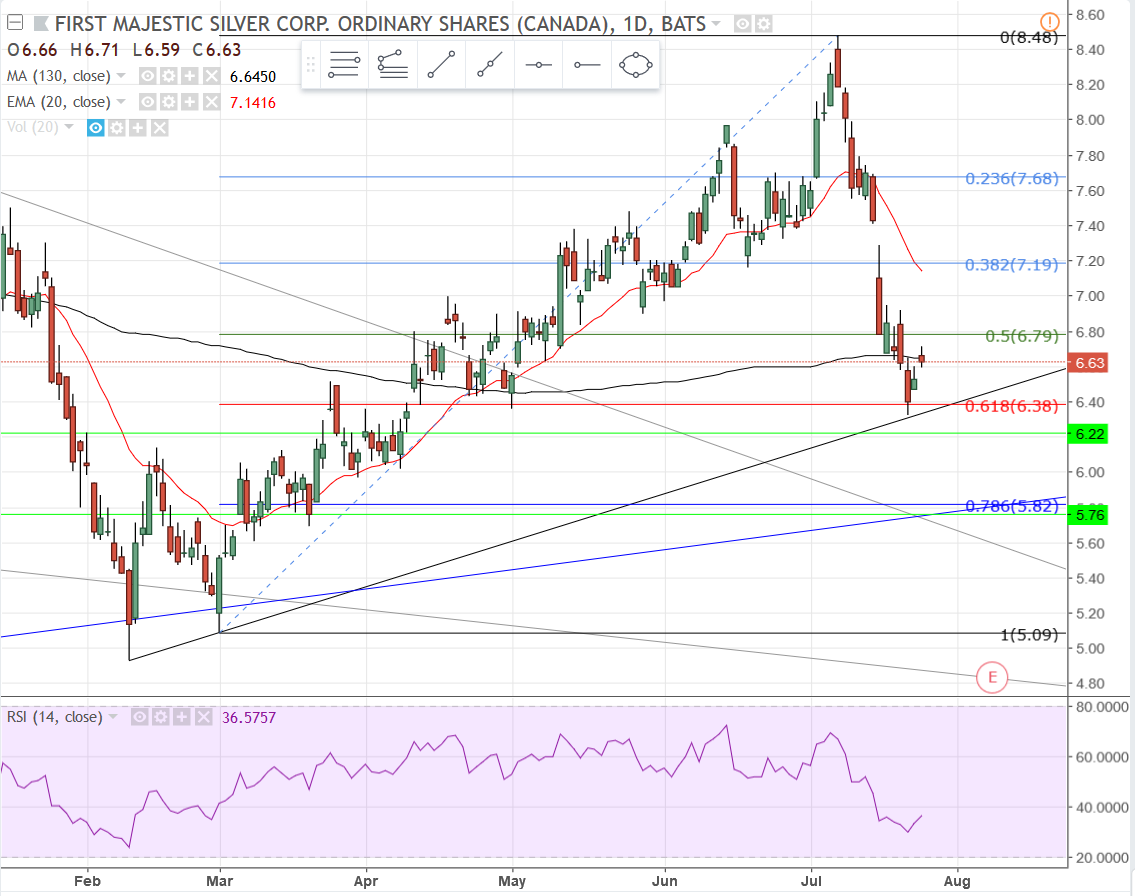
AG has hit the 62% retracement of its last major low of 5.09, as well as tagging the uptrend line. It appears to be making a bear flag, although opening above the 130 MA is a potential positive. It’s also making one of those downward sloping bear flags which causes me to wonder if it’s not setting up for a pop at least to the 20 EMA.

2 Likes

MUX Daily Interval

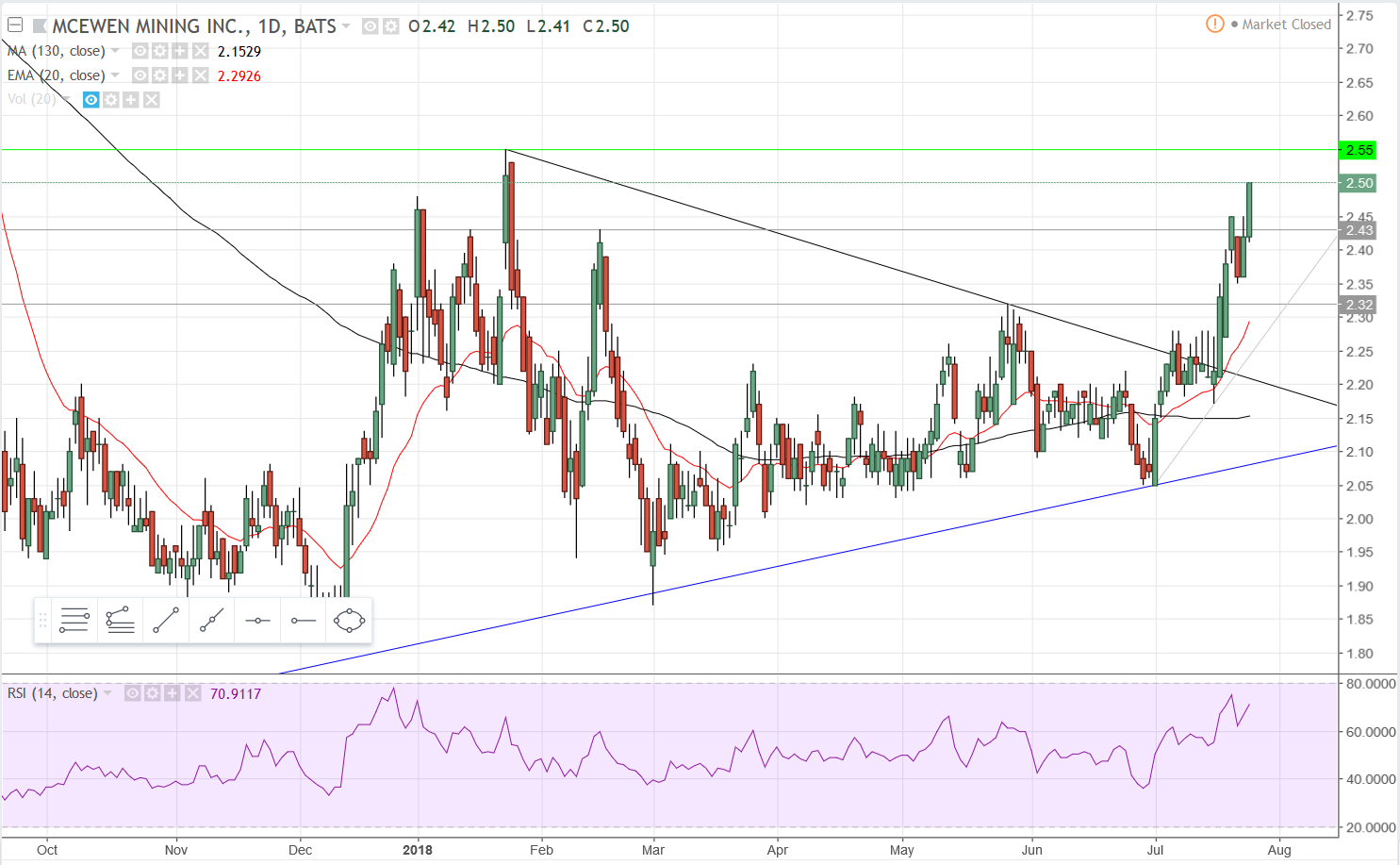
MUX is getting into overbought territory, but there’s a shot it tests the 2.55 high first.

4 Likes

Artemis should hit 16 to 18 cents within the next 2 months. . . percentage wise a real nice gain.

Pilbara (Artemis / Novo) summary research presentation:

1 Like

btw - the fact that Artemis is not mentioned in that report, is ridiculous, imo. There is something about the Sprott / Novo / Canadian gold guys league that holds some type of disdain towards Artemis. I would read it more as background to the very interesting Pilbara conglomerate gold developments then do your own research on Artemis within that context. Disclosure: I am a shareholder.

3 Likes

Thanks Rich…on the GTN graph… I’ve been watching what you post, and getting some what a handle on it day by day
Thanks

MUX

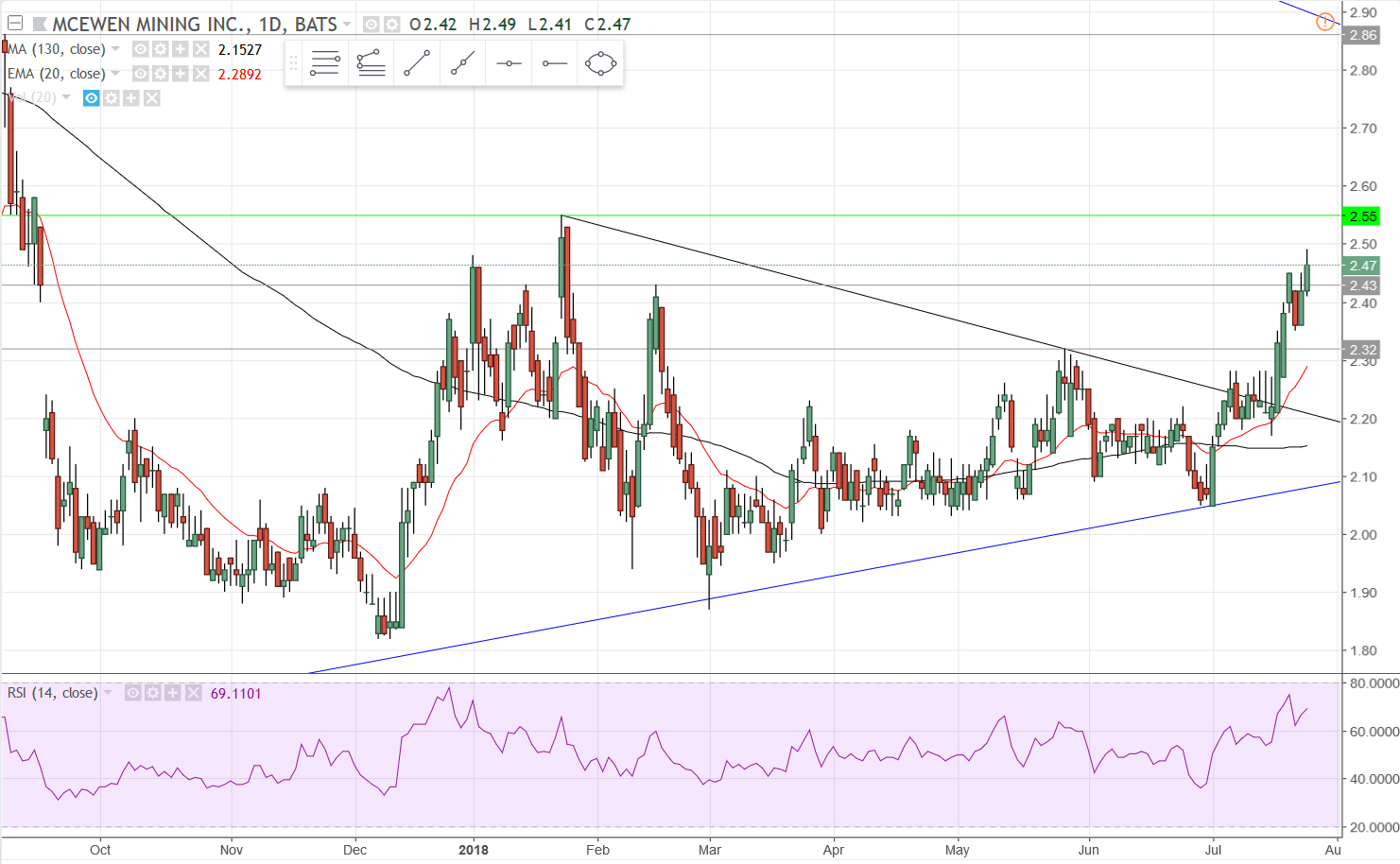
Closed at the 2.50 high today and there’s still a little room on the RSI to test the previous 2.55 high. It’s a pretty steep move so I don’t expect it to go much higher on this run without some pullback. Once it’s clear it has hit a high I’ll throw a Fibonacci on it and we’ll see where it finds support.

3 Likes

No problem CS. I took a look at GTN tonight. Still holding the 14.90 support line, but not much else to discuss yet. When there is I’ll post it.

1 Like

You’re welcome for GBTC and thank you for all of your efforts here. GBTC is interesting because it will also trade at different premiums to the price of BTC, so that’s another factor to consider. I flipped it a few times early on for some nice gains and am currently invested, so I look forward to your analysis.

2 Likes

Thanks Texhorn! Nice to be able to trade it on TDA.

1 Like

I’ve asked Kevin if Rich’s charts could be moved to a new thread.

They’re greatly appreciated RIch (both time and effort) but they are burying the other posts.

Thanks,
Rod

Barkerville drills 11.2 m of 17.56 g/t Au at Cariboo

ISLAND MOUNTAIN INFILL DRILLING INCLUDES 17.56 G/T AU OVER 11.2 METERS ON SHAFT ZONE AND 11.95 G/T AU OVER 22.5 METERS AT MOSQUITO CREEK

Barkerville Gold Mines Ltd. has released additional drilling results from the 50,000-metre 2018 Island Mountain exploration and delineation program at the company’s flagship Cariboo gold project. The infill drilling results continue to demonstrate continuity and expansion of modelled vein corridors at both Shaft Zone and Mosquito Creek.

Recent results include three intersections greater than 100 g/t Au including 105 g/t Au over 0.65 meters in hole IM-18-066, 113 g/t Au over 0.50 meters and 104.5 g/t Au over 1.15 meters in hole IM-18-081. Detailed drilling results, a drill hole location plan map and vertical section are presented at the end of this release.

Selected Drilling Highlights:

IM-18-062: 37.28 g/t Au over 4.30 meters
IM-18-065: 20.79 g/t Au over 8.00 meters
IM-18-066: 10.01 g/t Au over 7.30 meters
IM-18-070: 42.47 g/t Au over 2.20 meters
IM-18-074: 11.95 g/t Au over 22.5 meters
IM-18-081: 32.02 g/t Au over 7.55 meters
IM-18-087: 17.56 g/t Au over 11.20 meters
IM-18-090: 35.77 g/t Au over 6.00 meters

Vein Zone Continuity on Island Mountain

The intervals noted above were intersected in holes designed to infill and expand mineralized vein corridors on Island Mountain down to depths of 500 meters. The program consisted of 50,000 meters drilled in 162 holes in the Shaft Zone and Mosquito Creek on Island Mountain. Vein corridors are defined as a high-density network of mineralized quartz veins within the sandstones. Mineralized quartz veins on the Cariboo Gold Project are overall sub-vertical dip and northeast strike. These corridors have been defined from surface to a vertical depth of 600 meters and remain open for expansion at depth and down plunge. Gold grades are intimately associated with vein-hosted pyrite as well as pyritic, intensely silicified wall rock haloes in close proximity to the veins. A cross section of the vein corridor for IM-18-087 is presented below.

Chris Lodder, President and CEO, comments. “Exploration drill results from Mosquito Creek demonstrate strong potential to extend Island Mountain mineralization to the North West for several kilometers. Presently, exploration and infill drilling is focusing on Cow Mountain where mineralization is open at depth and on strike to the South East towards Barkerville Mountain.”

You know I love your charts and TA Rich, but I think Rod has a good point in that content posts get buried among the chart posts when there are multiple charts posted in succession.

I think all charts related to Bitcoin should be included on the Bitcoin thread to keep that subject matter together.

Charts for other stocks can be kept in the “Other Stocks” thread, because I think people want to see if something interesting is brewing on their stock as far as TA is concerned. But perhaps it would be best to only post when someone specifically requests or if you see a significant buying opportunity or interesting pattern unfolding that you think a novice or casual observer might want to make not of. Keep in mind that you and I and Karl and a few others always like reading the charts, but others might not so much.

Perhaps we can set up a TA thread for commodities and such, or where more active stock charting can be placed.

I think this would strike a good balance of mixing in the charting with the fundamental analysis while still keeping them somewhat separate.

No problem here Rick. I’ll stick to posting charts when requested of stocks that are discussed here. That’ll work best for me.

1 Like

I want to open an account that trades Australian (and Canadian) listed stocks. I am thinking about using Interactive Brokers. Does anyone have experience with them? Or would you recommend another broker that lists Australian and Canadian stocks?

I have an Interactive Brokers account. I like them better than any of the other popular brokers, although their charting isn’t all that great.

Here’s how much they charge for AUD and CAD data which I took right from my account…

Level I (NBBO)

AUD 11.00 / month
Chi-X Australia

Top of book data for Chi-X Australian ECNs.

Level II (Deep Book)

AUD 25.00 / month

ASX Total

Provides depth of book bid/ask/last prices for Australian Stock Exchange listed securities and Options. The major index is the S&P/ASX 200, an index made up of the top 200 shares in the ASX. Examples - AXZ.AX, SPN.AX, ASL.AX

AUD 21.50 / month

ASX24 Commodities and Futures

Provides real time depth of book bid/ask and last prices for Commodities and Futures listed on the SNFE such as the SPI 200.

Level I (NBBO)

USD 20.00 / month

Canadian Exchange Group (TSX/TSXV)

Provides real time top of book data for Canadian listed securities. Available for Non Canadian residents only.

Fee Waived

Canadian Securities Exchange (CSE)

Canadian Securities Exchange (CSE) L1 data. Waived through December 2018.

USD 9.00 / month

Montreal Derivatives

Provides depth of book data for Canadian derivatives - stock options and interest rate futures, as well as index options and futures on the Montreal Exchange. For non-Canada users only

USD 14.00 / month

Toronto Market by Price

Market by Price depth is an end-user service displaying the Toronto Exchange order book with committed, tradeable volume at each bid and ask level. It is a valuable tool for active traders and investors who need to see the prices of larger trades and the size behind the spreads. L2 only. Requires Canadian Exchange Group (TSX/TSXV) for L1

USD 16.00 / month

TSX Venture Market by Price

TSX Venture Level 2 (CL2) is a real-time service for listed junior equities that provides trades, quotes, corporate actions and index information from TSX Venture Exchange. L2 only. Requires Canadian Exchange Group (TSX/TSXV) for L1

The Smart Money is in Pilbara Conglomerate Gold Plays
Investing News Network - July 26th, 2018

Pilbara’s conglomerate gold discoveries may be a test of mining ingenuity but long-term investor confidence remains.

The Pilbara Gold Rush in Western Australia kicked off in July 2017 with Artemis Resources (ASX:ARV) and Canadian joint venture partner Novo Resources’ (TSXV:NVO) discovery of near-surface conglomerate-hosted gold nuggets over impressive strike lengths at Purdy’s Reward.

By November, more than two dozen resource companies had flooded into Pilbara searching for gold. The discovery also caught the attention of major player Kirkland Lake Gold Ltd (TSX:KL, ASX:KLA), which has invested C$56 million into Novo Resources, as well as kingmaker Eric Sprott who has taken up share positions in a number of players in the region.

The Pilbara Gold Rush is well into its first year and although there have been some road bumps along the way, there is still a healthy momentum rolling through that red earth. Resource companies are quickly securing strategic financial partnerships and acquiring land packages in the hopes of hitting pay dirt on the watermelon seed-shaped gold nuggets being likened to the conglomerate gold found in South Africa’s prolific Witwatersrand Basin.

What is conglomerate gold and why is it important?

Sediment-hosted conglomerates, of which Witwatersrand is the most famous example, account for more than half of the world’s gold production. These types of deposits are known to occur in many Archean cratons globally—including those found in Europe and India—resting unconformably over Archean granite-greenstone terrains.

Western Australia’s resource-rich Pilbara region covers more than half a million square kilometers including some of the world’s most ancient rock formations and is most well-known for its world-class iron deposits. However, the latest developments have shown significant potential for new gold-focused districts. The fact that the region remains underexplored despite a well-entrenched mining industry is all the more attractive to majors and juniors alike.

“The Pilbara Region of Western Australia is one of the most resource rich areas in Australia and there has been very little exploration at depth,” said Artemis’ Executive Chairman David Lenigas. “In essence, Western Australia has been spoilt for choice for shallow mineral wealth. It’s time that someone started looking for the source of a lot of mineralisation in the Western Pilbara that has fed the many surface deposits of cobalt, nickel, copper, zinc, gold and PGE’s, within Artemis’ extensive tenement package south of Karratha.”

The crux of the excitement in the region is over the possibility that the Pilbara Craton shares geological DNA with South Africa’s Kaapvaal Craton, home to the Witwatersrand Basin—which hosts the earth’s largest known gold reserves and is responsible for over 40 percent of the gold produced worldwide to date. The Witwatersrand Gold Rush of 1886 was largely responsible for the establishment of Johannesburg, and so important to the economic development of South Africa that the national currency is today known as the Rand.

While there are significant differences in the two systems (including provenance, tectonics and continuity), there are similarities worth exploring, according to a recent presentation by SRK Principle Geologist, Mike Cunningham. Both Pilbara and Witwatersrand sit on top of Archean granite-greenstone basement similar in age and composition, hosting numerous small mesothermal gold deposits (with high-nugget mineralization). In both regions, gold deposition is closely related to the deposition of detrital pyrite, uraninite and carbonaceous matter.

“Is the conglomerate gold in Pilbara real? Yes, of course it is. Can we use Wits as an analogue? Yes. But there are very important differences,” said Cunningham, who also emphasized that “discovery matters.” That is to say that although the deposit model type for Pilbara’s gold system may not be exactly the same as that found in the epic Witwatersrand Basin, it is in fact conglomerate gold and worthy of all the attention now focused on the region.

The challenge of the nugget effect

While the potential for prolific gold production makes the conglomerate type discovery at Purdy’s Reward attractive, the discontinuous distribution of the watermelon seed size nuggets has posed a problem for Novo Resources. Conglomerate gold by nature can display very irregular and patchy distribution, which can result in huge discrepancies even between adjacent drill holes. This discontinuity is what geologists call the ‘nugget effect’. This reality coupled with the fact that samples from conventional drilling are typically small in size often leads to a high level of uncertainty when generating grade estimates for resource blocks.

“The nugget effect for Pilbara gold poses a bit of a challenge, making it difficult to define a mineral resource estimate,” notes Cunningham. “Therefore, it’s hard to encourage money from investors because you need to obviously prove that you’ve got something worthwhile to invest in.” In fact, news of Novo’s first few exploration results fell flat and the market responded with a savage sell-off.

And yet, Novo’s challenge isn’t a reason to call it quits, take your ball and go home. Other resource companies have faced the challenge of nugget effect and won. It’s about being able to think outside the box. In his talk at the RIU Explorers Conference 2018, Cunningham posed the questions: How do we tackle this challenge? Is bulk sampling the answer?

Cunningham uses Inventus Mining’s (TSXV:IVS) Pardo conglomerate-gold host project in Sudbury, Ontario as an example. He points out that after obtaining an average gold grade of 1.34 g/t over 11 diamond drill holes, the company decided to conduct a large 1,000 tonne bulk sampling program which returned an average grade of 4.2 g/t gold.

Recognizing that the best way to advance the their JV project “is to ultimately move it toward large-scale bulk sampling,” Novo and Artemis recently announced a AU$5.4 million exploration program that both companies have referred to as an “important step” toward completing a JORC-compliant resource estimate in order to convert the exploration license to a mining lease and in turn boost investor confidence.

“Novo is at a critical point here with this next bulk sampling program. We’re talking about a new region with a new geology and new way of understanding the right exploration methods to develop an accurate resource model in a district that has the potential to become the next Witwatersrand ,” Jeb Handwerger, long-time gold stock analyst and founder of Gold Stocks Trade, told INN. “We can expect to see some important developments at Novo over the next few months as the complete their bulk sampling.”

Follow the smart money

It’s important that investors understand that when it comes to junior gold exploration, discoveries tend to build high expectations in the market sending share prices up; on the flip side when reality sets in—such as a challenging deposit type—those expectations can cool and settle down a bit until development and production bring another big rise in valuation.

“I understand that the discontinuity and the challenges of the nugget effect are causing some hesitation on the part investors and some of this critique may have truth to it,” said Handwerger. “What has really attracted me to the Pilbara region is the involvement of Eric Sprott and Kirkland Lake, whose shareholders include heavies such as Van Eck, Fidelity and Oppenheimer. This is an early-stage discovery, but the involvement of a company like Kirkland Lake—which has been one of the top gold mining stories in recent years—speaks highly of its potential.”

Kirkland chairman Eric Sprott is also a major shareholder in Novo Resources. Following the release of Novo’s first bulk sampling results from the Comet Well area of the project in May 2018, Sprott purchased 47,900 shares of Novo stock at an average cost of C$4.72 per share, for a total transaction of C$226,088.00.

Other players in the region with Sprott’s confidence
Pacton Gold (TSXV:PAC; US:PACXF) controls the third largest land package in the Pilbara region following a round of acquisitions of several projects located between the properties of Novo Resources and De Grey Mining. Pacton’s expanding portfolio includes properties known to host gold nuggets as well as several existing mining leases which provide the potential for immediate large-scale bulk sampling programs. The company’s most recent purchase is the Bellary Dome project from Marindi Metals (ASX:MZN) from which nuggets similar to those discovered by Novo have been recovered. The significance of Pacton’s land holdings has attracted the investment of Eric Sprott who holds 10.1 percent of the outstanding common shares in the company.

De Grey Mining (ASX:DEG) recently received a $5 million investment from DGO Gold (ASX:DGO) to advance exploration and pre-feasibility work at its Pilbara gold property. The project is unique for the area in that it has an established resource of more than 1.2 million ounces of conventional gold, with upside coming from its most advanced conglomerate prospects on the property (Loudens Patch, Jarret Well and Steel Well) which it plans to bulk-sample as well. About 100 kilometers east of Purdy’s Reward, the Loudens Patch alone has yielded more than 200 gold nuggets. Kirkland Lake has invested A$5million in De Grey.

Kairos Minerals’ (ASX:KAI) Pilbara gold project hosts the conventional Mt York deposit and recently reported an updated JORC resource estimate of 643,000 ounces of gold for the project. Kairos also holds 1,158 square kilometres of tenure which is highly prospective for conglomerate-hosted gold. Kirkland has invested $5million in Kairos.

The takeaway

The Pilbara Gold Rush is still in its infancy and the deposit type is not as yet understood, so challenges are to be expected. The geology may not be an exact replica of the prolific gold fields of South Africa’s Witwatersrand, yet all the signs are there that Pilbara has the potential to become a significant gold district in its own right.

https://investingnews.com/daily/resource-investing/precious-metals-investing/gold-investing/pilbara-conglomerate-gold-rush-nugget/
2 Likes

BTW, my current focus is on investing in companies exploiting the Pilbara region of Australia. Novo, Artemis et al. I think there is some serious opportunity there and I’m following the smart money.

2 Likes

If you listen to Eric Sprott’s Friday afternoon weekly wrap update interviews with Craig Hemke (a sprott production so you get some advertisements) (https://www.sprottmoney.com/blog/category/sm-radio.html), Eric is on there most weeks and for the past six months or so he has become accustomed to giving Pilbara updates, not every week, but many weeks. He is Chairman of Kirkland Lake which owns almost 20% of Novo, and he personally owns some Novo and other small Pilbara players. He also seems to know or even be friends with Quentin Henningh, the CEO of Novo and the geologist that kicked this whole thing off.

He has traveled to Australia multiple times and come back and made remarks and often refers to QH interviews etc. when they come out. Worth the Friday afternoon 10 or 15 minutes if you are interested in this play.

3 Likes

Insider Filings

Latest SEDI filings for NVO within the last 6 months
Amended Filing

As of 11:59pm ET July 26th, 2018

Jul 18/18 Jul 13/18 Sprott, Eric S. Direct Ownership Common Shares 54 - Exercise of warrants 1,176,471 $1.25

Jul 18/18 Jul 13/18 Sprott, Eric S. Direct Ownership Warrants 54 - Exercise of warrants -1,176,471 $1.25

Jul 16/18 Jul 11/18 2176423 Ontario Ltd. Direct Ownership Common Shares 10 - Acquisition in the public market 28,900 $4.15

Jul 16/18 Jul 11/18 Sprott, Eric S. Indirect Ownership Common Shares 10 - Acquisition in the public market 28,900 $4.15

Jul 11/18 Jul 4/18 2176423 Ontario Ltd. Direct Ownership Common Shares 10 - Acquisition in the public market 9,200 $4.15

Jul 11/18 Jul 4/18 Sprott, Eric S. Indirect Ownership Common Shares 10 - Acquisition in the public market 9,200 $4.15

Jun 19/18 Jun 14/18 2176423 Ontario Ltd. Direct Ownership Common Shares 10 - Acquisition in the public market 61,900 $4.15

Jun 19/18 Jun 14/18 Sprott, Eric S. Indirect Ownership Common Shares 10 - Acquisition in the public market 61,900 $4.15

Jun 15/18 Jun 12/18 2176423 Ontario Ltd. Direct Ownership Common Shares 10 - Acquisition in the public market 232,200 $4.49

Jun 15/18 Jun 12/18 Sprott, Eric S.