Auryn/Medinah 2026 1st half General Discussion

Its essentially a shell. They walked the share price up with very little volume to accomodate a reverse merger of 45% of Maurizio’s Columbian assets (EGM Columbia). Expect another 550M shares issued to acquire 100%. Maurizio has been looking for a public vehicle to absorb his private assets. Way easier than a public listing. At one point, IMO, AUMC was going to be the vehicle. The AMNP “shell” is a bit different in that it has the Pricessa Lara project in it (which nobody knows anything about). Next thing you know there’s going to be 2 billion shares out but nobody, beyond insiders (and now Glencore) owns it. Don’t expect to see much volume. Sounds a lot like the AUMC’s 7 billion shares before they reverse split 100 to 1. Its a very similar game plan.

I certainly wouldn’t agree with Mike in thinking that an offtake for AUMC with Glencore is next, given its small scale, but the odds increased. I would have assumed the Glencore offtake was with EGM not Lara. Maybe they already have one on EGM? It baffles me how these companies refuse to provide any details to these critical financings. What are the terms of the offtake beyond life of mine??

The positive spin, for anyone who actually owns AMNP (like MDMN) is that Glencore was willing to invest at a $200M valuation. At least that points to some sort of actual price discovery even though Glencore does enters these equity investments in exchange for landing the offtake (vs an ROI on the shares). Problem being that doesn’t mean much to the share price (14 cents) when billions of shares come into the float.

It wouldn’t be the first time I’m wrong about something but Glencore and Maurizio should be able to work out a mutually beneficially agreement for Auryn’s concentrates sooner rather than later. All of this should help to accelerate development on the mtn.

Still, let’s not get ahead of ourselves. Patiently waiting for an announcement that production has commenced.

2 Likes

As is the case with AUMC announcements, this announcement regarding the investment by Glencore is lacking significant information for the investing public. There are still nearly a billion shares unissued (46%). There is no way Glencore would be locking in their ownership percentage without knowing what the unissued shares were going to be issued for. Yet, we, the investing public have no clue what they will be issued for. They are interpolating that a $10million investment equates to a $200million market value with nearly half the authorized shares still not issued. Insiders get the details the rest of us get to guess!

1 Like

Hi Mike,

What I find appealing is that, to my knowledge, Auryn did NOT enter into a plain vanilla offtake agreement with an offtake partner prior to the “SMELTER CRISIS”. I’m going to guess that they are sitting in a very strong negotiating position especially if Maurizio is willing to aim the concentrate production from ALL of these mines he’s in the middle of putting into concentrate production, to the same offtake partner i.e. Glencore.

Glencore has a distinct pattern of buying $10 to $20 million worth of shares of the mining entity that they enter into an offtake agreement with. It would be ideal if any “MARKET RE-RATE” associated with Auryn officially going into extremely high-grade production (any day now), would occur BEFORE Auryn agrees to the terms of any share purchases by Glencore. My assumption is that if Maurizio promises to aim the “concentrate” being produced at the various mines he is now putting into production to one specific offtake partner, then he could negotiate a stronger deal for all of these new producers like EGM, American Sierra and their 45% owned Eagle Mine and their 100% owned Princessa Lara Mine, Auryn and their 100% owned Fortuna Mine, and soon their 100% owned Caren Mine, etc.

Maurizio worked extremely hard in keeping Auryn’s number of shares outstanding at 70 million shares. He didn’t sell one Auryn share to an outside investor but instead volunteered to advance all of the cash needed to make it into production while charging zero interest.

Imagine what Glencore might be paying if they had to go to the open market and buy $10 million to $20 million worth of “AUMC” shares out of the open market. I’m glad that Auryn hasn’t cut a deal with Glencore as of yet, although I do see it as being inevitable. Auryn’s Fortuna Mine will be in production well before American Sierra’s Princessa Lara goes into production (in late 2026) and Glencore has already cut a deal with American Sierra to act as the offtake partner for the P. Lara Mine.

Between the current “smelter crisis” and Auryn’s Fortuna Mine just now going into production, I think that Auryn would be in a pretty strong negotiating position. The Chinese are very aggressively going after the new producers of “concentrates” in Western Africa and South America as long as they’re not already engaged in a long term offtake agreement with another party.

The financial metric that Auryn is going to have to show off to potential investors is GOLD OUNCES PRODUCED PER SHARE OUTSTANDING. If Auryn can produce 10,000 ounces in Year #1 of full production, that ratio would be one ounce per 7,000 shares outstanding which is off the charts. The all-important EARNINGS PER SHARE will be extremely robust with a $4,700 price of gold and an AISC of somewhere around perhaps $1,250. In the history of mining, not many miners have been able to have profit margins of somewhere around $3,450 per ounce produced.

FULL DISCLOSURE: I am a huge fan of American Sierra (AMNP) and I continue to accumulate shares, but even their GOLD OUNCES PRODUCED PER SHARE OUTSTANDING ratio is about one per 95,000 (versus AUMC with one per 7,000). That one per 95,000 comes from AMNP’s 45% of EGM’s annual production of 20,000 ounces or 9,000 ounces plus I have the P. Lara penciled in at producing 12,000 ounces per year starting later in 2026. 21,000 ounces per 2 billion shares outstanding equals about one in 95,000. American Sierra, however, has $10 million in the coffers TODAY and will add another $10 million if Glencore exercises their option.

American Sierra’s deal with Glencore makes all of the Maurizio-related companies i.e. Auryn, Medinah, EGM, American Sierra, Masglas, etc. much stronger and it enhances the credibility of all of them. That deal can serve as a CATALYST for all of these other companies and their endeavors. With that cash in hand, American Sierra will be in a position to pay for its pro rata share of any efforts to ramp up production. This represents a “WIN-WIN” for both Glencore and American Sierra. For a company like American Sierra, or EGM, or Auryn/Medinah, it’s wonderful to have a powerhouse like Glencore sharing a financial incentive to make these companies successful.
5 Likes

Somehow this statement does not suprise me. You have a company (AMNP) that just completely blew out their capital structure, on their way to having 2 Billion (!!!) shares outstanding. The stock trades by appointment (read: no volume). The only price discovery would be the price that Glencore paid which has no relevancy as they pay little to no attention to valuation as there only focus is locking companies into lifelong offtake agreements. You have no way to value the EGM assets besides guidance for 20koz of production this year. You have no idea but have to assume that another 500M+ shares will used to buy the remaining 55%. You have no way to value and no information on the Pricessa Lara outside of their guidance of producing 12,000 ounces this year. There has been zero dislcosure on the terms of the offtake agreement. …AND the stock is flat on $20k of volume over a 48 hour period where the company announced this “momentus” deal (yes, I know, the market just doesn’t get it).

Buying shares in AMNP is analagous to throwing darts at clouds while blindfolded but “you are a huge fan.” I’d love to see the analysis behind this investment thesis.

1 Like

I would agree that the probability of streeeetching the Larissa offtake across to AUMC has increased. Given proximity. One has to wonder, given that AUMC is 6+ months closer to production vs. Larissa, why Maurizio didn’t already land that offtake. If this was an invetibability it logicaly should have preceded Larissa but we admittedly know next to nothing about that asset. Glencore prioritizes sulphides over oxides (as an example), and rarely enters offtakes without 10koz+ of production (which is still considerably lower vs a few years ago). Lots of possible factors.

I assume EGM is already locked into an offtake with Glencore. Only question will be if AUMC can produce the volume to warrant an offtake. To be clear, there is ZERO smelting crisis outside of Copper and Aluminum. AUMC, EGM and Larissa are not producing a copper concentrate so the theory that there is leverage is misplaced. It would have been helpful to actually see the headline terms (the granular details are rarely disclosed) of the Larissa offtake. Glencore ain’t a nonprofit and is known for taking their pound of flesh but, admittedly, their terms have softened up a bit. With these types of projects (EGM, Larissa), where its extremely difficult to land financing, this type of equity/offtake hybrid financing is often the best option.

Ahhhhh The company that keeps us shareholders always asking questions instead of getting transparency. Where’s our update that we were supposed to get over a month ago??

2 Likes

This doesn’t seem easily reachable until Auryn receives its 3000 tons per month permit. After that permit is received, it can easily meet 10k ounces per year at even less 10 g/t. The main bottleneck is running the mill at full capacity. If that can be attained, [(360,000 gm/yr) / 31.1 gm/oz] = 11,575 oz/yr. What measures do you see that can presort ore for debulking before running it in the mill?

Aren’t gravitational measures highly effective and standard industrial practice for removing coarse gold before the flotation mill. This enriches the overall yield immensely. In fact, from what I see in many operations (such as Banyan Gold) removing coarse gold early via gravity recovery is considered mandatory in most gold circuits.

EM

2 Likes

Easy,

I should add that they don’t have to run all the ore through the flotation plant. At current metal prices, they likely could remove some of the higher grade material by truck for offsite processing bypassing the floatation plant bottleneck. We don’t know how much material they have that it would make sense to process offsite but we do know that they have years worth of low grade material for the floatation plant already. So yes, 10,000 ounces might be reachable but with significant uncertainty of course.

3 Likes

Hi Mike and EZ,

With “over 60,000 Tonnes already stockpiled and separated by grade”, I’m not too concerned with the date at which the 3,000 TPM permit upgrade kicks in at the “NE drift”. Recall a while back when 3 consecutive quarterly updates noted how Auryn was mining in a somewhat surgical fashion “WITH MINIMAL DILUTION BY USING JACK-LEG/PERCUSSION HAMMERS”. Then on 3/30/24 they said that while mining in that fashion, they were averaging the same grades as they received on the Enami smelter tests which was 70 gpt “gold equivalent”. This smelter test involved a sample size of 2,200 pounds or 1 Metric Tonne.

The breakdown was 57 gpt gold, 978 gpt silver and 3.23% copper. After receiving these results, they sent a second sample for smelter testing at the Plenge Lab in Lima, Peru. This would provide them with a “second opinion”. Plenge only assayed the gold component and it came back at 128 gpt gold JUST FOR THE GOLD COMPONENT. This is when the BOD of Auryn essentially “fired” Enami and unanimously decided to froth float their own ore on site. S0, a certain percentage of the 60,000 Tonnes of ore “already stockpiled and separated by grade” is going to average around 70 gpt “gold equivalent”. Unfortunately, we don’t know what that percentage is but it is at least “270 days worth” of production. It makes sense that if you’re temporarily restricted to 100 Tonnes per month of intra-adit production, you might as well do a good job and make every tonne as high of a grade as possible. You have plenty of time.

Fortunately, the granodiorite host rock doesn’t look at all like the vein ore and “pre-sorting” can be done prior to the primary crusher (a jaw crusher). Nowadays, you can put a hand-held infrared scanner (a “PIMA”)onto a rock sample and it will tell you which metals are present. In some quarterly updates, Auryn refers to ore samples as not having been “prepared” yet. I’m assuming this refers to the sample as not having been “pre-sorted” yet. Management also put in an electromagnet which also does “sorting”. The ferromagnetic material, usually magnetite or Fe3O4, gets separated from the nonmagnetic material.

Recall that the artisanal miners averaged 64 gpt gold in the material they shipped to Enami from 1940 to 1970. This suggests to me that “pre-sorting” can be pretty effective with this ore. Granodiorite is really boring looking. You have blotches of blackish material (biotite and horneblende) surrounding blotches of whitish material (quartz, potassium feldspar and orthoclase). It looks a lot like a granite countertop or a granite tombstone. If you wet the material when its outside of the adit, the differential is even clearer. While it is true that management stated in its 10/30/24 release that when they are not able to mine the ore in a “WITH MINIMAL DILUTION” fashion (when the veins are skinny), we should only expect grades of “AT LEAST 10 GPT GOLD”, I’m staying wide open to upside surprises with the grades.

As far as the throughput rates, don’t forget that the plan is to open up the Caren Mine area soon (Merlin 1 Vein) mining from the surface downwards. A spiral decline is planned for the southern part of the vein and a straight “decline” is planned for the northern aspects of the vein. The surface trenching of the Merlin 1 Vein averaged over 26.9 gpt gold RIGHT AT THE VERY SURFACE. That’s insanely rich. This analysis used “volume weighting” which makes it super accurate. This ore has already been tested with “gravitational” methodologies (as opposed to froth flotation). The testing was done with the “Sepro/Falconer” system. The recovery rates were over 90%. This suggests that Auryn is going to go with an “oxide circuit”, especially for the Merlin 1 Vein near surface ore. The oxide circuit is usually located right next door to the flotation equipment. The throughput would then be the arithmetic sum of the FF plant throughput and the oxide circuit throughput. Oxide ore tends to be more coarse and amenable to low-cost gravitational methodologies like centriguges, shaker tables, etc.

An intra-adit production rate of 3,000 Tonnes per month will keep a 100TPD FF plant plenty busy. That 60-plus tonnes of ore “already stockpiled and separated by grade” will allow Auryn to process the highest grade ore first, whether it be freshly mined or stockpiled earlier. Previous press releases suggest that Auryn could be Ok to mine 6,000 TPD (3,000 from the NE drift and 3,000 from the Caren) in the not too distant future. This tells me that the plan is to crank up the throughput rate sooner than later. Oxide circuits can do this or “bolt on”/modular additions to the FF plant (“flotation columns” or additional “rougher, cleaner, and scavenger” additions). Miners regularly blow right through the “nominal throughput rates” set by the manufacturers. The fact that the Auryn miners have already stockpiled “over 60,000 tonnes of ore” suggests that they are not finding the mining process to be too complicated. What all of that stockpiled ore is going to do is to constantly put upward pressure on the AVERAGE HEAD GRADE sent to the primary crusher.

5 Likes

I like your entire analysis BB, especially the part about once the additional Merlin permit comes through. As you know, gravitational methods capture the free gold as soon as it is liberated from the rock without over-grinding it. There was free milling gold found in abundance near surface and in the adits of the Merlin. The coarsely crushed ore containing this free milling gold is fed into advanced spinning bowl concentrators, such as Knelson or Falcon concentrators. I mentioned in previous posts Banyan Gold integrated a gravity circuit into the mill flow sheet ahead of the flotation and Carbon-in-Leach systems and recovered over half of its gold up front. They were obtaining 53% from their gravity circuit and achieved 93% total recoveries. There are multiple possibilities for advancing higher recoveries than many presently realize.

EM

3 Likes

The understatement of the century

Only on this forum could folks start speculating on increasing capacity on a plant that’s already a year late and another several months late, since the last update(!), in commissioning.

Its not difficult to calcuate the “freshly mined rock” as a percentage of the supposed 60kt stockpile. This topic can be found in the archives. There was nowhere near 270 days of mining. Lots of starts and stops along with a considerable period of care and maintenance (unknownst to many until the company was forced to update). I have no idea if or how there is actualy 60kt of stockpile ore but speculating on grade or assuming a significant portion is coming from the vein and/or “fresh mining” defies logic. CHG’s post from several years ago does an excellent job explaining why:

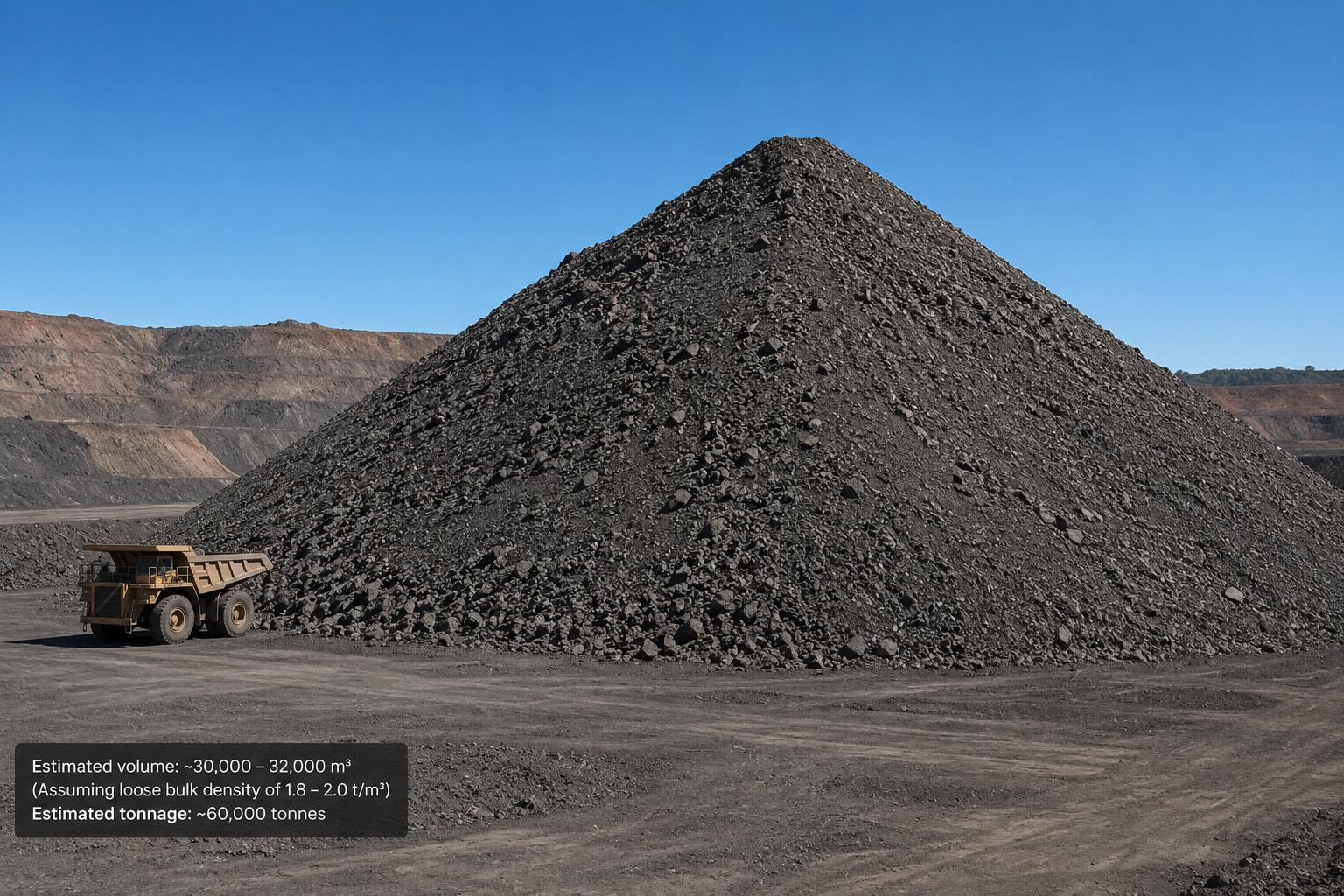
As a side note: based on all of the aerial views we all have seen and their proximity at the top of a mountain, where are they hiding these tailings. If you ask AI to provide a visual of 60,000 tonnes of stockpiled ore you get something along these lines. Maybe we are confusing a giant mountain top for a pile of stockpiled gold? And imagine sorting out that much ore into different grades.

2 Likes

Baldy,

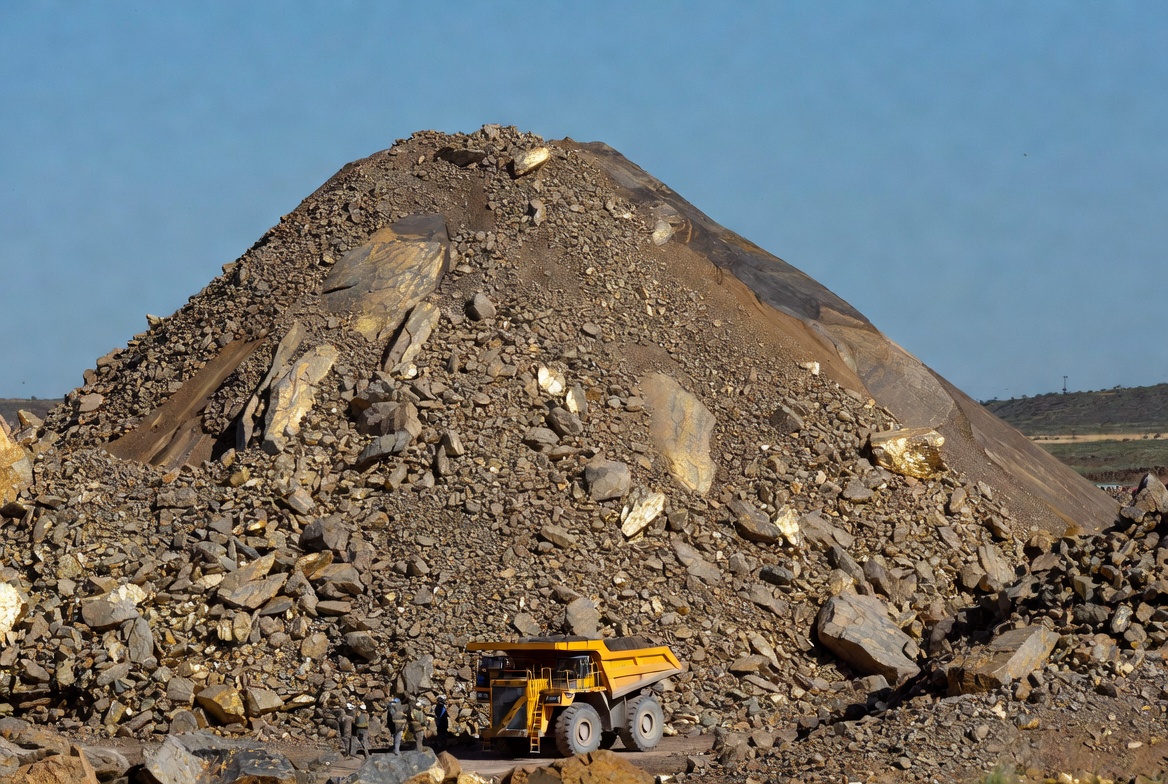
If Medinah started working on the pile 11 years ago when they full acquired the Alto, and working on it steady for 11 years, this shows how much they would need to mine each month. A little more reasonable! :slight_smile: (I actually think it would only be 185 cubic meters of rock.)

4 Likes

It appears that this pile of ore (pictured) includes rocks/boulders large enough to crush that haulage truck, which likely has a capacity of 30 to 150 tons. Any guess how much those big rocks weigh?

“Still, let’s not get ahead of ourselves. Patiently waiting for an announcement that production has commenced.”

Agreed.

But if I had to add my speculation: The Glencore thing is not about the small Peruvian or ADL gold production. It is more likely, imo, a cheap way in, to control a potential long term copper asset. I will mention again as I have for several years that Glencore was the initial big investor in Hot Chili Lmtd. up the coast of Chili and has financially shepherded that project for quite a few years now along with local Chilean entities to where production is a probable 2030 target. This is a lower grade coastal play by Glencore which required higher than $4 copper to make it work. They funded the studies, guided the financing and exploration etc. Now copper is $6+ and the 0.75% and 1% copper deposit makes more sense. The ADL is much farther behind and much much less defined (HCL has something like 200,000m of drilling done to date).

If you look out 15 or 20 years, copper has to go to $10 or $15 / lb to pay for many new deposits to come online which are no longer the 2% deposits of 20 years ago. The 0.5% and 0.75% deposits, which are all that is left, like Hot Chili, and perhaps the ADL require higher prices and with little doubt they will come because demand is not going away.

So imo, Glencore is playing a long game buying essentially a long term cheap ‘leap’ or ‘option’ via a partnership justified on small gold production that will give them a big in on a possible Chilean copper deposit in the region where Glencore plays, has assets, etc. for not much money now should the copper future and ADL exploration turn out the way everyone is predicting.

Maybe moly plays a role, maybe an in-between role. It’s all a probability option game.

You have to think 20 years out for big copper. Glencore has already demonstrated they are doing that in Chile. Placing an option order now, which can pay for itself in some gold production, and gives you potential in the distant future is not a bad approach.

5 Likes

….As long as they pay a nice premium for the AUMC shares. Nobody likes a 50 year investment play. If you can’t assign any value today, what the hell good is it for market investors like us? AUMC supposedly brought some great deal makers, let see it. We all want a return on our investment in this lifetime, not next.

2 Likes

Hi CHG,

I think your post was right on the button. I’m hoping that the recent move in the price of copper above $6 induces some action at Auryn/Medinah’s Pegaso Nero and LDM assets. I was told a long time ago, that the ADL Mining District is going to be a Gold-Copper play in the long term with meaningful silver and moly by-product credits. In the short term, the 7 Main Veins will generate some serious cash flow mainly related to the precious metals but I was told to keep an eye peeled for the copper grades due to “Supergene Enrichment” especially with bornite and chalcocite.

I agree that Glencore is playing the long game when they act as the offtake partner at places like the Eagle Mine and Princessa Lara Mine of American Sierra and probably soon the Fortuna Mine of Auryn/Medinah. The huge CAPEX involved in big copper projects and the inordinately long timeframes involved almost GUARANTEE that the price of copper is about to go nuts. The DEMAND is certainly not going to let up. The competition for electrical resources between us regular folks and the AI Data Centers is going to bring it all to a head.

Although a big check from Glencore would be wonderful for Auryn/Medinah, I hope that Maurizio does NOT sell a block of shares to Glencore in conjunction with an offtake agreement for quite awhile and at a much higher price. When a miner in production has an outstanding share count of 70 million and a “float” of around 5 million shares like Auryn has, you don’t want to increase the O/S count one share until after that tight of a float has done you some good via share price appreciation.

Even if Auryn only does 10,000 ounces of gold in their first full year of production, if they’re clearing around $3,300 per ounce pre-tax, that’s still $33 million in pre-tax earnings. With only 70 million shares O/S, that’s 47-cents per share in EPS. The recent study at the Stern School of Business at NYU tells us that the average “multiple” of EPS in the mining sector is 30.1. This suggests an appropriate share price of about $14 EVEN WITH A FLOTATION PLANT ONLY DOING 100 TPD.

Dr. Helmut Mischo, who is an expert in mineral economics for underground operations, and is the author of 184 scientific articles in various mining journals, told us that once Auryn’s FF plant is properly “dialed-in”, which is being done now, the ramp up process is going to be very “straight forward”. This is especially true if an oxide circuit for the Caren Mine oxides is placed on-site next door to the FF plant for sulphides. People need to keep in mind that a 100 TPD throughput rate is MICROSCOPIC compared to where it might be in a couple of years.

This scenario reminds me of a low-risk, low -budget “PILOT PLANT” done to provide “proof of concept” prior to an aggressive ramp-up. The trajectory of the production ramp-up is what commands a decent “multiple” of EPS. Investors want to see GROWTH POTENTIAL and starting with a miniscule 100 TPD FF plant should provide that nicely. With the new “Chilean Small Miners Statute” providing streamlined permitting and favorable tax rates for miners agreeing to limit production to 100 TPM per operational site, which is now in effect, those producers with an ultra-low number of shares outstanding can still produce extremely robust EARNINGS PER SHARE and OUNCES PRODUCED PER SHARE.

I too have been following Hot Chili fairly closely. The maritime concession they secured a while back is interesting especially when you keep in mind that the Filo and Jose Maria projects of Lundin and BHP (the Vicuna project) are going to need water. For me, the bad thing about investing in a miner in which production is still 4 or 5 years out, is the amount of share structure dilution that can occur near the finish line. This is that downward part of the "forward-leaning ‘N’ part of the Lassonde curve known as the “orphan period”. That’s why I prefer the “just went into production” junior miners. Production ramp-ups from diagnosing and treating operational bottlenecks is almost a freebie. Thanks for your post and don’t be a stranger!

4 Likes

And now, 3-2-1, waiting on “Tales from the Dark Side” …

6 Likes

OK. Now that you’ve cited this “study” to the point of exhaustion, it’s time to call you out on it:

  1. this study is a statistical average distorted by companies with very low to no earnings and not representative of any actual multiples (the GDX trades at a P/E of 10!!, the “junior GDX” or GDXJ trades at 12). There are 56 constituents in the “precious metals” sector in the study you are referencing
  2. nobody values the miners on a P/E basis. The more common metric is a multiple of cashflow. Typically EV/EBITDA. Barrick, as an example, trades at 7x. With AUMC would need to add back all of its debt, minus cash (zero) to calculate the numerator.
  3. miners can trade at higher multiples when the market is able to analyze mine lifes. If a company doesn’t have a resource it’s impossible to know how long a mine will be. You don’t get a 30 P/E with a 10 year mine life, as an example.
  4. Most importantly: in the study you are referencing, the last one issued in Jan 2026 the forward P/E is 16 not the 30.1 you’ve been referencing for years.

Price Earnings Ratios

Time to ditch the cut and paste and fact check some of these aged assertions.

Darth out.

1 Like

Thanks for your new moniker ID. I think a few here think of you in that role, while you also have a following of a few. Very apt sign off!

“Vader’s character represents a blend of fear, rage, and profound tragedy, often considered one of the most iconic villains in cinematic history. [1, 2, 3, 4, 5]”

EM

3 Likes