No its not odd that I keep saying this. He’s plastering it all over the shareholder updates. You are suggesting its predominantly worthless barren rock. Kind of of an important topic wouldn’t you say?
3 Likes
As I just said, I can point to plenty of things that were “plastered all over updates” that never led to anything specific of value and/or the company’s direction. Remember when production began at Caren and we were to expted 10k ounces iin the following 12 months? We NEVER actually received any clarification of what happened (I’m fairly postive the grades weren’t high enough to offset transport costs, but we’l never know!!). My point is that these shareholder updates are NOT anything like normal public PRs where those company’s are held to a different standard (by the SEC). Maurizio can talk about a 60kt stockpile all he wants. Is there some value, no value, or “tonnes” of value? You have no idea. In an earlier post I asked if anyone could figure out how that many tonnes have been stockpiled given what we know past mining activities. Crickets.
If Maurizio ultimately wants to uplist to a legitiamte exchange these updates will look entirely different and, just as importantly, you as an investor wil begin to receive actual details, supported by actual facts to better inform your investment decision. As of now you’re jokingly asking about the value of a pile of rocks that nobody can explain how it go their (the mining doesn’t add up) and nobody can tell you what its worth (there have been no assays). Unfortunately, these massive voids of information are filled with unrealistic, unsuported, “hopes.” Like I “hope” there are going to be dividends or I “hope” that the terms of the debt financing are exorbitantly expensive.
95%-99% barren rock. Pardon me.
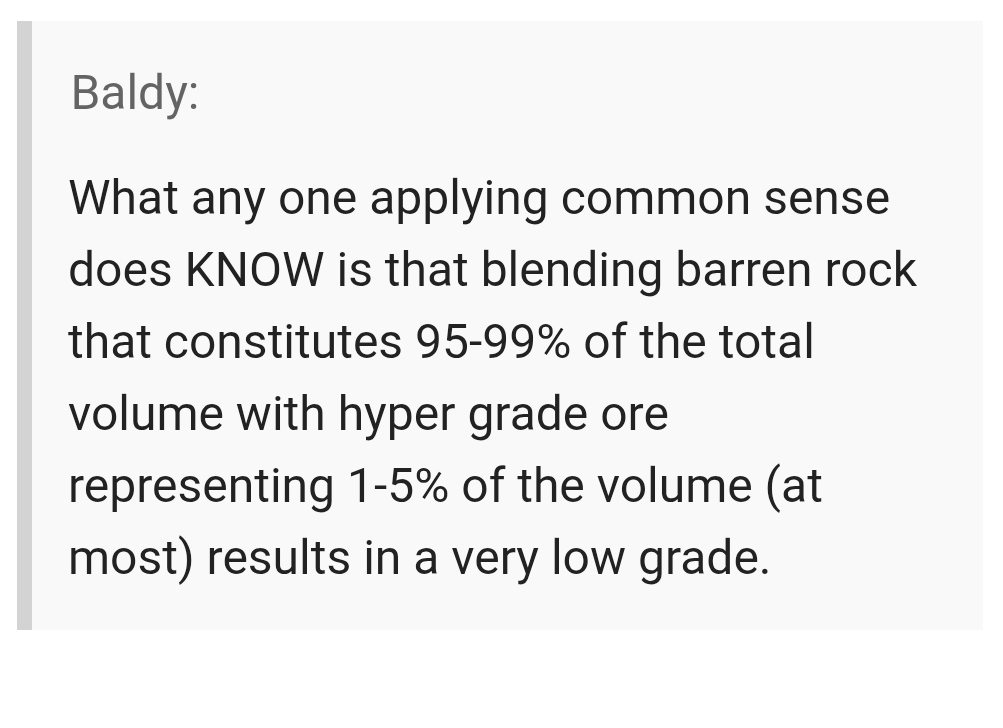
Where do you draw the line then on how far MC is willing to mislead or perhaps even skim from shareholders? Insider deals, or maybe even selling ore and taking unreported proceeds? We don’t have audited f/s after all. Should we be concerned?
1 Like
THE USE OF SHARE STRUCTURE ISSUES IN PREDICTING THE POTENTIAL SUCCESS FOR A MINING INVESTMENT
It’s always amazed me how few mining investors ever concentrate on the SHARE STRUCTURE of a mining corporation including firstly, the number of shares issued and outstanding fully diluted (shares I/O) and secondly, the “float” of readily sellable shares. The number of “Shares I/O” is critical to keep low because it serves as the denominator (lower half) of the all-important EARNINGS PER SHARE (EPS) fraction. The corporation’s share price is going to approximately equal the EPS times the average “multiple” of EPS that corporations in that sector tend to trade at. The “float” is equally critical because it represents the share “SUPPLY” variable that interacts with the “DEMAND” variable to determine share prices through the “PRICE DISCOVERY” process.
Thus, both SHARE STRUCTURE variables, "Shares I/O and “float”, have predictive value to do with the SHARE PRICE, which is what investing is all about. The “float” is also critical because it represents the differential between the number of “Shares I/O” and the number of “Restricted” and/or “Control” shares held by management members. If management doesn’t own a significant percentage of the “Shares I/O” and therefore has plenty of “skin in the game”, then why would an investor invest in the company?
In order to recognize the pivotal role that a mining firm’s SHARE STRUCTURE plays in gauging the chances for the success of a mining investment, you need to first isolate the mineral assets of the mining corporation away from its share structure and do an isolated analysis of the share structure. I’ve posted many times that arguably, one of the most valuable assets of Auryn, in addition to its high-grade ore, is its share structure as it transitions into PRODUCTION and the inevitable “MARKET RE-RATE” (share price appreciation) that typically accompanies a junior miner going into production.
What you might consider doing is taking a “split screen” approach to screening mining investment opportunities. On the left-hand screen you have all of the sometimes confusing geological information (“geogibberish”) that brings value to the mineral assets. On the right-hand side you have the SHARE STRUCTURE which tells a prospective investor of how many other units of equity ownership, which we call “shares”, are going to be “sharing” in the earnings capacity of the mineral assets. The SHARE STRUCTURE serves as a cumulative “score card” reporting on how good of a job management and prior management teams did in making sure that all shares issued by a corporation contributed positively to the earning capacity of the mineral assets. Prior mistakes don’t get erased, they live on forever within the SHARE STRUCTURE of the corporation. For example, if a prior management team sold hundreds of millions of shares in order to raise money to drill out a mineral prospect and the drilling program didn’t bear any fruit, then that “DILUTIONAL” damage will live on forever within that corporation’s SHARE STRUCTURE.
As most of us are aware, Auryn was able to circumvent the massive amount of share structure dilution that most mining juniors suffer from, when Maurizio offered to advance all of the cash Auryn needed throughout its development, while charging zero interest. The question becomes, just how big of a deal does this represent in regard to the chances for success of the investments made in Auryn and Medinah. The answer is that it has everything to do with the prognosis for success of an investment made in Auryn. Auryn’s future earnings, whether it be in year #2 or year #22, are going to be what they’re going to be. What we do know is that the benefits of those earnings are not going to have to be divided up amongst many holders of these things called “shares”.
“Bootstrapping” refers to a corporation’s refusing to sell shares to outside investors in order to raise development funds. The “bootstrapping” approach Auryn took during their corporate development resulted in them entering into high-grade PRODUCTION with an insanely low 70 million shares issued and outstanding and about 7 million shares (not a misprint) currently contained in their “float” of readily sellable securities. Now, in order to illustrate a point, let’s make a metaphorical “clone” of Auryn with all of the same exact mineral assets and developmental achievements Auryn has made and assume this “clone” took the “traditional approach” to building a mining company instead of a “bootstrapping” approach. This would involve the sale of hundreds of millions of shares throughout the decade or two typically needed to advance a mineral prospect into production. This Auryn “clone” would then transition into production with perhaps 700 million shares issued and outstanding, instead of 70 million, and perhaps 650 million of those composing the “float” of readily sellable securities, instead of 7 million.
First of all, you need to realize that the original Auryn is going to have more DEBT than the “Auryn clone”. Maurizio, for example, is owed $10.3 million without any interest being owed. Auryn’s institutional investor, “Strategic Investments,S.A.C.” (“SISAC”) is owed $4 million with an interest rate of “SOFR” plus 4% (a little bit over 8%). This debt is to be paid over 5 years and it has a 10-month “grace period” during which no payments are owing. Auryn hired a firm known as “Ashmore Group/Stracon/Ameco, SA” to act as the mine designer, builder, and mine operator". They basically run the show. They are to be paid a maximum of $20 million over the course of 5 years of service. This equates to an average of about $4 million per year MAXIMUM. Auryn opted to “outsource” the engineering, building and initial operating of their mine to a professional group (Ashmore Group, Stracon, Ameco, SA) which acts as the mine operator at 51 mines in Chile, Peru, Colombia, and Mexico. Part of the $10.3 million owed to Maurizio was paid to Auryn’s miners that already mined and stockpiled over 60,000 Tonnes of ore on-site which is to serve as “feed” for the new froth flotation plant. Some of that $10.3 million also went to the construction of an all-weather camp to house the crew and some went to build an on-site geochemical assay lab.
Because of the recent breakout to the upside in the price of the 3 metals that Auryn will be selling (gold,silver, and copper), Auryn was able to “LEVER” the $14.3 million it borrowed from Maurizio and SISAC into assets able to generate hundreds of millions of dollars worth of EARNINGS over the mine life of the ADL Mining District. They accomplished this without issuing one share of stock. That’s an insane accomplishment.
Shares of corporations in the mining sector tend to trade at a “multiple” of EARNINGS PER SHARE (EPS). The average “multiple” in this white hot sector is now 30.1. Compared to Auryn’s “clone” that metaphorically took the “standard approach” to corporate development, Auryn’s EARNINGS PER SHARE and share price will average 10-TIMES that of the “clone” with identical assets. Don’t forget that Auryn will need to “service” their debt, most of which is non-interest bearing, with monthly payments.
The question now becomes, what is the amount of enhanced VALUE Auryn acquired through their insistence on “bootstrapping” their way through corporate development in order to circumvent SHARE STRUCTURE DILUTION. If Auryn and “Auryn-clone” are each going to be producing at the ADL Mining District for, let’s say, 20 to 30 years, should Auryn’s market cap exceed that of “Auryn-clone” by perhaps a couple of hundred million dollars along this journey? Don’t forget to factor in that “EXTRA” 60,000 Tonnes of ore Auryn already mined, stockpiled, segregated by grade, and paid for with Maurizio’s cash advances.
With Auryn being cash flow positive, the need to sell shares in the future becomes negligible. Part of the calculus in this analysis is just how much of a burden it will be for Auryn to service the little amount of debt they have outstanding. With the price of the metals being sold trading at where they currently are i.e. at all-time highs, it appears that the monthly servicing of the debt will not be much of an issue.
WHAT ARE THE SHORTCOMINGS OF INVESTING IN THE JUNIOR MINERAL EXPLORERS/DEVELOPERS?
The problem is that the statistical odds for a junior miner not only making an economic discovery but also doing what is necessary to get it into production is about 1-in-1,000. As if that’s not bad enough, the average amount of time it takes for this “lucky” 1-in-1,000 junior miner to go from the commencement of exploration to production is between 17 and 24 years. Because of these bleak odds and inordinately long timeframes, the junior miners (with Auryn being the exception) rarely qualify for debt financings. Since all the juniors tend to do is SPEND MONEY, this means that they need to constantly sell shares, over an inordinately long timeframe, just to pay the monthly “burn rate”. These sales are typically made at near zero share prices because of the distant odds for success and the inordinately long timeframes. The end result is MASSIVE levels of SHARE STRUCTURE DILUTION. There is a gigantic “UNLESS” that might come into play once every couple of hundred thousand times. That is “UNLESS” the CEO of the junior miner volunteers to advance all of the cash needed to make it all of the way into PRODUCTION, preferably while charging zero interest. Auryn is a one-off, you’re not likely to ever see this again. Enjoy it while you’ve got it.
Even though “Auryn-clone” has a much more diluted share structure, when it advances into production, it too will no doubt experience a significant “MARKET RE-RATE”. After all, it also defied the odds and put in the time needed to advance all of the way into production. How much larger of a “MARKET RE-RATE” should Auryn expect with its tiny share structure and microscopic “float”? Throughout history, these “MARKET RE-RATES” earned by new PRODUCERS, have averaged a certain amount. How much larger of a “MARKET RE-RATE” should Auryn expect when the prices of the 3 metals they are about to sell is at an all-time high? Auryn’s ore grades are significantly higher than that of the average junior miner making it into production. How much higher of a “MARKET RE-RATE” should this attract?
In the junior mining sector we witness “5-, 10-, and 20-baggers” all the time but nobody ever seems to be able to explain these phenomena. We know from studying the “LASSONDE CURVE” that the share prices of the junior miners entering into the “CONSTRUCTION PHASE” just prior to going into PRODUCTION, tend to go ballistic. This is what happens when the metals prices are “average”. In this particular sector, the incremental increases in the prices of the metals being mined and sold tend to drop straight down to the bottom line. I’m not in any position to predict with certainty any future share price of Auryn or Medinah. What I can say is that the mineral assets on the left-hand side of that metaphorical “split screen” I described earlier, are much more valuable than those of the average junior miner, and the SHARE STRUCTURE shown on the right-hand side of the screen is insanely favorable.
2 Likes
I don’t need to draw the line. I’m not invested. Why would Maurizio skim anything? He owns the majority of the company. Did past shipments to Enami go directly to him? We know trucks went down the mountain and we know there have never been reported revenues. I can only assume those proceeds went to pay down $ owed to him. Who knows? This is just one example of MANY.
You should be concerned if you think you’re invested in a company that is reporting like a “normal company” but this is a penny stock. You get what you pay for. You should be concerned if you actually think AUMC will hit $5 a share. Anything is possible but there’s NO way that ($350m) is a sustainable valuation until/unless AUMC uplists to a more legit exchange and/or begins to disclose to higher standards.
There just may be an army of Bubbas who are willing to pay any price but “real” money will not commit funds until the stock becomes “investable”. By way of example, it’s literally impossible to value the company until you know ALL of the details of the debt financing and the massive “service fee” attached to it. You don’t know how $20m will flow thru the cash flows. Fundamentally you have NO idea what the company hopes to produce on an annual basis and at what cost (ASiC). It’s called a mine plan.
Candidly, the fact that AUMC is trading at a $100m is a small miracle. I’m not saying it can’t grow into this valuation but there is a LOT of wood to chop on the disclosure front. Absent this critical information and details NEEDED to properly value the co, you’re basically left with logic like: “if DOGE can go up so can we or if company ABC has a $500m val, so should we.”
It’s worth pointing out, the sustainability of higher prices and valuation are equally important to reaching higher prices. When considering the VAST majority of investor’s capital is trapped in MDMN, sustainability is huge. Once shares in AUMC are received (Q4 2026/Q1 2027?) there will be a legend (restriction) of at least six months. If AUMC rips to $100 and then comes back to $1 (or whatever level the fundamentals support) it doesn’t do much good as a spectator with restricted shares. Sustainability built on strong fundamentals and adequate disclosure making this an investable stock are key.
It amazes me you can make such a statement in light of the multitude of derogatory posts you have made of the company, MC, and actual shareholders that post here. You deserve an award for Biggest Cajones!  Seriously, when will you finally announce that you are returning as a shareholder?
Shareholders will very likely see $5 long before you stop insisting that only standard mining operations can lead to profitability. To be honest, your arguments have been wearing pretty thin year by year. There is actually a slightly conciliatory tone in some of your posts. History has shown time and again that persistence and vision can lead to success, even after many failed attempts. I do wish and think 2026 will be a pivotal year for all shareholders here.
EZ
8 Likes
Jimmyp,
From the shareholder update, “Approximately 13,000 tonnes prepared and being transported for start-up, supported by total on-site stockpiles estimated to exceed 60,000 tonnes.” It isn’t clear to me how much of the 60,000 is existing stockpiles at the Alto that have been around literally for decades from previous mining at Lampa and elsewhere on the Alto.(This has been mentioned in several previous reports.) This material was in the form of tailings. It is well known that tailings for historic mining operations generally still has plenty of gold in it especially if it was bound with sulfur which apparently much of was. There is also some ore from the initial construction of the new mine tunnel and the various veins that were intersected. Note that the update says prepared and “transported” ore…seems odd to say that unless it is actually being moved from areas outside the current mining footprint from say historic operations.
The shareholder update then states, “Lower-grade material will be processed during the initial commissioning period (approximately 30 to 45 days) to fine-tune plant performance and recovery parameters before transitioning to higher- grade feed from active mining operations.”. Again this implies to me, that most of the 60,000 is actually left over tailings and that the actual ore mined from the Fortuna vein will have a significantly higher grade. So, in a nut show, I’m assuming an initial grade of around 5 grams(10 at most) per ton of the tailing portion of the ore.
3 Likes
You seem to be confused. While I’m not currently invested and likley won’t be until the valuation becomes a lot more compelling this does NOT mean that I’m not looking forward to some actual production.
It should be a bit concerning that the SHARE STRUCTURE is repeatedly celebrated as core to the investment case here when we all know that 70m shares is only the result of a 100 for 1 stock split. PPX, the “red headed step child” in these parts would only have 8 million shares outstanding if they pursued the same “strategy.” What about MDMN with 2.8 billion shares outstanding. Yes, the avoidance of dilution following the massive reverse split is relevant, as long as AUMC shareholders bought 10x their original investment to maintain their ownership. Otherwise they simply got diluted (by 90%) in the beginning vs. the end of the process. But its important to keep in mind, dilution is supposed to occur because the company is building or enhancing the value of the underlying assets. AUMC found a vein, accrued $10M in debt and then debt financed a plant with a massive “service contract” bolted onto it. Its not like Maurizio pursued an exploration strategy, feasibility studies, and a mine plan (all of the things that allow companies in the pre-construction phase to go parabolic). Why would there be any dilution?
I NEVER argued that only standard mining operations could be profitable but rather that the decision to not pursue a resource/mine plan wasn’t a sound strategy. Given the past ten years of imminent production, false starts, failed financing, etc, etc this argument, not surpisingly, turned out to be factual. Empiricallly. Ironically, Maurizio could have avoided a mountain of debt and a lot of opportunity cost if he made the decision to build a plant from the onset. They didn’t have a resource or mine plan back then and they don’t have a resource or mine plan now. As Mgold astutely points out in his recent post, there was a large stockpile of something back then and there’s that same stockpile, along with a small quantum of incremental tonnage from “finding the vein”, there now. The writing was on the wall after the Caren issues. Water under the bridge at this point.
While I think there will be several very rude awakenings as investors who’ve spent the past 30 years speculating on hypotheticals collide with the realities of acutally mining (while chasing a vein), I’m not sure how anyone, invested or not, wouldn’t be excited to see some production. When considering that this $5 price target is being thrown around, with expectations that this is truly acheiveable, I’m fairly comfortable in saying that I, as spectator and not investor, will probably enjoy this stage of development more than most!
Not at all. It is very simple. You don’t recognize why I have remained supportive of MC and other shareholders here.
EZ
1 Like
Les Price was a POS for creating fraudulent shares but there should be liability to the transfer agent who sold them. They should have done due diligence to realize the fraud unless they were in on it!!
3 Likes
While I agree with you about Les Price… I think it’s a little late to go after the transfer agent.
Seems Kevin tried everything he could to fix this situation, but if I remember correctly, the transfer agency was given false documentation. At the time I don’t know that Kevin had the power or the money to hire attorneys and investigators.
I do know he did a hell of a lot of work to bring a certain amount of accountability and claw back as many shares as possible. Thank you Kevin!!
But in reality, unfortunately I believe this to be a dead issue. It sucks I know but I wouldn’t even know where to start at this point.
4 Likes
Gold ripping again this afternoon! Hey Jimmy there is a lot of money in those “tailings”!
1 Like
This is a bit off track but does anyone know about American Sierra Gold or have shares… I have shares and don’t know what’s next if anything. Answers appreciated..thanks
Yes, I was there… lots of good questions that were handled at the time that we found out about the shares being distributed…. As I remember this was being addressed as a short scandal until one of our own looked into it…. As far as why didn’t the lawyer handle it…. I really don’t remember lawyers being involved… I’m probably wrong on this, but the other thing is who was footing the bills for the lawyers.
I certainly wasn’t asked…
I’m very confident pursuit of all that was properly weighed by Wizard/MC back then - you have to take into account the COST of generating competent evidence, the cost of attorneys, and the long timeline of litigation. I trusted Wizard/MC with that and moved on, long ago. You willing to pay to resurrect that, test it in federal court? If not, why dwell on it? Please.
3 Likes
Yes, thanks Bubba, Settlements were made and transactions closed out, and wrapped up, that’s what Wizard spent 2 years doing. Nothing more is going to change the past- move on from posting “coulda, shoulda”.
BTW, extra shares were created at that meeting when our “dividend” shares were authorized, they just were intended to be held in reserve and not sold.
4 Likes
Oh, extra shares as a buffer, in case we have people appear out of the woodwork?
Thanks - I did not know/remember that - and makes me feel even better.
Yes they issued a share dividend at that AGM. Not sure what you mean by they were intended not to be sold. Everyone was given a % dividend of their holdings. They were not restricted.
Also was my last post deleted?
Appears the bar date has been set:
In Progress - Claims Bar Date: February 15, 2026
3 Likes
My memory would be wrong, but I think they were restricted. I remember having to jump through some hoops to get the restrictions removed.
Also, at that meeting, the board of directors announced they were increasing the number of authorized shares to 3 billion. But those additional shares were not to be issued. However, Les Price took advantage of the increased authorization.
2 Likes