I think they said yesterday they got permits for the MILL and the tailings facility.
I don’t know if that includes the flotation plant, but I assume not. That being said, I’m not schooled in regulatory matters as such. We’ll see.
I think they said yesterday they got permits for the MILL and the tailings facility.
I don’t know if that includes the flotation plant, but I assume not. That being said, I’m not schooled in regulatory matters as such. We’ll see.
Mike, I am bowing down to you as I have never had to deal with a floatation plant… most of my experience is with generators in industrial plants delivering high volume 24/7.
Your AI analysis seems pretty spot on, which I never would have thought of… Thank you!
In my experience they have set three generators so that even if they do have a power source, if it goes down they have the ability to keep running without interruption… smart move.
GC,
If you take this one step further, I think they will be able to run the whole operation including plant operations and mining for $15,000/day.
The expected daily operational costs for a 100 tonne/day gold flotation plant powered by diesel generators, located within 50 miles of Santiago, Chile, are rough estimates based on industry benchmarks. These are approximate and can vary significantly depending on ore characteristics (e.g., grade, hardness), exact energy needs, labor rates, reagent prices, maintenance, and other site-specific factors. Chile’s mining sector has relatively high costs due to labor, regulations, and energy, but proximity to Santiago reduces some logistics expenses compared to remote northern sites.100 tonne/day Gold Flotation Plant (Diesel-Powered)
Processing/plant operating costs (excluding power and mining): Industry data for small-scale gold flotation or similar processing ranges from ~$10–$30 per tonne of ore processed, with flotation-specific costs often around $10–$20/tonne (including reagents, maintenance, labor, consumables, and grinding/energy portions). For a small 100 tpd plant, a realistic midpoint is ~$15–$25/tonne.
Power costs (diesel generators): Small flotation plants (crushing, grinding, flotation, pumps) often require 20–50 kWh/tonne, heavily driven by grinding. Assume ~30–40 kWh/tonne for a conservative estimate → 100 tpd requires ~3,000–4,000 kWh/day.
Diesel generator delivered costs in remote/mining contexts are often 20–30¢/kWh (or higher), factoring in fuel, O&M, and efficiency. In Chile, with current diesel $1.08/liter ($4.08/gallon), and generator fuel consumption/efficiency, power can run $0.20–$0.30/kWh or more for off-grid setups.
Daily power: 3,000–4,000 kWh × $0.20–$0.30 = $600–$1,200/day (potentially higher if trucking or inefficiency adds costs).
Total estimated daily OpEx: Combining the above, plus minor G&A/labor adjustments for a small operation near Santiago: $3,000–$6,000/day (or ~$30–$60/tonne overall). Diesel power is a major contributor (20–40% of total OpEx in off-grid cases), and costs could skew higher if the plant needs more power or if diesel prices fluctuate.
These figures align with broader small-scale gold processing benchmarks ($10–$50/tonne total OpEx) adjusted for diesel reliance and Chilean context (higher than grid-connected but lower logistics than remote Andes sites).1000 tonne/month Underground Gold Mining Operation (Narrow High-Grade Veins)This equates to ~33–40 tonnes/day (assuming ~25–30 operating days/month), typical for a small-scale, selective underground operation targeting narrow high-grade gold veins (e.g., using cut-and-fill, shrinkage stoping, or narrow long-hole methods for selectivity and minimal dilution).
Underground mining costs: Narrow-vein underground operations are expensive per tonne due to selectivity, development, ventilation, support, and lower productivity. Benchmarks for small-scale underground gold mining range from $40–$120/tonne mined (or higher for very narrow/selective methods), with $80–$150/tonne common for small Canadian/Australian analogs (adjusted lower in Chile due to labor but higher for narrow veins).
Including processing: If ore is trucked to a nearby plant (e.g., flotation or gravity), add $15–$40/tonne processing.
Total estimated monthly OpEx: $100,000–$300,000/month (or ~$100–$300/tonne), with daily equivalent ~$3,300–$10,000/day assuming 30 days.
Key drivers: Labor (high for skilled underground work), explosives/drilling, equipment maintenance, ventilation/power (possibly diesel if off-grid), and development (sustaining capital not included in pure OpEx).
Narrow high-grade veins aim for low tonnage to keep costs manageable, but per-tonne costs rise sharply below larger scales.
These are broad estimates—actual costs require detailed engineering studies (e.g., ore hardness, vein width, depth, recovery rates). In Chile’s Andes context, costs could be influenced by water access, environmental compliance, and proximity to infrastructure near Santiago (potentially lowering transport/labor logistics vs. remote northern mines). For precise figures, consult site-specific feasibility studies or local mining consultants.
Thanks Mike. Its very refreshing to FINALLY read some grounded analysis. What you are describing is a 10k tonne annual production (which assumes no downtime due to weather and 25 of 30 days a month of “production.” At 15gpt average grade this would equate to ~5000 ounces of annual production. This is a number that Maurizio (amongst “others” on this board) has referenced in past conversations and seems like a reasonable goal with decent execution. At $5000oz gold (an aggressive assumption but warranted given the macro environment), we’re talking about $25M in topline/revs.
Using your cost analysis ($300t) and a grade of 10-15gpt the AISC would be $1000 to $1400oz BEFORE sustaining capex. Worth noting your cost analysis doen’t incude the “service agreement” premium b/c nobody has any idea of how that will be priced but its safe to assume that the services will come as a premium to bolster the ROI on the debt/services agreement. Sus capital is a key component as it represents ongoing investments to maintain current prodcution levels. Average sus capex adds $300oz to AISC ($1300 to $1700oz) but this relates to mines who have already spent the money to define a resource, feasability study, mine plan. In AUMC’s case one could argue the sus capex will be significanly higher given the lack of “initial capital” (not included in AISC) commited to the project. “Some” here have suggest an AISC of $2000oz. Based on your mining and processing cost analysis, in combination with a conservative sustaining capital estimated of $500 to $700t vs industry average $300t this AISC ($1900-$2200oz AISC) seems like a decent “base case” estimate.
At 5000oz production and a $2000 AISC, AUMC would be in a position to generate $15M in cash flows, and somewhere in the neigborhood of $10-12M in net profits (not including any debt servicing/repayment). Does a $150M market cap support this outcome? For those who understand that a P/E of 30 is laughable for a single asset, junior producer, AUMC trading at 10x CF and a PE of 15 is reasonable at some point in the future IF they execute, maintain 15gpt (very high) on a continous basis, gold stays at this level, and the company is able to updgrade its reporting, financials, and the exchange on which it trades. Applying a discount rate to reflect these various “executalbe” events would bring the NPV to a considerably lower current valuation but the market isn’t an exact science. Not to mention, given the lack of any volume in AUMC, it becomes almost impossible to know where this “should” be trading b/c there’s no real price discovery (real money assigning a price/value where its willing to commit real capital).
Baldy,
I think a better way to look at it is share price drives market cap, not the other way around. On the other hand, market cap is a good reality check especially long term.
If the price runs to above $5 a share, we will need to see some decent scalability of the 100 ton/day floatation plant, 3000+ ton/month mining production, encounter higher than normal gold grades, a major mining partner, and better resource definition to keep the momentum going to the next level. I think most of us are still here because we think all of those items are possible/probable.
Anything is possible. The share price is the market cap, reflecting a valuation used on an absolute and relative basis. The current share price is determined by the whims of small retail buyers and sellers, limiting credible price discovery.To reach $5, I believe you will need real, institutional/HNW money to commit funds and, as I’ve opined, there’s no way that type of money will come into an uninvestable stock on pure speculation. I’m not sure if there is a chicken and egg analogy to be found here.
I would argue that a $350M market cap without a resource isn’t in the realm of possibilities and would challenge you to find an example of a company, across the 1000’s of miners, to prove me wrong. Yes, if AUMC is able to generate $50M+ in cash flows and the mineralization becomes “more evident” to the technical community who can “connect the dots” in the absence of a feasability study, via AUMC’s continous mining, that type of valuation is possible, even in the absence of a resource but that’s a long way a several 100tpd expansions beyond the current setup. There are several examples of miners with “smaller” defined resources trading at 5-7x CF.
The obvious disclaimer here is that AUMC could go to $1 or $20 based on various, non fundamental, factors. The issue is sustainability which will be tied to fundamentals. A pop to $20 isn’t going to do much good for folks around here who will be stuck with MDMN/restricted shares for the foreseeable future. Sustainability is the only thing that counts.
Look at that Jimmy Gold back over 5200.
They need to get MDMN trading again and let it go where it goes. IMHO
All coming together. $5k oz POG floor should hold now. $2 AUMC pps floor looking to stick soon.
Not sure if Kevin is allowed to disclose that yet. I’m having a hard time getting too enthusiastic until I’m confident my trapped MDMN shares will safely land as AUMC shares in a reasonable timeframe.
Whatever debts are outstanding should be paid by Chapin and Goodin, in my opinion. Why aren’t the ones who has Fiduciary responsibility being held monetarily responsible for their despicable negligence? People on a freaking message board could see that the share supply was not making sense yet nobody at the company thought to contact the TA and find out wtf was going on? People like to jump on Baldy, however go back and read his incessant posts about the need for a share audit during the years proceeding when the fraud was officially uncovered/publicized.
I feel very stupid asking this but is my 5,000 share physical cert of Medinah Minerals worth anything and if so can it be changed to AUMC? I’m so out of the loop that I forgot what happened! Is it not enough to bother with? Please advise.
oz
Oz,
Theoretically, you could be mailed a AUMC dividend cert in the next year or two for a few shares if Medinah/transfer agent has your correct mailing address. The cert would be R144 restricted. Then you would need to figure out a way to get it into your brokerage account. Assuming that your broker will even accept it, many brokerages will charge a flat fee to research/remove the restriction. This could easily be more than the cert is worth in this case.
Thank you Mike & Madmen, much appreciated. I have some research to do and calls to make. At least there is action on the mountain, great pictures and great prices!
oz
Just a guess, but I think Auryn will try to open the new floatation plant and run the first test batch of ore through the process to coincide with PDAC conference next week. Let’s see if they make it in time.
Well, I think you’re prescient - look what they JUST posted on Twitter!
The sounds of mining life at Fortuna as the team starts testing each of the individual components before commissioning.
I’ve been in this over 25 years and invested a significant amount of money into MDMN It’s great to finally see machinery ready to produce. I’m more than ready to watch this develop and have AUMC shares distributed!!!
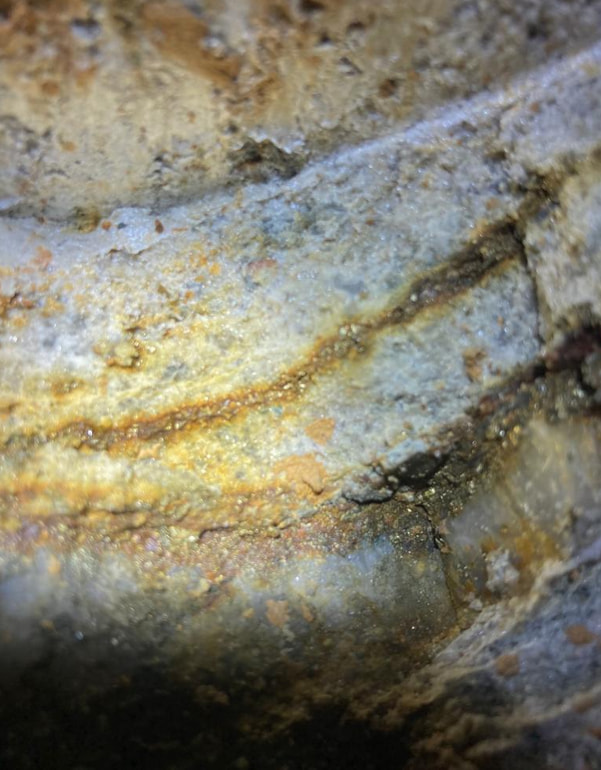
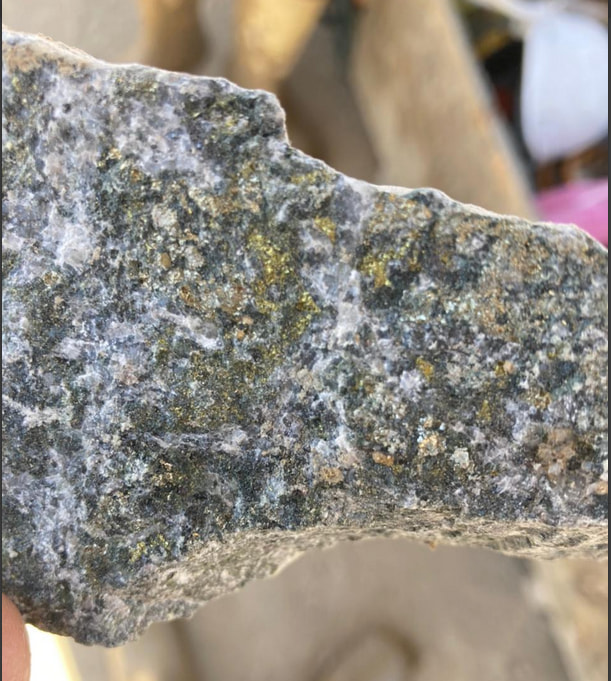
Attending PDAC is certainly a good idea, especially this year with the POG on a sustained upwards trend. Maybe there will be a display at PDAC of some of the sample rocks encountered:
The above rocks are from the Antonio tunnel on the way to encountering the Don Luis Vein. Perhaps it may garner some interest on the current activity taking place on the ADL and start of production. It certainly isn’t going to diminish investor interest. Still here and still long.
EM
HOW DOES AURYN’S LANDING OF THE PERMITS FOR BOTH THEIR ORE PROCESSING FACILITY AS WELL AS THEIR “DRY STACK” TAILINGS STORAGE FACILITY CHANGE THE RISK/REWARD CALCULUS FOR EXISTING MEDINAH AND AURYN SHAREHOLDERS AS WELL AS PROSPECTIVE INVESTORS?
To answer that question, I think you need to go back to the proper characterization of the junior mining sector in general. This sector is where investors (actually speculators) willingly take on ULTRA-HIGH RISKS in search of ULTRA-HIGH REWARDS. Conversations tend to center around somebody’s last “10-bagger”. This is a very ATYPICAL sector dominated by “speculators”. Part of the appeal is that there really do seem to be a lot of “10-baggers” in this sector, especially when the metals prices are on a roll, as they are now.
The two permits just granted to Auryn represent two of the largest of these remaining ULTRA-HIGH RISKS for Auryn being successfully mitigated. These “PERMITTING RISKS” include not only the chance of not being granted the permits, but also having to spend an inordinate amount of time waiting on the permits. Auryn successfully dodged a couple of potential bullets in this regard.
The result for new investors or existing shareholders wishing to add to their position, is a RISK/REWARD scenario that might be characterized as now incurring MODERATE or perhaps even LOW RISK in search of ULTRA-HIGH REWARDS. The magnitude of the potential ULTRA-HIGH REWARDS hasn’t necessarily changed, but the statistical chances for attaining those REWARDS has improved measurably. The NET PRESENT VALUE (NPV) of a PERMITTED AND PRODUCING mining operation is well in excess of the NPV of a nonpermitted mining operation yet to go into PRODUCTION. Auryn’s mineral assets gained a lot of “VALUE” because of these permits being granted right before commencing PRODUCTION.
So, congratulations are definitely in order. The timing might also be fortuitous in that Auryn will be represented at the PDAC Annual Mining Convention on March 1-4 in Toronto. A lot of the 30,000 mining investors that attend this conference, whether individual or institutional, don’t want to touch a nonpermitted, nonproducing mining project due to the ULTRA-HIGH RISK involved. Everybody and their brother are now seeking out a “PRODUCER”, established or brand new, whose share price has not already quadrupled with the recent upward moves in the metals prices. Auryn should qualify for this characterization. Mining companies are famous for using large mining conventions as a backdrop for making important news releases. These conventions represent a coalescence of like-minded investors/speculators anxious to identify the next potential “10-bagger”. Having management on-site to field questions can help Auryn “develop an audience”.
Many investors deploy a strategy involving allowing the CURRENT RISK/REWARD calculus to determine their allocation of investment capital. If the ULTRA-HIGH RISK variable, native to this sector, were to suddenly diminish markedly and the ULTRA-HIGH REWARD variable remained the same, then capital might be allocated accordingly. The trick is knowing what the components of the ULTRA-HIGH RISK variable consist of and when they have been successfully mitigated. The ultimate goal for an investor in this sector is to allocate the majority of one’s capital when the RISK is dwarfed by the potential REWARD i.e. to incur ULTRA-LOW RISK while seeking ULTRA-HIGH REWARDS. This would allow an investor to take advantage of the asymmetries that can periodically appear between RISK and REWARD.
In this sector, there is a concept known as “DE-RISKING” that occurs as exploration and development efforts are carried out on a mineral prospect. For each milestone successfully reached, the ULTRA-HIGH RISK drops down a notch. The ultimate goal for a junior miner is to get one of their mineral prospects into PRODUCTION and EVEN MORE IMPORTANTLY to do so with as few shares issued and outstanding on the first day of production as possible. This is how to maximize EARNINGS PER SHARE (EPS) and therefore SHAREHOLDER REWARDS.
WHAT ARE THE FACTORS THAT AFFECT THE LEVEL OF “ULTRA-HIGH REWARDS”?
In this sector, the price of gold and the number of shares issued and outstanding on the first day of production would fall into that category. In the case of Auryn, the investors that invested many years ago have received a marked increase in the level of their potential ULTRA-HIGH REWARD due to the breakout in the price of gold. The ULTRA-HIGH REWARD characterization for this sector applies to an “average” price of gold over time. One way to characterize the ULTRA-HIGH REWARD available after the price of gold has gone to all-time high levels, as we are experiencing now, might be an ULTRA-ULTRA-HIGH REWARD. The level of ULTRA-HIGH REWARDS would also increase if management was able to keep the number of shares issued and outstanding at a minimum. This way, each share owned would receive a higher pro rata share of the profits especially in the case of cash dividend distributions should management so choose.
The ULTRA-HIGH REWARD variable can also be enhanced by deploying some of the operational profits into what is referred to as “MECHANIZATION LEVERAGE”. For example, If a miner, accustomed to mining with somewhat archaic “jack-leg” drills were to take, let’s say, 5% of one quarter’s profits, and buy or rent a “jumbo” drill rig that enhanced the PRODUCTION RATE by 30% per quarter over the entire mine life, then that miner was able to massively LEVER those profits because of the availability of “MECHANIZATION LEVERAGE”.
Similarly, if a miner took a tiny percentage of one quarter’s profits and executed a diamond drill hole at the Pegaso Nero copper/moly porphyry prospect that revealed a long intersection into a copper/moly porphyry structure, then that tiny percentage of one quarter’s profits may have been levered many-hundred fold WITHOUT THE NEED TO SELL ANY SHARES. Prior to going into PRODUCTION, this drilling would have necessitated the sale of shares and the dilution of the share structure.
When management is able to keep the number of shares issued and outstanding at extremely low levels, like 70 million shares in the case of Auryn, and the “float” of readily sellable securities at extremely low levels, like approximately 7 million shares in the case of Auryn, then a given amount of TOTAL EARNINGS will result in a higher EARNINGS PER SHARE (EPS) figure because the number of shares is so low. In any sector, corporations tend to trade at an average “multiple” of EPS. A study done by the Stern College of Business at NYU showed that the average “multiple” for the mining industry is 30.1. Thus, if Auryn were to be able to earn $70 million per year in pre-tax income i.e. $1 per share, then their “appropriate share price” would THEORETICALLY be around $30 per share. This is not a prediction but serves to illustrate how these things called “10-baggers” can come about. You need a large discrepancy between the current market cap and the market cap that could easily be attainable based on current facts and trends. These markets tend to be anything but “EFFICIENT MARKETS” because the subject matter involving complicated geological realities is difficult to understand for most investors.
Investors determine the “multiple” they are willing to pay for the shares of a producing miner, especially one with a tiny number of shares outstanding. There is a phenomenon known as “multiple expansion” in which the market will tend to reward corporations with certain characteristics with a higher “multiple” than the “average” for the sector. As an investor, I will obviously be willing to pay a higher “multiple” for shares of a miner with only 70 million shares outstanding than one with nearly 1 billion shares outstanding. If you picture yourself in perhaps 3 or 4 years at a time in which you want to take profits, you don’t want to compete against the purchasers of nearly a billion shares to sell your shares into a fixed level of buy orders/DEMAND. “Multiple expansion” especially occurs with young “producers” that can rapidly ramp-up PRODUCTION RATES from their initial production rates. Major miners cannot replicate the robust growth profiles of young “producers”. Extremely high-grade projects with low ALL IN SUSTAINING COSTS, like Auryn’s Fortuna project, will also tend to command a higher “multiple”.
SO, WHAT EXACTLY IS GOING TO CHANGE AS AURYN TRANSITIONS INTO PERMITTED PRODUCTION?
THE SPOT PRICES OF THE METALS BEING SOLD-All of a sudden, the spot price of gold really matters because incremental increases in the price of gold tend to drop straight down to the bottom line of any "PRODUCER’.
ENHANCED VISIBILITY-It is notoriously difficult for even a sophisticated mining investor to estimate the NET PRESENT VALUE (NPV) or ENTERPRISE VALUE/EV (Market Cap plus debt minus Cash) of a mining corporation before it commences production. Once into PRODUCTION, however, we have many metrics that can be used to estimate an NPV or EV.
Prior to production, balance sheets and income statements provide a limited amount of salient information in the case of a junior miner with a mineral prospect. EARNINGS PER SHARE is the one metric that most closely parallels SHAREHOLDER REWARDS. Until there are these things called “EARNINGS”, EARNINGS PER SHARE has no meaning. For a company able to realize the ULTIMATE GOAL for a junior miner i.e. to enter into permitted production with as few shares outstanding as possible, a microscopic number of shares outstanding does indeed attract attention as does a robust level of EPS. A tiny number of shares outstanding will tend to go unnoticed UNTIL the junior miner goes into PRODUCTION. Then an extremely high level of EARNINGS PER SHARE can be recognized by the investment community.
However, until production actually commences, any junior miner is often looked upon as just another one of 3,000 other junior miners 98% of which will never advance a mineral deposit into production. ENHANCED VISIBILITY is a very good thing for the investment community. Recall that Auryn has announced that they are in possession of “DETAILED CASH FLOW ANALYSES” regarding their Fortuna project. The problem is that the only parties that have been privy to them is the institutional investor that recently handed a $4 million check to Auryn. Institutional investors that are privy to “DETAILED CASH FLOW ANALYSES” are, of course, not able to participate in open market purchases of shares UNTIL that "NON-PUBLIC/“INSIDER” INFORMATION has been made public.
“MARKET RE-RATES”- Most of the PRODUCERS of the various metals currently trading at or near their all-time high prices, have already enjoyed a quadrupling of their share prices and market caps because they can DIRECTLY benefit from these high prices. As noted, in this sector, incremental increases in the price of the metals being sold tends to drop straight to the bottom line. Because of this, brand new “PRODUCERS” typically can look forward to a share price enhancement known as a “MARKET RE-RATE” when they can irrefutably prove that they are now a bona fide “PRODUCER”. If the brand new “PRODUCER” behaved itself during its infancy and kept its number of shares outstanding as well as its “float” to a minimum, it can expect a higher “MARKET RE-RATE” than the average “new producer” that suffered massive share structure dilution along the way.
HUGE IMPROVEMENT IN THE RISK/REWARD PROFILE-In order to get into PRODUCTION, a lot of “RISK BOXES” need to be checked off on and the RISKS mitigated. In Latin America, PERMITTING RISKS are extremely critical. The miner not only seeks permit approval, but approval in a timely fashion. Recall that the PRIMARY GOAL of any junior miner is to not only get into PRODUCTION but to do so with as few shares issued and outstanding and as few shares in the “float” as possible. Going into PRODUCTION affects both variables in the RISK/REWARD equation. By definition, getting into PRODUCTION translates into most of the RISKS having already been mitigated. The main risk left becomes “OPERATIONAL RISK” which is always present. As the RISK levels melt away, the REWARD variable takes on a sense of IMMEDIACY. EARNINGS make up the REWARDS. Depending on how management decides to allocate capital, EARNINGS can result in CASH DIVIDENDS, SHARE BUY-BACKS, ACCESSING MECHANIZATION LEVERAGE, or RAMPING UP PRODUCTION LEVELS resulting in higher levels of EARNINGS, which sets up a positive feedback cycle.
ACCESSING A SUPERIOR TRADING VENUE-Auryn management has already cited that once they go into production, the plan is to become “FULLY REPORTING” to the SEC and seek a higher trading venue. This serves to enhance credibility and potentially attract institutional investors.
THE PROMOTABILITY SHOULD BE GREATLY ENHANCED-In order to “promote” a corporation, you need something to brag about. There is no event in the genesis of a mining company more important than advancing into PRODUCTION.
First of all, Auryn has already mined and stockpiled over 60,000 Tonnes of ore at the ADL Mining District. Thus, one could make the case that they are already “IN PRODUCTION” as we speak. Auryn could be shipping that ore today, but if they wait and run that ore through their new froth flotation plant prior to shipping, and then ship an extremely high-grade “float concentrate”, their profits will be much higher. The next stop for most “float concentrate” is the “smelter”.
TO THE AVERAGE MEDINAH OR AURYN SHAREHOLDER, WHAT IS GOING TO BE DIFFERENT ONCE AURYN OFFICIALLY COMMENCES PRODUCTION?
In a nutshell, the answer is pretty much everything. Why is this? In order to fully appreciate the significance of a junior miner advancing a project into PRODUCTION, you need to gain an appreciation for the statistical odds of pulling this off (about 1-in-1,000) as well as the inordinate length of time it takes to get a project into production after the commencement of exploration (an average of 17 to 24 years). The NET PRESENT VALUE of a PRODUCING MINE factors in these distant odds and inordinately long timeframes. The major miners in need of constantly replacing the ounces they annually mine, don’t want to face these odds nor spend the time required. They’d much prefer to just buy the junior miner especially if it is in PRODUCTION.
In this industry, when the prices of the metals are through the roof, you’re either a “PRODUCER” that can DIRECTLY benefit from these enhanced prices or you’re not, it’s very binary. The number of ounces of MINERAL RESERVES/MINERAL RESOURCES in the ground, that might not be mined for 5 or 6 years, becomes of secondary importance because the prices of the metals are through the roof TODAY.
A junior miner either has high-grade, near surface,“EARLY PRODUCTION OPPORTUNITIES” or they don’t That too is very binary. When the prices of the metals are breaking out to the upside, it becomes a RACE to get your project into PRODUCTION in order to become a DIRECT beneficiary. If you are mining a high-grade deposit in an environment like this, the “ECONOMIC FEASIBILITY” can become a “no-brainer”. If it is clearly obvious that the “mine life” is going to be measured in decades, then there is no reason to take 4 or 5 years off from production, at all-time high metals prices, in order to determine exactly how many years the estimated mine life is or exactly how many ounces are in the ground.
The same is true if it is obvious that there are over perhaps 2 million ounces in-situ. Spending hundreds of millions of shares in order to determine exact numbers makes no sense when there is a fortune to be made just mining that ore. When you have a CEO willing to provide all of the cash needed to advance the project all of the way into production while charging zero interest there are 3 main informational boxes needing to be checked off on. Firstly, are there plenty of ounces in the ground. Secondly, is there plenty of mine life available. Thirdly, is the project “ECONOMICALLY FEASIBLE” at the current metals prices.
I’ll be the first to admit that if a junior miner does NOT have a CEO willing to advance all of that cash, then those hundred of millions of shares are probably going to need to be sold to do extensive amounts of diamond drilling and execute a series of feasibility studies. Auryn is an anomaly, don’t expect to encounter another one in your investment lifetime.
SHARE STRUCTURE REALLY MATTERS
I would recommend thinking of a tight share structure like Auryn’s as the “corporate packaging” that the mineral assets come wrapped up in. The number of shares in the “float” represents the “SUPPLY” variable that will interact with the “DEMAND” variable to determine the appropriate share price through the “SHARE PRICE DISCOVERY PROCESS”. The “SUPPLY” represents the resistance the share price will encounter given a certain level of “DEMAND” in the form of buy orders. As a rule, investors don’t worry enough about the share structure of a corporation being studied. In the junior mining sector, it’s almost as if the assumption is that all junior miners will have significant levels of share structure damage from exploration and development efforts as if by default.
Auryn proved that this is not the case. Auryn and Medinah shareholders got extremely lucky when Maurizio volunteered to advance all of the cash needed to put the project all of the way into production while charging no interest i.e. zero “cost of capital”. That’s an insane concept that most of us will never see again, so you’d better appreciate it while you have it. Perhaps 99% of the junior miners need to sell hundreds of millions of shares at near zero share price levels just to advance exploration and development efforts. This is because the odds of success are so low. Willing financiers need to insist upon massive discounts to existing share price levels in order to mitigate their RISK prior to a project.
Finding a financier to advance all of the cash needed at zero interest rate is a pipe dream, but a reality to Auryn shareholders. That ultra-tight share structure can last for the life of the corporation. Once cash flowing, the need to raise funds by selling shares at massive discounts to existing share price levels goes away because the profits can now pay the bills.
IS IT REALLY TRUE THAT AURYN “HAS NO RESOURCE”?
You’ve heard that accusation hundreds of times over the last seven years. Auryn has provided evidence of the existence of more than 2 million ounces of “gold equivalent” at the ADL Mining District as well as a mine life of several decades based on the initial throughput rate of their froth flotation plant i.e. 100 Tonnes per day. But is Auryn management allowed to make a formal press release stating that they have blocked out 1 to 2 million ounces of “NI 43-101 COMPLIANT OUNCES OF MINERAL RESERVES/MINERAL RESOURCES” and assign them to 1 of the 5 categories of MR/MR? No.
Forunately, Auryn has not sold hundreds of millions of shares in order to fund several phases of diamond drilling on their vein deposits and execute a formal PEA, PRE-FEASIBILITY STUDY, and a BANKABLE FEASIBILITY STUDY. Why? Because they had already gathered all of the geological and technical information needed to fund the project all of the way into production and make a “POSITIVE PRODUCTION DECISION”. As Auryn management cited in a recent press release, “WE HAVE COMPLETED DETAILED FINANCIAL ANALYSES OF THE FORTUNA PROJECT”.
The NI 43-101 standards came about due to the “BRE-X” mining scandal. What it does is outline how a mining corporation can communicate information to the investing public. Gathering geotechnical and economic information in order to make a “POSITIVE PRODUCTION DECISION” is a different matter. Gathering the necessary information in order to make business decisions is one thing, but the legal way to disclose that information to the investing public is quite another.
In order to be able to disclose certain information to the public, a mining firm needs to retain an INDEPENDENT QUALIFIED PROFESSIONAL (“QP”), to gather up a tremendous amount of information. Auryn has preferred to use “IN-HOUSE” geoscientists and engineers to gather up and process information prior to making business decisions. Prior to getting involved with a junior miner, a mining major will insist upon the gathering up of volumes and volumes of information by an INDEPENDENT QUALIFIED PROFESSIONAL. This is part of the “DE-RISKING” process needed to protect the members of the BOD of the mining major that makes risky business decisions. Any banker willing to finance a project will insist upon a “BANKABLE FEASIBILITY STUDY” prior to getting involved.
Auryn’s financiers did not need this level of “DE-RISKING”. Maurizio and family already own 62% of Auryn’s shares. They would suffer the majority of the damage from the share structure dilution induced by selling hundreds of millions of shares to pay for extensive diamond drilling programs and the execution of various feasibility studies. The “ECONOMIC FEASIBILITY” of Auryn’s project at today’s prices of the metals being mined is a no-brainer. There was no need to massively damage the share structure in order to gain the right to disseminate certain information to the investing public. The financiers, Maurizio and SISAC, opted to shoulder that risk burden so that the shareholders didn’t have to. Having a CEO willing to advance all of the cash needed to go all of the way into production while charging zero interest represents an ANOMALY THAT YOU’RE NOT LIKELY TO EXPERIENCE AGAIN. Auryn opted not to spend 4 to 5 years doing extensive amounts of diamond drilling and executing all of those studies. Their project had already been in production for 30 years from 1940 to 1970. The information related to this work, due to its age, does not qualify for distribution to the investing public as “NI 43-101 COMPLIANT DATA”. It’s too old, but the deposit is 91 million years old and nothing has changed since it was formed. The vast amounts of data remain valid and the massive amount of work done on the infrastructure is still present.
Because of taking this “road less traveled” approach, Auryn had the ability to go straight into production at a time in which the metals they are mining and selling are trading at or near their all-time highs. They did not opt to take a 4 to 5 year detour in order to be able to classify those ounces in the ground to be “NI 43-101 COMPLIANT”. Instead of making very rough forward looking projections to the investing public, now they can report ACTUAL RESULTS instead of rough projections, without suffering all of that share structure dilution.
The financiers willing to fund the project all of the way into production still needed to gather and process all of the geological and technical information needed to be willing to cut the checks, but since they already owned 62% of Auryn’s shares, they would have suffered the most from all of that share structure dilution. Because of this, prospective investors in Auryn can study the ACTUAL economics from the ACTUAL operational data instead of rough forward looking projections, prior to making an investment in a company with an extremely tight share structure.
I think the key concept in all of this somewhat difficult to understand scenario is that we are dealing not only in an investment sector that is extremely ATYPICAL but we are also dealing with a corporation that was fortunate enough, due to the generosity of its CEO, to be able to take a vastly different approach to entering into PRODUCTION without suffering the massive share structure damage associated with taking the more “traditional approach”.
“Auryn’s financiers did not need this level of DE-RISKING”
Uh-huh - 30 years of production will do that. The object is to make money - they did it for 30 years. Sounds good to me.
That’s a very bold statement BB. However, it is not that farfetched!
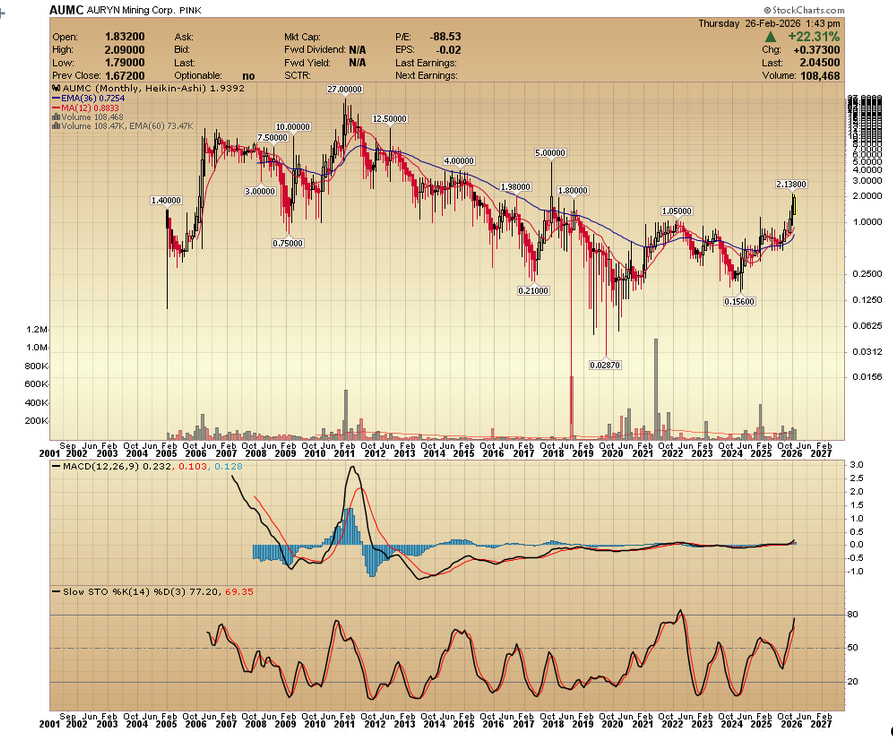
Surprisingly, it would only have to bring this back to it’s former high and a little beyond when I look at this monthly price chart. I have always thought there is a Tier 1 deposit contained under the ADL, especially if the Pegaso Nero is included … The company and the contained mineral deposit is certainly an anomaly that does not fit into any conventional mold.
EM